


At BS Manthan, Pralhad Joshi outlines storage push for 500GW target by 2030
At BS Manthan, Pralhad Joshi says India's 500 GW non-fossil target hinges on scaling storage, strengthening domestic manufacturing and ensuring cheaper renewable power
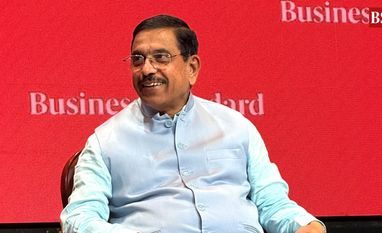 "Pralhad Joshi")
Joshi highlighted the transformation since 2014. Solar capacity stood at just 2.8 GW then
Listen to This Article
Union Minister Pralhad Joshi laid out a roadmap to 500 GW of non-fossil capacity by 2030, backed by falling solar tariffs, expanding domestic manufacturing, rooftop solar growth and a large storage push, while speaking at Business Standard’s flagship BS Manthan summit on Wednesday.
How close is India to its 2030 renewable energy target?
At the third edition of BS Manthan, the Union Minister for Consumer Affairs, Food and Public Distribution, and New and Renewable Energy said India has already achieved more than 50 per cent of its installed power capacity from non-fossil sources, five years ahead of schedule among G20 nations.
The next milestone is 500 gigawatt (GW) of non-fossil fuel capacity by 2030, a commitment made by Prime Minister Narendra Modi at COP26.
Joshi highlighted the transformation since 2014. Solar capacity stood at just 2.8 GW then. Today, excluding large hydro, renewable capacity has reached 195 GW. Overall non-fossil installed capacity now stands at 267 GW.
Also Read

 "Stock Market LIVE, February 25, 2026")
 "Ramesh Chand, Member of NITI Aayog; Ashok Gulati, Professor at ICRIER; and Laveesh Bhandari, President and Senior Fellow, CSEP, at BS Manthan")
 "Nirmala Sitharaman")
 "Finance Minister Nirmala Sitharaman")
 "Ravneet Kaur")
In the last calendar year alone, India added over 50 GW, marking the highest-ever annual addition. He emphasised that scale has brought down costs and strengthened investor confidence globally.
How is India tackling renewable energy intermittency?
Intermittency remains one of renewable energy’s biggest structural challenges, as the sun does not always shine and the wind does not always blow. Joshi acknowledged grid integration issues but said multiple solutions are being rolled out simultaneously, such as:
- Hybrid projects combining solar and wind
- Pumped storage hydro
- Grid-scale battery storage
- Addition of nuclear energy, including small modular reactors
- AI-driven digital twin technologies for grid management
The government is preparing bids for 43 gigawatt-hour (GWh) of battery storage capacity and planning around 411 GWh of storage alongside the 500 GW renewable target by 2030.
The idea, he said, is to match affordability with reliability.
Has renewable power really become cheaper than fossil fuel?
According to Joshi, solar tariffs, which were ₹11–12 per unit a decade ago, have fallen to about ₹2.50 per unit. Even firm and dispatchable renewable energy (FDRE) and round-the-clock (RTC) renewable bids discovered by SECI are in the range of ₹4 to ₹4.50 per unit.
By comparison, new fossil fuel-based generation costs between ₹7 and ₹8 per unit, as acknowledged by the power ministry in Parliament.
The minister argued that affordable power is central to India’s ambition of becoming the world’s third-largest economy. Lower power costs, along with reduced logistics expenses, would enhance industrial competitiveness.
Is India becoming self-reliant in solar manufacturing?
According to Joshi, manufacturing has emerged as a key pillar of the renewable push.
India’s solar module manufacturing capacity has crossed 144 GW, making the country self-sufficient and even surplus. Imports have already reduced by more than 50 per cent, and Joshi expects them to fall by 70–80 per cent this year.
Under the ₹24,000 crore Production Linked Incentive (PLI) scheme for high-efficiency solar PV modules, domestic capacity is expanding rapidly, he said.
The minister said the aim is to build a fully integrated domestic supply chain to reduce import dependence and strengthen energy security.
What is the future of rooftop solar and universal energy access?
Rooftop solar has seen rapid expansion, with 3 million installations completed in just two years, generating nearly 14 GW.
Joshi described the scale as unprecedented and said the scheme would further “scale up and speed up”.
For households without rooftops or those unable to afford installations even after subsidies, the government is exploring utility-led models in coordination with states.
He cited examples from states such as Maharashtra and Andhra Pradesh, where innovative approaches are being tested.
What about grid curtailment and discom stress?
Answering questions over concerns regarding grid curtailment and distribution companies hesitating to sign power purchase agreements, Joshi acknowledged grid challenges but maintained they are transitional issues typical of large-scale technological shifts.
According to him, the response strategy includes:
- Scaling storage alongside generation
- Hybridisation of renewable projects
- Integration of nuclear capacity
- AI-based forecasting and load balancing
- Digital twin technologies for optimised grid flow
The emphasis, he said, is on building a resilient and technologically advanced grid capable of handling distributed renewable supply.
More From This Section
 "Amitabh Kant at BS Manthan")
 "Amitabh Kanth, former G20 sherpa")
 "Day 2 Manthan")
 "Commerce and Industry Minister Piyush Goyal ; Union Agriculture Minister Shivraj Singh Chouhan; and Nitin Gadkari, Union Minister for Road Transport and Highways at BS Manthan | Photos: Kamlesh Pednekar & Priyanka Parashar")
 "Suman Bery, Vice Chairman, NITI Aayog (Photo: Kamlesh Pednekar)")
Don't miss the most important news and views of the day. Get them on our Telegram channel
First Published: Feb 25 2026 | 2:23 PM IST