


CERN's $17 bn Future Circular Collider proposal clears technical hurdles
CERN, in its analysis, has found this next-generation collider to be an essential tool to tackle some of the most perplexing questions about the universe
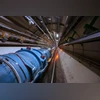 "Large Hadron Collider")
The LHC is currently the world's largest and most powerful particle accelerator. The 27 km-long ring at CERN is located far from prying eyes, a good 100 metres below the ground. | Photo: CERN
Listen to This Article
Other than Nasa, the European Organization for Nuclear Research (Cern) laboratory is probably the only other major scientific institute that plays a key role in a Hollywood movie. In 'Angels and Demons', based on a Dan Brown novel, it is where researchers extract so-called 'anti-matter' from smashing sub-atomic particles against each other.
Now, Cern has announced that it has cleared all technical hurdles as it moves to build the Future Circular Collider (FCC), slated to be the world's biggest particle collider, even as critics raise questions over the $17 billion cost of the project. The FCC is planned to be an impressive 91 km long circular tunnel running beneath the Swiss-French border.
Cern, in its analysis, has projected this next-generation collider to be an essential tool in tackling some of the most perplexing questions about the universe, such as dark matter and dark energy. It will also help in exploring the fundamental properties of the universe’s smallest particles — particles that are millions of times smaller than an electron, with 100 trillion of them passing through the human body every second.
What exactly will the Future Circular Collider do?
The proposed FCC is designed to accelerate and collide particles at unprecedented energies. The purpose of the proposed project is to collide protons at high energies in order to study fundamental forces and particles.
Also Read

 "Caption: The Large Hadron Collider (LHC) tunnel")
 "Karoline Leavitt")
 "study loan, education loan")
 "Waqf Protest, Protest")
 "LSG vs PBKS")
As per the plan, the FCC will be developed in two phases. The first phase will feature an electron-positron collider, expected to begin operations in 2046, while the second phase will introduce a proton-proton collider in 2070. The collider is expected to target an energy level of 100 trillion electronvolts — over seven times higher than the maximum energy achieved by the Large Hadron Collider (LHC).
The recently released feasibility study confirms that there is no technical barrier in constructing the FCC. Cern’s member states will have time until 2028 to decide whether to allocate the funds needed for this project. Some scientists and environmental advocates have argued that the funds might be better used for smaller-scale research projects. The FCC’s projected cost of about $17 billion is more than twice the $8 billion price tag of the LHC.
Large Hadron Collider (LHC)
The LHC is currently the world's largest and most powerful particle accelerator. The 27 km-long ring at CERN is located far from prying eyes, a good 100 metres below the ground. Its purpose is to smash subatomic particles together to understand how they work and what they're made of. To conduct this experiment, the LHC uses superconducting magnets that accelerate protons or ions to nearly the speed of light.
The construction of this collider began in 1998 and it started up on September 10, 2008. The collider has been used to prove the existence of the Higgs boson, dubbed as the God particle. The LHC had also faced its own share of controversy and conspiracy theories, with sceptics suggesting it could theoretically create black holes that would swallow up the entire planet.
Having comprehensively disproved those theories, the LHC is now expected to have fully run its course by 2041; CERN has been analysing options to allow scientists to keep pushing the envelope for more discoveries related to the fundamental part of Physics. The FCC is expected to do just that.
More From This Section
 "Tech Wrap April 1")
 "iPhone XS")
 "OpenAI")
 "POCO C71")
 "Google Photos")
Don't miss the most important news and views of the day. Get them on our Telegram channel
First Published: Apr 01 2025 | 10:34 PM IST