


Vivo V50 review: A blend of style and substance rolled into one smartphone
Vivo V-series smartphones focuses on design and imaging, and the Vivo V50 is no different. Though not perfect, the smartphone ticks the right boxes and is a competent model in its segment
 "Vivo V50 in Starry Night colourway")
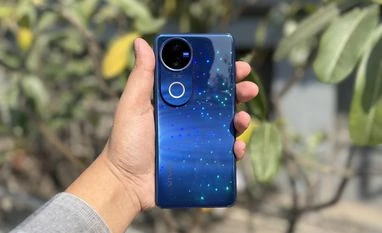
Vivo V50 in Starry Night colour
Listen to This Article
The Vivo V50 is a new entrant in the midrange smartphone segment in India. Like the predecessors in the series, the focus here is on design and imaging but Vivo strides on other fronts too to make it an all-round proposition. The company claims that the smartphone brings notable upgrades designed to appeal to a broad audience. Is the Vivo V50 a design marvel with a camera system to impress or is there more to it? Let us find out:
Design
The Vivo V50 retains a design language from its predecessor but introduces key refinements that help it stand out. One of the significant changes is the new quad-curved display design, a step up from the two-side curved screen of the V40. This enhances ergonomics and reduces accidental touches. While the rear camera module remains largely unchanged, the V50 now features a larger aura-ring light.
A standout design element is the Starry Night colour variant (review unit), which employs stereoscopic holographic display technology to create a dynamic back panel effect. Under direct lighting, the rear panel resembles a starry night sky with a 3D effect, while in sunlight, the bright spots elongate, mimicking shooting stars.
Though visually striking, the phone’s design may feel too flashy for those preferring a more understated look. The smartphone is also available in Titanium Grey and Rose Red, both offering a subtle aesthetic. However, it is worth noting that the Titanium Grey variant has a plastic back, whereas the other two feature glass.
Also Read

 "Tech Wrap February 17")
 "Vivo V50 smartphone")
 "Vivo V50 in Starry Night and Rose Red colourways")
 "Tech Wrap February 7")
 "Vivo V50")
Despite not being the lightest smartphone, the V50’s well-balanced weight distribution ensures comfort during extended use. The glossy back panel, however, is prone to fingerprints and smudges, requiring frequent cleaning. On the plus side, with an IP69 rating for dust and water resistance, the device offers strong durability.
Display and audio
The Vivo V50 has a 6.77-inch AMOLED display, which is largely similar to its predecessor. However, the company has reduced the screen resolution from 2800 × 1260 on the V40 to 2392 × 1080 on the V50. Though a downgrade on-paper, the display delivers sharp and vibrant visuals in most scenarios. It also offers excellent viewing angles and decent legibility under direct sunlight. Additionally, the smartphone supports HDR10 and has Widevine L1 certification, enabling high-quality streaming on platforms like Netflix. Vivo has included a few advanced display features, such as “Visual Enhancement,” which optimises colour and contrast in select visuals. Users also have the option to push individual apps beyond their default refresh rate settings.
Audio performance, however, leaves room for improvement. While the stereo speaker setup offers sufficient loudness for indoor use, the audio output tends to sound flat, with slight distortion at peak volume levels. On the positive side, Vivo has incorporated useful software tools to enhance the listening experience. The “Audio Super Resolution” feature improves the clarity of lower-quality audio, making it more intelligible. Additionally, the device includes various sound-tuning modes for compatible earbuds. One such feature, “Ear Customization,” adjusts audio output based on the listener’s age for a more tailored experience.
Camera
The Vivo V50 retains the same camera setup as its predecessor, featuring Zeiss-powered dual rear cameras comprising a 50-megapixel primary sensor with optical image stabilization (OIS) and a 50MP ultrawide sensor. On the front, it sports a 50MP camera for selfies and video calls.
Building on its collaboration with Zeiss, the V50 offers multiple portrait styles, including Cine-Flare, Planar, Biotar, Distagon, and Sonnar. Over the years, Vivo has refined these styles, resulting in more natural-looking bokeh effects. While standard portraits are already impressive, combining these styles with the wedding photography mode enhances the overall imaging experience, particularly in vibrant settings. The device delivers strong edge detection and a fine background blur in portrait shots. However, facial details can sometimes appear underwhelming, especially in close-up portraits.
Vivo V50 camera samples (Portrait styles with Wedding photography mode)
Beyond portraits, the V50 captures daylight images with a good dynamic range, producing accurate colours and well-preserved details. However, sharpness occasionally falls short. In low-light conditions, the phone performs well by slightly boosting colours while maintaining shadow details. Ultra-wide shots, however, are less impressive, as the sensor struggles to retain finer details.
For video recording, the V50 supports 4K resolution at 30fps from both the rear and front cameras. However, its ultra-stabilisation mode is limited to 1080p recording at 30fps.
Performance and software
The Vivo V50 is powered by the Qualcomm Snapdragon 7 Gen 3 chipset, paired with up to 12GB of RAM. It delivers swift performance for everyday tasks and can handle more demanding workloads, including multitasking, high-resolution video recording, and intensive gaming. Thermal management is well-optimised, with no noticeable heating issues even when running graphically demanding games like Genshin Impact at mid-to-high settings
On the software front, the Vivo V50 comes with Android 15-based FunTouchOS 15. Notably, the number of pre-installed third-party apps has been reduced, resulting in a cleaner user interface. While Vivo’s Android skin is not the slickest of the lot, it has improved significantly over previous generations. The software also includes several AI-powered features, such as an object remover in the gallery, audio recording transcription, and Google’s gesture-driven Circle to Search integration. Additionally, the phone offers a Live Call Translation feature that works in real time, however, its accuracy can be questionable at times.
Battery and charging
The Vivo V50 is powered by a 6000mAh battery, delivering two-day battery life. Even with intensive usage, it comfortably lasts a full day, while moderate usage can extend it up to two days.
For charging, the smartphone includes a 90W adapter in the box, capable of charging the device from 15 per cent to full in just over 40 minutes.
Verdict
Starting at Rs 34,999, the Vivo V50 stands out in the camera department with its strong portrait capabilities and overall decent imaging performance. It also delivers solid performance and excellent battery life for a mid-range smartphone. However, the absence of a dedicated telephoto lens may be a drawback for users seeking a more comprehensive camera setup.
More From This Section
 "Samsung Galaxy S25 and Galaxy S25 Plus")
 "Samsung Galaxy S25 Ultra")
 "Logitech Pop Icon combo with Apple MacBook Air M3")
 "Xiaomi Pad 7 with Focus Pen and Focus Keyboard")
 "POCO X7 Pro")
Topics : Vivo Smartphone review smartphones Technology
Don't miss the most important news and views of the day. Get them on our Telegram channel
First Published: Feb 24 2025 | 4:10 PM IST