


Andhra-origin scientist leads US team to historic black hole breakthroughs
Largest samples of intermediate-mass black holes and dwarf galaxies hosting active black holes have been discovered by a team of scientists led by Indian-origin astrophysicist Raga Deepika Pucha
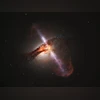 "star birth, NASA, black hole, space")
Listen to This Article
Indian-origin astrophysicist Raga Deepika Pucha spearheaded a groundbreaking discovery in the US, leading a team that discovered the largest-ever samples of intermediate-mass black holes and dwarf galaxies hosting active black holes.
The latest sample, which is three times the existing census of black holes and dwarf galaxies, will help in conducting an in-depth study of the dynamics between dwarf galaxy evolution and the black hole growth.
Deepika's team compiled the largest-ever sample of dwarf galaxies that host actively feeding black holes from the early data shared by Dark Energy Spectroscopic Instrument (DESI). This is also the most extensive collection of intermediate-mass black hole candidates to date.
This discovery paves the way for a deeper understanding of the black hole population in the universe, offering crucial insights into their formation and their role in shaping galaxy evolution. It also sets the foundation for future explorations into these cosmic giants and their influence on the universe's vast dynamics.
NoirLab released a statement mentioning that DESI is a state-of-the-art instrument capturing light from 5,000 galaxies simultaneously. It was constructed and operated with funding from the US Department of Energy (DOE), Office of Science.
Also Read

 "black hole")
 "UCL Round of 16")
 "Champions Trophy 2025: Check all live updates related to AFG vs SA match today here")
 "Modi, Narendra Modi, Tshering Tobgay, Bhutan PM")
 "A23 Rummy, A23 Poker")
Project to survey 40 million galaxies, quasars
The five-year program is currently in its fourth year surveying the sky and it is set to observe roughly 40 million galaxies and quasars by the time the project ends.
Over 900 researchers from more than 70 institutions are collaborating for the DESI project managed by DOE's Lawrence Berkeley National Laboratory.
Deepika, a postdoctoral researcher from the University of Utah, led a team that obtained an unprecedented dataset including the spectra of 410,000 galaxies, including roughly 115,000 dwarf galaxies – small, diffuse galaxies that contain over a thousand to several billions of stars and very little gas.
This data helped Deepika's team to explore the complex interplay between the evolution of black holes and dwarf galaxies.
Astrophysicists are confident that all massive galaxies, including our Milky Way, host black holes at the centre; this picture blurs when moving towards the low-mass end of the spectrum. Although finding black holes is a challenge, identifying them in dwarf galaxies is even tougher. It is easier to spot actively feeding black holes.
"When a black hole at the center of a galaxy starts feeding, it unleashes a tremendous amount of energy into its surroundings, transforming into what we call an active galactic nucleus. This dramatic activity serves as a beacon, allowing us to identify hidden black holes in these small galaxies," Deepika explained.
The team led by the Andhra Pradesh-origin scientist identified over 2500 candidate dwarf galaxies that host an active galactic nucleus (AGN). The significantly higher fraction of dwarf galaxies hosts an AGN (2 per cent) which is relative to previous studies (about 0.5 per cent). The latest study suggests scientists have been missing a substantial number of low-mass, undiscovered black holes.
More From This Section
 "Tesla, Tesla logo")
 "Sunita Williams, Butch Wilmore")
 "Flight, plane, Airplane")
 "Benjamin Netanyahu, Benjamin, Netanyahu, Israel PM")
 "Donald Trump, Volodymr Zelenskyy")
Topics : black holes Andhra Pradesh Scientist
Don't miss the most important news and views of the day. Get them on our Telegram channel
First Published: Feb 21 2025 | 4:57 PM IST