


World leaders welcome US-Iran ceasefire, calls for lasting peace in region
From UN chief Antonio Guterres to European Commission Vice-President Kaja Kallas, UK PM Keir Starmer, and several other leaders welcomed US-Iran ceasefire and push for de-escalation
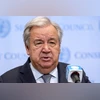 "Antonio Guterres")
UN Secretary General Antonio Guterres called for lasting peace in the region (Photo:PTI)
Listen to This Article
UN Secretary General Antonio Guterres on Wednesday welcomed the announcement of a two-week ceasefire by the United States and Iran.
In a statement delivered by Stephane Dujarric, Spokesman for the Secretary-General, it was said that an end to hostilities is urgently needed to protect civilian lives and alleviate human suffering.
"The Secretary-General welcomes the announcement of a two-week ceasefire by the United States and Iran. He calls on all the parties to the current conflict in the Middle East to comply with their obligations under international law and to abide by the terms of the ceasefire in order to pave the way toward a lasting and comprehensive peace in the region."
"The Secretary-General underscores that an end to hostilities is urgently needed to protect civilian lives and alleviate human suffering. He expresses sincere appreciation for the efforts of Pakistan and other countries involved in facilitating the ceasefire. The Secretary-General's Personal Envoy Jean Arnault is in the region to support efforts toward lasting peace," the statement read.
Ukraine welcomed the ceasefire agreed between the US and Iran and the unblocking of the Strait of Hormuz, Foreign Minister Andrii Sybiha said, calling for similar "decisiveness" by Washington in stopping Russia's war in Ukraine.

 "The Port of Fujairah, United Arab Emirates, near the Strait of Hormuz, in 2023 (Photo: Reuters)")
 "Ayatollah Ali Khamenei addressing a public meeting in Tehran, Iran, on February 1, 2026 (Photo: Reuters)")
 "US President Donald Trump at the Lima Army Tank Plant Joint Systems Manufacturing Center in Ohio in March 2019 (Photo: Reuters)")
 "US Army National Guard")
 "stock markets")
"American decisiveness works. We believe it is time for sufficient decisiveness to force Moscow to cease fire and end its war against Ukraine," Sybiha wrote.
UK Prime Minister Keir Starmer also welcomed the ceasefire agreement between the United States and Iran, while stressing the need to work towards a more long-lasting peace.
In a post on X, he said, "I welcome the ceasefire agreement reached overnight, which will bring a moment of relief to the region and the world. Together with our partners, we must do all we can to support and sustain this ceasefire, turn it into a lasting agreement and re-open the Strait of Hormuz."
Vice-President of the European Commission Kaja Kallas also said that the ceasefire was much-needed.
In a post on X, she said, "The U.S.-Iran agreement on a ceasefire is a step back from the brink after weeks of escalation. It creates a much-needed chance to tone down threats, stop missiles, restart shipping, and create space for diplomacy towards a lasting agreement. The Strait of Hormuz must be open for passage again."
Kallas said that the EU stands ready to support such efforts.
"I spoke to Pakistani Foreign Minister Ishaq Dar and thanked him for securing this initial deal. The door to mediation must remain open, as the underlying causes of the war remain unresolved. The EU stands ready to support those efforts and is in touch with partners in the region. I will discuss this in Saudi Arabia today," he said.
Germany's Federal Chancellor, Bundeskanzler Friedrich Merz welcomed the move while thanking Pakistan for mediating the conflict.
In a post on X, "I welcome the two-week ceasefire agreed by the United States and Iran last night. We thank Pakistan for its mediation. The aim now is to negotiate a lasting end to the war. We are in close coordination with our partners on this matter."
Australian Prime Minister Anthony Albanese also welcomed the United States' decision to suspend its strike campaign against Iran for a two-week period, describing the move as a step in the right direction amid rising global tensions.
In an interview to Sky News, Albanese said, "This is positive news. We have been calling for a de-escalation for sometime. We want to see a resolution of the conflict. The impact that would have arisen from an escalation within Iranian response would've let to greater global economic damage. We're already seeing a substantial impact of war which is on the other side of the world but is having an impact on Australians here conflict."
In an official statement released by Albanese along with Minister of Foreign Affairs Penny Wong, the Australian government said, "Australia welcomes the agreement by the United States, Israel and Iran to a two-week ceasefire to negotiate a resolution to the conflict in the Middle East.The Australian Government has been calling for de-escalation and an end to the conflict for some time now."
The statement mentioned the consequences of Iran's closure of the Strait of Hormuz.
"Iran's de facto closure of the Strait of Hormuz, coupled with its attacks on commercial vessels, civilian infrastructure, and oil and gas facilities, is causing unprecedented energy supply shocks and impacting oil and fuel prices. We have been clear the longer the war goes on, the more significant the impact on the global economy will be, and the greater the human cost," the statement read.
The statement also mentioned that Australia supports diplomacy.
"Australia has been working with international partners in support of diplomatic efforts to reopen the Strait of Hormuz so critical supplies can flow to those who need it, including the most vulnerable. We thank and support the work of negotiators, including Pakistan, Egypt, Turkiye and Saudi Arabia, in advancing de-escalation efforts. Australia wants to see the ceasefire upheld and a resolution to the conflict. We continue to call on all parties to uphold international humanitarian law and protect civilian life," the statement read.
Albanese's remarks and the statement come after US President Donald Trump announced a temporary halt to the "bombing and attack" campaign on Iran, proposing a two-week, double-sided ceasefire window. Trump also indicated that a 10-point proposal put forward by Iran was "workable," signalling a possible diplomatic opening between the two long-time adversaries.
The development follows heightened tensions in the region, with fears of escalation threatening global energy markets and economic stability. The Strait of Hormuz, a key maritime passage for global oil shipments, has remained at the centre of geopolitical concerns, given its strategic importance and vulnerability during conflict.
Iran has outlined a comprehensive 10-point framework that it says could form the basis for a long-term resolution. Among its key demands is a firm US commitment to "Non-aggression" and the "Continuation of Iran's control over the Strait of Hormuz," underscoring Tehran's insistence on sovereignty over the critical waterway.
Another major component of the proposal is Washington's "Acceptance of enrichment," referring to Iran's nuclear programme, which has been a longstanding point of contention with the United States and the broader international community. The issue has been central to multiple rounds of negotiations and sanctions regimes over the past two decades.
Tehran has also sought significant economic concessions, including the "Lifting all primary sanctions" and the "Lifting all secondary sanctions," measures that have severely constrained its economy. These sanctions have been a cornerstone of US policy aimed at curbing Iran's nuclear ambitions.
Additionally, Iran has called for the "Termination of all UN Security Council resolutions" and the "Termination of all IAEA Board of Governors resolutions" related to its nuclear activities. Such steps would represent a substantial rollback of international monitoring and regulatory frameworks governing Iran's nuclear programme.
While the proposed ceasefire remains temporary, global leaders, including Albanese, have emphasised the urgent need for sustained diplomatic engagement to prevent further escalation and mitigate broader economic and security risks.
(Only the headline and picture of this report may have been reworked by the Business Standard staff; the rest of the content is auto-generated from a syndicated feed.)
More From This Section
 "US Ambassador Sergio Gor is seen during a press conference, in New Delhi, in this file photo dated Monday, Jan. 12, 2026. (PTI Photo/Atul Yadav)")
 "Donald Trump, Trump")
 "Donald Trump, Trump")
 "White House")
Topics : Australia Anthony Albanese Israel Iran Conflict US-Iran tensions US Iran tensions UN Secretary General United Nations United Nations Secretary-General Antonio Guterres Antonio Guterres Ukraine
Don't miss the most important news and views of the day. Get them on our Telegram channel
First Published: Apr 08 2026 | 10:41 AM IST