


China's 600 kmph Maglev train turns 5.5-hour trip into 2.5-hour ride
China unveils its fastest ground transport yet - a 600 kmph maglev train that could cut Beijing-Shanghai travel time to 2.5 hours, combining speed of flight with safety of rail
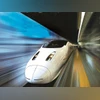 "Bullet train, train, railway")
The train is meant to function as a 'point-to-point transport tool' connecting major cities. (Representational image)
Listen to This Article
In a bold leap toward the future of high-speed travel, China has unveiled its fastest ground transport vehicle yet — a sleek maglev train capable of hitting speeds up to 600 kmph, South China Morning Post reported. Revealed at a major rail exhibition in Beijing, the futuristic train reflects China’s growing ambition to lead the global high-speed rail revolution and dramatically cut travel times between major cities.
A high-speed maglev train developed by the China Railway Rolling Stock Corporation (CRRC) was officially presented to the public at the 17th Modern Railways exhibition in Beijing. With a top speed of 600 kmph (373 mph), this is China’s most advanced ground transport project yet.
Designed for maximum aerodynamic efficiency, the train has a pointed nose to reduce air resistance.
Designed to transform city-to-city travel
According to Shanghai-based news outlet The Paper, the train is meant to function as a 'point-to-point transport tool' connecting major cities. At 600 kmph, a trip from Beijing to Shanghai — a distance of about 1,200 km — could be reduced from 5.5 hours by current high-speed rail to just 2.5 hours.
Also Read

 "artificial intelligence, AI, GenAI")
 "Donald Trump, Trump")
 "markets, Sensex, nifty")
 "Nato Secretary‑General Mark Rutte")
 "China, chinese manufacturing, China economy, markets, consumers")
Shao Nan, a senior engineer at CRRC, said the aim is to bridge “the speed gap between high-speed rail and aviation within 2,000 km”. The news report quoted him as saying that the new train would combine the punctuality and safety of rail travel with the speed advantages of flying.
Clean, quiet, and energy efficient
The maglev train uses superconducting electric magnetic levitation technology, which offers an environmentally friendly solution with no emissions, low operating noise, and reduced friction due to its non-contact design. At speeds above 150 kmph, the train levitates above the track using electromagnetic induction. Below that speed, it moves on rubber wheels.
Shao also highlighted the train’s fully automated driving system, which integrates 5G communication, AI video analysis, acoustic sensors, and various monitoring tools along the route to ensure safe and efficient operation, the news report said.
A long journey of maglev development
China first launched a maglev train in 2003, with a German-built link between Shanghai Pudong International Airport and the city. In 2016, the country introduced its first domestically built maglev in Changsha, followed by another line in Beijing in 2017. However, these earlier versions were low-speed, with maximum speeds around 120 kmph.
CRRC’s high-speed maglev is just one of many ambitious transport projects in China. In 2023, China conducted a successful test run of a maglev hyperloop, aiming for speeds of up to 1,000 kmph using low-pressure vacuum tubes and magnetic propulsion.
In another major breakthrough this May, researchers from the China Aerospace Science and Industry Corporation said they developed an AI-guided suspension system to reduce the vibrations passengers might experience at extremely high speeds.
Challenges ahead for next-gen rail travel
Despite the exciting progress, experts warn of significant challenges ahead. The construction of high-speed maglev and hyperloop systems demands huge investments and advanced infrastructure. Specialised superconducting magnets, dedicated tracks, and engineering expertise are essential — making large-scale deployment a complex task, the news report said.
China’s growing high-speed rail network, already the world’s largest with 48,000 km of track and plans to cross 50,000 km in 2025, signals its commitment to shaping the future of global transport.
More From This Section
 "Mark Carney")
 "Gaza protest")
 "United States, Moody's Ratings, US flag")
 "Benjamin Netanyahu, Benjamin, Netanyahu, Israel PM")
 "A US armoured vehicle in the centre of Baghdad, after ploughing through a passenger car and causing civilian casualties on November 10, 2003. In Afghanistan, Iraq and several West Asian countries, the US, Nato and Israeli militaries have failed to an")
Topics : China Chinese Bullet train BS Web Reports
Don't miss the most important news and views of the day. Get them on our Telegram channel
First Published: Jul 16 2025 | 3:53 PM IST