


Why China's restaurants are facing social media outrage over pre-made food
A social media storm over 'pre-made' dishes and rising calls for transparency have hit China's restaurant chains just as the extended National Day holiday begins
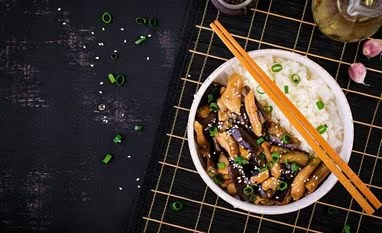 "Chinese food")
China’s catering industry earned 3.6 trillion yuan between January and August 2025. (Photo credit: Freepic)
Listen to This Article
China’s 'super golden week', a rare overlap of the National Day and Mid-Autumn Festival holidays, has been marred by an uproar over pre-made food. What began as a single influencer’s complaint has become a national debate over transparency, food quality, and the economic realities reshaping dining in post-pandemic China.
What’s the latest
According to a report by South China Morning Post, the uproar began on September 10 when influencer Luo Yonghao, known for his outspoken social media posts, accused the popular Xibei restaurant chain of serving “disgusting” pre-made meals at premium prices. His post drew millions of views and triggered calls for mandatory menu labelling of non-freshly made dishes.
Xibei’s founder Jia Guolong responded by asserting that the chain only uses “semi-processed” ingredients and opened kitchens at its nearly 400 outlets for public scrutiny. But videos showing other eateries using frozen or packaged items quickly went viral, fuelling further outrage online.
Numbers game
China’s catering industry earned 3.6 trillion yuan ($505.2 billion) between January and August 2025, which is a modest 3.6 per cent rise from a year earlier, according to the National Bureau of Statistics. That marks a slowdown from 6.6 per cent growth in 2024 and 19.4 per cent in 2023, signalling weaker consumer spending.
The National Day holiday, traditionally one of the busiest times for restaurants, overlaps with the Mid-Autumn Festival this year, creating an eight-day break that should have boosted sales. Instead, many chains fear backlash could dent profits as social media remains abuzz with criticism.
Also Read

 "India china")
 "typhoon, vietnam, Typhoon Kajiki")
 "Donald Trump, Trump")
 "China Taiwan")
 "data centre")
How did the Chinese industry react?
Under pressure, Xibei reportedly cut prices by 20–40 per cent across its outlets to calm consumers, the South China Morning Post report confirmed. The company is also appealing to diners’ pocketbooks to recover trust amid shrinking margins.
Meanwhile, the popularity of pre-made meals continues to rise. China Fortune Securities estimates that per capita consumption grew from 5.4 kg in 2013 to 9.1 kg in 2022, with the market valued at 475.7 billion yuan ($66.8 billion) this year.
Public distrust has exposed regulatory gaps. A March 2024 notice from the State Administration for Market Regulation (SAMR) defined pre-made food as “pre-packaged products made from agricultural ingredients” that require heating before eating. Yet, no binding labelling or safety standards exist.
Responding to the public outcry, China's State Council Food Safety Office said on September 21 that it would expedite national standards and labelling rules but did not give a timeline.
What consumers are saying
Polls suggest deep scepticism. A New Express survey found one-third of 70,000 respondents said they would never eat pre-made food, and over 40 per cent demanded clearer labelling.
For some, the shift is driving restaurants out of business. “I went to a restaurant recently and found many freshly cooked dishes were gone. Only pre-made dishes remained,” said Guangzhou diner Qiu Rui. “Honestly, it’s no surprise it was shutting down.”
What it means
For restaurateurs, pre-made dishes are a survival tactic amid slowing consumption and higher labour costs. “Shifts in Chinese households and the economy mean pre-made dishes will only grow more popular,” said Wu Yi, a Guangdong-based restaurant investor, as cited by South China Morning Post. “Chains need consistency and cost control; younger consumers prefer convenience.”
Yet, the backlash shows a fragile trust between consumers and businesses. As Wu added, “What consumers really resent isn’t pre-made dishes, but paying premium prices for them.”
More From This Section
 "Syria, Syrians celebrate new govt, Syria flag")
 "Donald Trump, Trump")
 "Sanae Takaichi")
 "Russian invasion of Ukraine")
Don't miss the most important news and views of the day. Get them on our Telegram channel
First Published: Oct 05 2025 | 12:13 PM IST