


Oppn in Germany wins election, far right is 2nd with strongest result
Chancellor Olaf Scholz conceded defeat for his centre-left Social Democrats after what he called a bitter election result
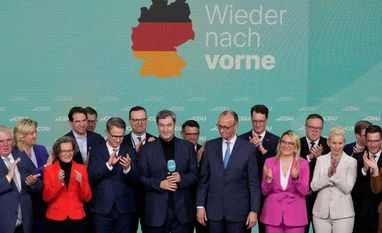 "German conservative party, Merz")
Merz vowed to move quickly to put together a coalition government. But that's likely to be a complicated task | Photo: Reuters
Listen to This Article
Provisional results in Germany's election confirmed that mainstream conservatives led by Friedrich Merz won Germany's national election, while a far-right party surged to become the nation's second-largest.
The campaign was dominated by worries about the years-long stagnation of Europe's biggest economy and pressure to curb migration something that caused friction after Merz pushed hard in recent weeks for a tougher approach.
It took place against a background of growing uncertainty over the future of Ukraine and Europe's alliance with the United States.
The results released by the electoral authority showed the conservative Christian Democrats and the centre-left Social Democrats winning a combined majority of seats in the national legislature after small parties failed to make the electoral threshold.
The left-wing Sahra Wagenknecht Alliance, came in just barely under the 5 per cent hurdle needed to get seats in parliament, while the pro-business Free Democrats also failed to reach 5 per cent.
Also Read

 "Friedrich Merz")
 "Germany, Germany flag")
 "Germany, Germany flag")
 "Tesla")
Chancellor Olaf Scholz conceded defeat for his centre-left Social Democrats after what he called "a bitter election result". Projections for ARD and ZDF public television showed his party finishing in third place with its worst postwar result in a national parliamentary election.
Merz said he hopes to put a coalition government together by Easter. But that's likely to be challenging.
The election took place seven months earlier than originally planned after Scholz's unpopular coalition collapsed in November, three years into a term that was increasingly marred by infighting. There was widespread discontent and not much enthusiasm for any of the candidates.
The campaign was dominated by worries about the years-long stagnation of Europe's biggest economy and pressure to curb migration something that caused friction after Merz pushed hard in recent weeks for a tougher approach. It took place against a background of growing uncertainty over the future of Ukraine and Europe's alliance with the United States.
Germany is the most populous country in the 27-nation European Union and a leading member of NATO. It has been Ukraine's second-biggest weapons supplier, after the US.
It will be central to shaping the continent's response to the challenges of the coming years, including the Trump administration's confrontational foreign and trade policy.
More than 59 million people in the nation of 84 million were eligible to elect the 630 members of the lower house of parliament, the Bundestag, who will take their seats under the glass dome of Berlin's landmark Reichstag building.
More From This Section
 "Israel Flag, Israel")
 "Pope Francis")
 "Elon Musk, DOGE, Tesla CEO")
 "Benjamin Netanyahu, Benjamin, Netanyahu, Israel PM")
 "Elon Musk")
Don't miss the most important news and views of the day. Get them on our Telegram channel
First Published: Feb 24 2025 | 7:24 AM IST