


US defense secy shared Yemen attack details in second Signal chat with wife
Pete Hegseth shared details about the Houthis attack in a second private Signal group chat that included his wife and brother: Details here
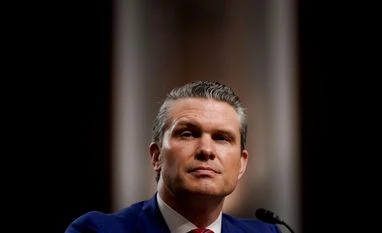 "Pete Hegseth, US defence secretary")
Pete Hegseth, US defence secretary | Image: Bloomberg
Listen to This Article
The fallout from US Defense Secretary Pete Hegseth’s alleged mishandling of sensitive military information has grown more serious, with a new New York Times report revealing that he may have shared details of a military strike in Yemen in yet another private Signal chat. This fresh revelation follows weeks of controversy over a separate messaging blunder that has already prompted investigations and high-level dismissals within the Pentagon.
Hegseth shares Yemen attack detail with family
On March 15, as the US prepared to launch airstrikes against Houthi targets in Yemen, Hegseth reportedly used an encrypted Signal chat to share details about the upcoming operation — including flight schedules for the F/A-18 Hornets involved. This chat, according to The New York Times, included Hegseth’s wife, Jennifer (a former Fox News producer), his brother Phil, and personal lawyer Tim Parlatore.
Though Parlatore and Phil Hegseth hold Pentagon roles, neither had a direct ‘need-to-know’ regarding the strike details. Jennifer Hegseth, meanwhile, holds no government position whatsoever.
The chat in question — named ‘Defense | Team Huddle’ — was created by Hegseth prior to his confirmation as Defense Secretary and was reportedly used for scheduling and administrative purposes. Hegseth used his personal phone, not a government-issued device, to communicate in the chat.
Who was involved in Hegseth’s second Signal chat?
The ‘Team Huddle’ chat reportedly included a close-knit group of Hegseth’s aides and advisers—some of whom were later fired after being accused of leaking information themselves. Dan Caldwell and Darin Selnick were dismissed last week alongside Colin Carroll. All have denied wrongdoing.
Also Read

 "Pete Hegseth")
 "donald trump, pete hegseth, michael waltz, JD Vance")
The turbulence within Hegseth’s office has prompted further scrutiny. John Ullyot, a former senior Pentagon official, recently described the department under Hegseth as being in ‘disarray’ and called for his removal in an op-ed.
An investigation by the Pentagon’s acting inspector general is already underway, focusing on the use of Signal for discussing official military operations. It’s unclear whether this newly reported chat, which includes non-government individuals, was part of the review when it began.
Journalist added to Yemen attack Signal chat
This comes on the heels of a previous controversy, where Hegseth shared similar strike details—including timing and aircraft information—in another Signal group. That group, intended for senior national security officials, was created by National Security Adviser Mike Waltz and mistakenly included The Atlantic's editor-in-chief, Jeffrey Goldberg.
Waltz took responsibility for the error, explaining that the group — dubbed ‘Houthi PC small group’ — was intended for the Principals Committee, which coordinates sensitive national security decisions. Still, the presence of a journalist in such a group set off alarm bells across Washington.
The Trump administration attempted to discredit Goldberg in the aftermath of the leak. Goldberg later released the entire chat with only certain sensitive information—names of CIA officials— redacted.
How has the White House responded to the leaks?
While the White House and Pentagon had downplayed the significance of the initial leak, insisting no classified material was shared, national security experts pushed back. Information like flight schedules and timing, even if not explicitly marked as classified, would typically fall under operational security restrictions. Its disclosure could have endangered lives and compromised the mission.
According to an earlier report by the The New York Times, aides had cautioned Hegseth not to use the Signal chat for sensitive matters just days before the March 15 strikes, showing the defense secretary’s apparent disregard for internal warnings. Moreover, the sharing of such operational details with family members has now raised questions about the secretary's judgment and adherence to protocol.
Also Read: Gunman opens fire at Harvard subway station; suspect remains at large
Democrats call for Hegseth’s resignation
Hegseth’s appointment as defense secretary was already considered controversial due to his far-right views. Hegseth, a former Fox News commentator had previously said women should not serve in combat roles, recommended the military purge generals and faced allegations of sexual assault and alcoholism. The US Army had also barred Hegseth from serving on duty at the inauguration of Joe Biden in 2021 after a service member flagged him as a potential insider threat.
Aside from these controversies, critics had also pointed out his lack of experience in managing a government body as large and significant as the US Department of Defense.
This controversy has now sparked partisan backlash on Capitol Hill. Some Democrats have called for his resignation, citing recklessness. The Trump administration, meanwhile, continues to defend Hegseth. White House Deputy Press Secretary Anna Kelly called the repeated focus on the chats a “nonstory”, and Hegseth himself insists no war plans were leaked. The broader implications of using encrypted, non-government platforms like Signal remain unresolved.
More From This Section
 "Mark Carney")
 "Donald Trump, Trump")
 "Photo: Shutterstock.com")
 "Drones, Mysterious objects in US")
 "Donald Trump, Trump")
Don't miss the most important news and views of the day. Get them on our Telegram channel
First Published: Apr 21 2025 | 11:57 AM IST