


US lawyer refuses to disclose fate of wrongly deported Maryland man
Immigration officials arrested Abrego Garcia on March 12 and accused him of playing a "prominent role" in MS-13, though he hasn't been convicted of a crime or charged with one
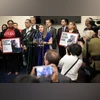 "Jennifer Vasquez Sura, the wife of Kilmar Abrego Garcia")
Jennifer Vasquez Sura, the wife of Kilmar Abrego Garcia, speaks during a news conference at Cannon House Office Building in Washington, DC, on April 9 | Image: Bloomberg


Listen to This Article
By David Voreacos, Chris Strohm and Greg Stohr
A Trump administration lawyer refused to tell a judge what the government is doing to bring back a Maryland man wrongly deported to a notorious prison in El Salvador.
US District Court Judge Paula Xinis clashed Friday with Justice Department lawyers a day after the Supreme Court said the government must “facilitate” the return of Kilmar Abrego Garcia. Federal officials have conceded he was deported despite a 2019 order saying he shouldn’t be sent to El Salvador.
After the high court ruled Thursday night, Xinis ordered US lawyers to tell her Abrego Garcia’s location and status in prison, and what they were doing to facilitate his return. She gave them until Friday morning to answer her questions in writing, but they said that wasn’t enough time. At a court hearing on Friday afternoon, Xinis grew impatient with a Justice Department lawyer.
“This is a direct question — where is he and under whose authority?” Xinis asked in federal court in Greenbelt, Maryland.
Also Read

 "shipping, container, import, export, trade")
 "JD Vance")
 "Commerce and Industry Minister Piyush Goyal")
 "Starlink")
 "Donald Trump, Trump")
“We are still internally reviewing the Supreme Court’s decision and vetting what we can say to this court,” Justice Department lawyer Drew Ensign said.
“There is no evidence as to where he is today and that is extremely troubling,” Xinis said.
The showdown came after the Supreme Court put a limit on President Donald Trump’s deportation power as he pushes for sweeping authority with minimal judicial review. The high court on Monday voted 5-4 to let the administration keep using a wartime law to try to deport alleged Venezuelan gang members, but only if they first have a chance to make their case to a judge.
Asked about the high court’s ruling in the Abrego Garcia case, Trump on Friday indicated he was not fully clear on the details of the Abrego Garcia case but would respect the decision.
“If the Supreme Court said bring somebody back I would do that. I respect the Supreme Court,” Trump told reporters.
Ensign said the government thinks the Supreme Court order means it should first decide whether Abrego Garcia’s case implicates Trump’s foreign policy powers or involves privileged information. The judge rejected Ensign’s argument, saying she will require daily updates from government officials who actually have the information she is seeking, starting Saturday.
‘Make a Record’
“We’re going to make a record of what, if anything, the government is doing or not doing,” Xinis said.
Ensign replied: “The United States intends to comply with the Supreme Court’s order.”
Trump officials have said that Abrego Garcia, 29, is a member of the MS-13 criminal gang, which his lawyers and Xinis rejected.
Abrego Garcia had been lawfully living in Maryland with his wife and three children, all US citizens. Under a 2019 immigration court order, he can’t be deported to El Salvador, where he says he would face gang-based extortion and persecution.
Immigration officials arrested Abrego Garcia on March 12 and accused him of playing a “prominent role” in MS-13, though he hasn’t been convicted of a crime or charged with one. He was flown to El Salvador on March 15 along with more than 200 other alleged gang members.
Ensign has previously come under fire before a Washington judge who has threatened to hold Trump officials in contempt of court for allegedly violating his order to immediately halt deportations of Venezuelans suspected of being gang members.
An appellate court panel upheld Xinis in a ruling on Monday, when Judge Stephanie Thacker said the government “has no legal authority to snatch a person who is lawfully present in the United States off the street and remove him from the country without due process.” She said the government’s position that federal courts are powerless to intervene was “unconscionable.”
In its ruling on Thursday night, the Supreme Court said the US is required to facilitate Abrego Garcia’s release from custody in El Salvador and “to ensure that his case is handled as it would have been had he not been improperly sent to El Salvador.”
Xinis gave the US until Friday at 9:30 a.m. to say how it would respond but just minutes before the deadline, Justice Department lawyers asked for a filing extension until April 15. The judge rejected that request, saying the US must respond by 11:30 a.m.
‘The Reality’
“The defendants’ suggestion that they need time to meaningfully review a four-page order that reaffirms this basic principle blinks at reality,” Xinis ruled. In a filing that was nearly an hour past the new deadline, US lawyers wrote that they cannot share information sought by Xinis. “That is the reality,” the US wrote.
In a shot at Xinis, the government lawyers wrote: “Foreign affairs cannot operate on judicial timelines, in part because it involves sensitive country-specific considerations wholly inappropriate for judicial review.”
At the hearing, Xinis scolded Ensign for the Justice Department’s inaction.
“Despite this court’s clear directive, your clients have done nothing to facilitate the return” of Abrego Garcia, she said. Ensign’s said the government’s response might involve privileged information.
“We’re not going to slow walk this,” Xinis said.
A Justice Department spokesperson said Friday that the Supreme Court correctly recognized “it is the exclusive prerogative of the president to conduct foreign affairs.”
“By directly noting the deference owed to the executive branch, this ruling once again illustrates that activist judges do not have the jurisdiction to seize control of the president’s authority to conduct foreign policy,” the spokesperson said.
The Supreme Court case is Noem v. Abrego Garcia, 24A949.
More From This Section
 "Serbia flag, Serbia")
 "Pope Francis")
 "Space Startups")
 "florida plane crash")
 "JP Morgan")
Don't miss the most important news and views of the day. Get them on our Telegram channel
First Published: Apr 12 2025 | 7:16 AM IST