


When should India employ hard power in Maldives?
Greater prosperity and a change in world order demand that we counter threats before they touch the homeland
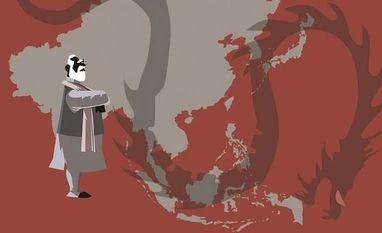 "India Maldives")
premium
Illustration by Binay Sinha
I write this after the president of the Maldives has arrested judges of the Supreme Court instead of following its orders to release all political prisoners arrested under trumped-up charges. It’s only the latest turn in a drama that started exactly six years ago when the country’s first democratically elected pro-India president was ousted in a coup. Among others, his successor repudiated an airport-development contract that had been awarded to an Indian company. The $270 million in damages that international arbiters forced the Maldives to pay was financed through funds injected by Chinese and Saudi investors.
New Delhi’s responses to all of these have scarcely gone beyond monitoring the situation closely. The Maldives regime, meanwhile, has changed its land ownership laws, sold an island close to its capital to the Chinese, and signed a free-trade agreement with Beijing bypassing parliamentary scrutiny. Neither the United Progressive Alliance government nor the Narendra Modi government seem to care that a strategic Indian Ocean neighbour has been taken over by an autocratic regime so confident of Chinese support that it feels emboldened to go beyond merely thumbing its nose at New Delhi. It’s poking us in the eye.
The case for a hard Indian intervention is so strong, the international context so conducive, the military equation so overwhelmingly favourable that we must ask: If not now, when? Will we wait for construction of a foreign naval base to start at Feydhoo Finolhu near Male before we decide to intervene? What use are grand conferences, declarations of being “an Indian Ocean power”, “a net-security provider” or vasudaiva kutumbakam, when governments in New Delhi are disinclined to forcefully protect India’s own core interests?
Maybe the Modi government will decide to compel the Yameen regime to act constitutionally, follow Supreme Court orders, and generally stop being an anti-India dictatorship. It’s unlikely that this is possible without the signalling of the readiness to use force. Even if it does — as the Rajiv Gandhi government did in 1987 — it should lead to a larger national debate over why, when and where will India use military force, beyond defending borders and UN peacekeeping.
As the Maldives has shown us, we cannot duck the question anymore. There is a genocide — and I do not use the word casually — taking place in Myanmar at this time, as the Rohingya continue to be under attack despite falling off the world news headlines. Because the business is on the unpopular side of India’s domestic politics, we are joining the rest of the world (which couldn’t care less) in ignoring it. Yet both our interests and our values suggest that New Delhi take a greater interest in the issue. Doesn’t the claim that India is, or can be a net-security provider in the region ring hollow when New Delhi is a bystander to mass atrocities?
New Delhi’s responses to all of these have scarcely gone beyond monitoring the situation closely. The Maldives regime, meanwhile, has changed its land ownership laws, sold an island close to its capital to the Chinese, and signed a free-trade agreement with Beijing bypassing parliamentary scrutiny. Neither the United Progressive Alliance government nor the Narendra Modi government seem to care that a strategic Indian Ocean neighbour has been taken over by an autocratic regime so confident of Chinese support that it feels emboldened to go beyond merely thumbing its nose at New Delhi. It’s poking us in the eye.
The case for a hard Indian intervention is so strong, the international context so conducive, the military equation so overwhelmingly favourable that we must ask: If not now, when? Will we wait for construction of a foreign naval base to start at Feydhoo Finolhu near Male before we decide to intervene? What use are grand conferences, declarations of being “an Indian Ocean power”, “a net-security provider” or vasudaiva kutumbakam, when governments in New Delhi are disinclined to forcefully protect India’s own core interests?
Maybe the Modi government will decide to compel the Yameen regime to act constitutionally, follow Supreme Court orders, and generally stop being an anti-India dictatorship. It’s unlikely that this is possible without the signalling of the readiness to use force. Even if it does — as the Rajiv Gandhi government did in 1987 — it should lead to a larger national debate over why, when and where will India use military force, beyond defending borders and UN peacekeeping.
As the Maldives has shown us, we cannot duck the question anymore. There is a genocide — and I do not use the word casually — taking place in Myanmar at this time, as the Rohingya continue to be under attack despite falling off the world news headlines. Because the business is on the unpopular side of India’s domestic politics, we are joining the rest of the world (which couldn’t care less) in ignoring it. Yet both our interests and our values suggest that New Delhi take a greater interest in the issue. Doesn’t the claim that India is, or can be a net-security provider in the region ring hollow when New Delhi is a bystander to mass atrocities?
Illustration by Binay Sinha
Disclaimer: These are personal views of the writer. They do not necessarily reflect the opinion of www.business-standard.com or the Business Standard newspaper