The true value of a book really lies in what the reader takes from it

If leaders read this book, reflect upon the contents, relate the lessons to their own experiences, and hold tight to their NI (natural intelligence), they increase their odds of success

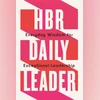
HBR DAILY LEADER: Everyday Wisdom for Exceptional Leadership
R Gopalakrishnan
5 min read Last Updated : Apr 22 2025 | 11:39 PM IST
HBR DAILY LEADER: Everyday Wisdom for Exceptional Leadership
Curated: Harvard Business Review archives
Publisher: HBS Publishing/Penguin Random House
Pages: 376
Price: ₹899
  There is a mystique about leadership. Management pedagogy is awash with theories of how leaders develop. The Great Man theory that history is made by great men or heroes has been the favourite haunt of historians to explain how great men shaped the trajectory of history. These theories trace their inspiration to Thomas Carlyle, who delivered a series of lectures on heroism in 1840. 

Also Read

 
The opposite of the Great Man theory is the behavioural theory of leadership. According to this theory, leadership qualities are developed through behaviours and skills that can be learned. Leaders are made, not born, the votaries of the behavioural theory would argue.
 
Business leadership pedagogy, of course, propagates the behavioural theory. This has given rise to a plethora of books, apart from academic research and teaching of behavioural science in B-schools and leadership institutions.
 
In one way, this book is exceptional. In another way, it is a routine brahma-mantra book. The true value of the book is not what is in it, but what the reader takes out of it. Let me explain.
 
An exceptional book has authorship of high credentials, boasts original research, citations and references, all meticulously assembled in a bibliography. The content is presented through a consistent and persuasive narrative.
 
This book has 365 leadership lessons, assembled in a one-per-day format. Each lesson is about 150 words, presented with appealing simplicity, though the apparently simple content is backed by articles and research papers by recognisable researchers and authors. That is why it has the mark of being an exceptional book.
 
It also comes through as a routine brahma-mantra book because it is an assembly of things that most people know but fail to practise consistently. Example: Demonstrate Your Strategic Thinking in Meetings — Know Your Emotional Impact — Articulate Your Personal Philosophy. The reading of the book provokes a doubt: Can you read a lesson a day, try to implement them, and thereby become an exceptional leader? The answer obviously is No. That is why it comes through as an average DIY leadership book.
 
It requires some reflection to realise that this is so with every knowledge and skill area. You cannot achieve exceptional Bharatanatyam skills by reading a book titled, for instance, Kalakshetra’s Daily Dance Lessons, even if it is by the great Balasaraswati. I might confess that I have failed hopelessly at improving my golf handicap despite reading Golf My Way by Jack Nicklaus. My golf coach collects his fee by saying the same three things to me after every coaching session—head down, loose grip, follow through! Jokingly, I asked him once why he collects a fee for saying the same things to me each time.
 
His serious reply applies equally to golf and to management: You do not consistently do what you know to be correct. It is precisely this dilemma that the reader will face. If sheer knowledge would result in behavioural change, you would not see an obese doctor, or a maritally separated divorce counsellor!
 
However, if the reader reviews a lesson and reflects on his own experiences and mistakes, then great value could accrue. 
 
For example, Lesson Number 9 reads, “What derails collaboration?” It points out that when you ask teams to collaborate, teams can feel insecure. It poses a question: As the leader, are there things you can do to help teams feel less threatened? Apply this lesson to the public affairs space. Can the New Educational Policy be explained and implemented without the insecurity it produces in, for example, the South? What can leaders do to reduce insecurity? In politics, the public debate gets aggressive, and the insecurity increases. However, that need not be so within a company.
 
Lesson Number 56 reads, “Great Mentors Choose Mentees Carefully.” It states that the mentee must be serious about changing by doing the work required. A mentee that thinks that the mentor will do the work is not worth mentoring. Of course, this is correct. Yet, I do receive enquiries “to mentor our top leaders, about ten in number, for six months.” Even before reading this book, I have been declining!
 
Lesson Number 281 advises, “Give People Time to Process Change.” It goes on to suggest that leaders must give time to people to experience and raise their deepest concerns. It would be wrong of the leader to assume that theirs is a manifestation of resistance to change. Great. But does the environment of the future leader, who needs to lead in tumultuous times, encourage the leader to “give people the time?” If so, evangelists of Artificial Intelligence would have to be ignored or not taken too seriously. Which leader can take such a risk?
 
Context and intuition are, therefore, important when it comes to leadership. Think about the story of Stanislav Petrov, who was the duty officer at the command centre of the OKA nuclear warning system of the Soviet Union. On September 26, 1983, the system reported that a missile had been launched from the United States, followed by four more. Petrov’s training and duties were to press his retaliatory buttons, which would certainly lead to a nuclear war between the Soviets and the Americans. Petrov felt that something was amiss in the data and readings, though unsure what. In his context, using his intuition, Petrov disobeyed “his training and orders”. Petrov was rightly credited as having saved the world.
 
If leaders read this book, reflect upon the contents, relate the lessons to their own experiences, and hold tight to their NI (natural intelligence), they increase their odds of success. And that is great value, as much as any reader can expect for having bought the book for ₹899.
The reviewer is an author and corporate commentator

One subscription. Two world-class reads.

Already subscribed? Log in

Subscribe to read the full story →
*Subscribe to Business Standard digital and get complimentary access to The New York Times

Smart Quarterly

₹900

3 Months

₹300/Month

SAVE 25%

Smart Essential

₹2,700

1 Year

₹225/Month

SAVE 46%
*Complimentary New York Times access for the 2nd year will be given after 12 months

Super Saver

₹3,900

2 Years

₹162/Month

Subscribe

Renews automatically, cancel anytime

Here’s what’s included in our digital subscription plans

Exclusive premium stories online

  • Over 30 premium stories daily, handpicked by our editors

Complimentary Access to The New York Times

  • News, Games, Cooking, Audio, Wirecutter & The Athletic

Business Standard Epaper

  • Digital replica of our daily newspaper — with options to read, save, and share

Curated Newsletters

  • Insights on markets, finance, politics, tech, and more delivered to your inbox

Market Analysis & Investment Insights

  • In-depth market analysis & insights with access to The Smart Investor

Archives

  • Repository of articles and publications dating back to 1997

Ad-free Reading

  • Uninterrupted reading experience with no advertisements

Seamless Access Across All Devices

  • Access Business Standard across devices — mobile, tablet, or PC, via web or app

Topics :BS ReadsBook readingBOOK REVIEWLeadership

Next Story