


A fast-paced study on India's public finances
In places, Dr Rao rushes through the conclusions as well, not giving enough time to explain the rationale behind the conclusion
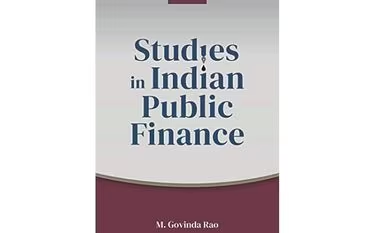 "Studies in Indian Public Finance")
premium
Studies in Indian Public Finance; Author: M Govinda Rao; Publisher: Oxford University Press; Pages: 272; Price: Rs 1,495
In 1776, when Adam Smith laid down his canons of taxation, the idea was simple: How much tax could the state extract without burdening the masses? Moreover, his concept was also an attempt at maximising state revenues. In India, a few millennia before Smith, Kautaliya had laid down his treatise of taxation, highlighting the state’s role in taxation and principles of equity. While discussions on the role of the government have raged ever since, it was only in 1958 that Richard Musgrave formalised a theory of public finance. The work has been the bedrock of theories in public finance. Musgrave’s work assumed more importance during the cold war era, as the two different ideologies collided on the appropriate role of the state. In India, the discussion on taxation has followed a similar trajectory. Moreover, governments have tried to balance taxation and fiscal federalism. One example of this is the goods and services tax (GST) regime, which has recently completed five years.
Topics : BOOK REVIEW tax GST