Needless to say, it wasn’t always so. For those of us actually from Bikaner, there was a delicious irony that the Volvo buses to and from Jaipur used Bikaner House as its hub, and a sense of snobbishness about boarding a plebian form of transport from arguably the most expensive real estate in the country. Here, we’d sip Saras lassi in idling cars, waiting for some late-night service to bring an in-law to be ferried home, or arrive at the crack of dawn to see off a hungover cousin. There was always someone familiar on the bus, resulting in a flurry of “khamaghanis” and quick updates on family or acquaintances. The bus travellers included bureaucrats’ families, fledgling designers and women entrepreneurs; most came with their own books, or bought magazines from the kiosk outside the gate, minded each others’ bags — a civilised, Wodehousian cabal embryonically linked by the bus adda at Bikaner House.
Even before that, I’d associated Bikaner House with the grimness of government offices. This was where the offices of Rajasthan Tourism used to be, and you came here to check the schedule for the Palace on Wheels luxury train, or to get rates for RTDC (Rajasthan Tourism Development Corporation) facilities. Rajasthan’s bureaucracy may be as obdurate as any other, but its officials are altogether more convivial, so at least you were guaranteed a cup of tea and a comfortable chair while someone sorted through your requests. There was the more “senior” wing of the building where officials of the Rajasthan government had their offices, but I was not privileged to be invited to their chambers — I had no sarkari business there.
L’Opera is ideal for light dining. Photo: Dalip Kumar
Nevertheless, it used to be a source of some little embarrassment that Bikaner House was so austere in comparison to its more ostentatious neighbours on the hexagon — the breathtaking Hyderabad House, where the PM hosts visiting heads of state for meals; the majestic Baroda house which, despite being the headquarters of the Northern Railways, has astounding architectural appeal; Jaipur House, an absolute jewel that is rightfully the National Gallery of Modern Art; even Patiala House, given the general squalor that is attached to any courts, has a sprawl that is magnificent. What mattered, though, was that the princely state of Bikaner was given a spot on the hexagon at all. It wasn’t among the richest, most powerful of kingdoms, but Maharaja Ganga Singh had become an ally of the Empire, a close friend of King George V and Queen Mary, had represented India at the Treaty of Versailles, and had turned his annual sandgrouse shoot in Gajner into British India’s go-to party that everyone craved an invitation to. The Viceroy felt compelled to offer the desert state premier space to build its palace when the capital shifted from Calcutta to New Delhi, causing, no doubt, a little heartburn among those who felt they better deserved the honour.
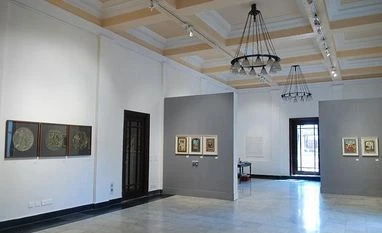
The art gallery. Photo: Dalip Kumar
Bikaner House may have been modest as a building, but its neo-classical bones have proven good. So, when Chief Minister Vasundhara Raje Scindia decided to convert her government’s capital outpost into a hub of culture, it rose to the occasion. The address couldn’t be bettered. Mumbai-based conservationist Abha Narain Lambah took on the restoration with due care not to turn it into an “opulent” building, instead concentrating on re-plastering the lime coats and repairing the chajjas (ledges) while leaving the simple fireplaces be. The CM’s cultural ambassador, the gregarious Malvika Singh, was served the mandate of ensuring due programming at the venue — and there isn’t a person she doesn’t know in the city. Kama Ayurveda owner and designer Vivek Sahni and his partner Vikram Goyal opened the delightful Vayu as a place more of wonder than shopping. Two diverse restaurants added to its dining choices — Rohit Khattar’s Chor Bizarre with its Kashmiri cuisine, which, admittedly, you can indulge in only occasionally, given its general calorific content; and the very likeable, very French L’Opera for casual light dining, a tiny outlet of which next to my office keeps me intravenously supplied with cappuccinos.
Meanwhile, I’m getting withdrawal symptoms, having missed the opening of both Hashiya, an exhibition on augmentations and embellishments on the borders of paintings, and Making Visible on rafoogiri. Fortunately, both remain on view — it’s rendezvous time with Bikaner House…


 "Bikaner House")