


Souza's shock waves
Souza's influence on Indian modernism is akin to that of Picasso on most artists
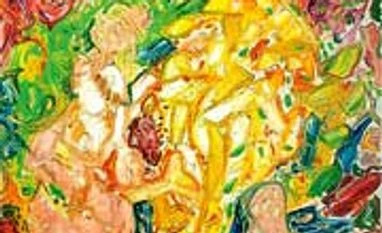)
Imagining Francis Newton Souza as a pugnacious 23-year-old in 1947 can be droll. The artist who led the formation of the Progressive Artists' Group in 1947 was one about whom finding anything nice to say could prove a strain. He was misogynistic, laced a truck-driver's rude tongue with an equally abusive vocabulary, was unnecessarily provocative, and would rather ruffle than soothe feathers. By the time India became independent, he was already disillusioned, a cynic and on his way to gaining notoriety. Bombay's fashionable set, given to attending exhibitions as a social outing, found his art - or was it him? - "disgusting". Two years later, Souza packed his bags and left Bombay for London.
Sixty-seven years years later, Souza is as difficult to like, and his art still has the same ability to shock. He was rarely kind or loving in his portrayal of women, though he seemed to have the knack of drawing them to himself with his abrasive intelligence. Did they react to the obvious cruelty, or was he, underneath the surface, a loving person? The jury's out on that, but kindness and affection are rarely terms used in reference to Souza. He was always scathing in his comments, not caring to spare even the timid. If he had a point of view, he would voice it, regardless of its effect on the unfortunate recipient.
Had he lived, he would have been 89 this year and probably as bitter as he was in 2002, the year he died. There can be no doubt he would have struck out at the current aesthetics powering India's art market. The lack of rebellion among today's generation of artists would have appalled him. Is this what he had pilloried when he wrote in his manifesto that "today we paint with absolute freedom for content and techniques almost anarchic"? And yet, the Progressive artists could hardly be judged as rebels themselves. M F Husain fell foul of political activists for supporting the Emergency and for his portrayal of Hindu goddesses, but preferred courting markets to controversy. S H Raza's work may be overwhelming, but create room for reflection rather than debate. K H Ara's nudes, however interesting, appear anaemic beside Souza's. Gade, Bakre, the "associates" Krishen Khanna, Gaitonde, Ram Kumar, Mohan Samant, Bal Chabdda may have made room for interesting discourse but their work was far from an indictment of society. Akbar Padamsee had a run-in with the law but ended up earning a reprieve for artists and galleries in India. Tyeb Mehta's works can best be described as powerful but are hardly, I think, confrontational.
And yet, Souza's influence on Indian modernism is akin to that of Pablo Picasso's on most artists. He made them think; he insisted on breaking the stranglehold of ideology; decorative art was anathema to him. His career bloomed in London in the Fifties and Sixties (or at least till the mid-'60s) but became repetitive and lost its robustness thereafter. Ought he have changed with the times? I can almost hear him snort in derision.
His life in New York was near penurious but he remained at least as prolific as he had been in London. Part of that abundance will be up for auction next month at Saffronart's first live auction in Mumbai from the collection of his daughter Keren Souza Kohn. Will the works consigned to the auction have stood up to his own high ideals? That might be arguable, but this at least can be said - that every time a fresh body of works by Souza enter the market, art-lovers go ballistic and there's a high buzz. The mark of a genius?
Kishore Singh is a Delhi-based writer and art critic. These views are personal and do not reflect those of the organisation with which he is associated

Don't miss the most important news and views of the day. Get them on our Telegram channel
First Published: Aug 16 2013 | 9:27 PM IST