


Riding on new launches, auto sales extend momentum in April
Estimate passenger vehicles sales to grow 8-9 per cent in the current financial year, provided monsoon plays out well, said Subrata Ray, analyst with ICRA
 "graph")
premium
graph
Last Updated : May 02 2018 | 12:39 AM IST
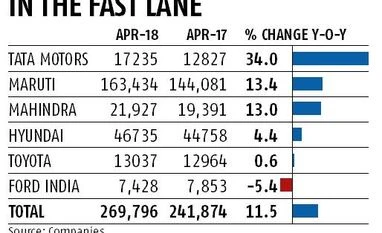
Passenger vehicle sales at most automakers kick started on a strong note this financial year. According to the monthly data released by the auto firms, the cumulative sales volume of the country’s top six passenger vehicle manufacturers rose 11.5 per cent to 269,000 units compared to a year-ago period. The auto companies in India count dispatches to dealers as sales.
Prospects of a better economic growth, a favorable monsoon and a sustained benign interest, coupled with new model launches, perked up the sales of the fastest expanding auto market in the world. April was the sixth-month of continuous growth. Passenger vehicles sales last dipped in October because of the disruptions caused by the implementation of goods and services tax (GST). The Reserve Bank of India expects the economy to grow faster at 7.4 per cent against 6.8 per cent in 2018-19.
Maruti Suzuki, which sells one in every second passenger vehicle in the country, led the pack with its sales jumping 13.4 per cent to 163,434 units over the same period last year. The volumes were led by a robust 32 per cent increase in volumes of compact models such as Swift, Ignis, Celerio, Baleno, Dzire, and Tour S.
Besides the Baleno, volumes in the segment were bumped up by the new generation Swift launched in February. In just over two months, the car received 100,000 bookings. Currently, Maruti has a backlog of 28,000 units for delivery, said a company’s spokesperson. The compact models now account for one in every two models sold by the company. Maruti’s two old workhorses — Wagon R and Alto — have been losing traction. The sales of the two brands dropped 2.8 per cent over a year ago as buyers’ preference for pricier and premium models continued.
Hyundai Motor India, the second largest in the pecking order, also saw an increase, though at a slower pace. The maker of the Creta SUV and i20 hatchback sold 46,735 units, up 4.4 per cent over the last year.
It was a good start for Mahindra and Mahindra too with its sales expanding 13 per cent 21,927 vehicles over the last year.
The Mumbai-based company launched the new XUV5OO on 14 April. With the launch of the new model, Mahindra hopes to recover the ground it has lost to the rivals in the SUV segment.
Closing in on the archrival Mahindra, Tata Motors has seen sales climbing up since the launch of the new age models.
The company sold 17,235 units, up 34 per cent over the last year. “While there were challenges in the market, strong demand for new generation products such as the Tiago, Tigor, Nexon and Hexa lead the growth,” said Mayank Pareek, president passenger vehicle business unit at Tata Motors.
Dispatches at Toyota Kirloskar Motor remained muted during the month. A total of 13,037 units against 12964 units over a year ago. Last month, Toyota entered the competitive sedan segment with the Yaris. The model goes on sale this month.
Ford India was the only company that saw sales dip during the month. The company dispatched 7,428 units, down 5.4 per cent over the last year. Ford introduced compact utility vehicle, Ford Freestyle last month. Anurag Mehrotra, president and managing director, Ford India, said that an increasing inflation trajectory which might weigh on customer’s access and cost to credit, coupled with increasing crude prices could lead to passenger vehicle industry growing “at low single-digits so far this year.”
Estimate passenger vehicles sales to grow 8-9 per cent in the current financial year, provided monsoon plays out well, said Subrata Ray, analyst with ICRA.
“The April sales have been better than expectation,” said Ray adding the increasing crude prices or inflationary trend is unlikely to have a material impact on the auto sales as the fundamentals continue to be strong. On April 5, private weather forecasting agency, Skymet said the monsoon this year could be 100 per cent of the long period average with a model error of plus and minus 5 per cent.
Shrugging off the impact of the note ban in November 2016, passenger vehicles sales in India advanced 14.68 per cent to 277,602 units in April 2017 over 2016, according to Society of Indian Automobile Manufacturers (Siam).