


Young classical performers continue to struggle to find a listening ear
Groups such as Baithak are springing up in every city and a fair number of institutions and corporate donors are involved in the support of Indian classical music
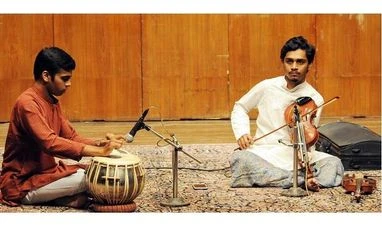 "Young artistes performing as part of the Baithak series")
premium
Young artistes performing as part of the Baithak series
In a school, a short distance away from where the annual Sawai Gandharva festival is held in Pune, a small group of musicians is talking to a classroom full of boys and girls about Indian classical music. Had they heard of a singer, perhaps, or about an instrument? A young boy raises his hand. His reply: Honey Singh.
The answer hits Mandar Karanjikar, the man asking the question, like a whiplash. But it is not really a surprise, says Karanjikar, an engineer and a classical vocalist: if the children don’t hear classical music, how will they know it? Mandar, along with Dakshayani Athalye, has set up Baithak, a not for profit in Pune to “promote classical music in all sections of the society, irrespective of socio-economic background”.
Groups such as Baithak are springing up in every city and a fair number of institutions and corporate donors are involved in the support of Indian classical music. Yet, spaces and audiences for amateur performances are shrinking.
Suvarnalata Rao, programming head of Indian music at the National Centre for Performing Arts (NCPA), Mumbai, says it is important now more than ever before to bring young, fresh out of their training musicians on to public platforms.
NCPA, she says, has one of the oldest programmes for promoting young artistes. The latest one is the Citi-NCPA Promising Artists Series that supports eight gurus and their (three each) shishyas. The gurus are looked after under the programme and they do not charge the chosen students. One of the artistes being trained under the scholarship is Rageshri Vairagkar who says that this is a boon for musicians like her who spent every waking hour thinking of music. “I know that it will take time to be a great singer but I am only happy when I am doing my riyaz,” she says.
The answer hits Mandar Karanjikar, the man asking the question, like a whiplash. But it is not really a surprise, says Karanjikar, an engineer and a classical vocalist: if the children don’t hear classical music, how will they know it? Mandar, along with Dakshayani Athalye, has set up Baithak, a not for profit in Pune to “promote classical music in all sections of the society, irrespective of socio-economic background”.
Groups such as Baithak are springing up in every city and a fair number of institutions and corporate donors are involved in the support of Indian classical music. Yet, spaces and audiences for amateur performances are shrinking.
Suvarnalata Rao, programming head of Indian music at the National Centre for Performing Arts (NCPA), Mumbai, says it is important now more than ever before to bring young, fresh out of their training musicians on to public platforms.
NCPA, she says, has one of the oldest programmes for promoting young artistes. The latest one is the Citi-NCPA Promising Artists Series that supports eight gurus and their (three each) shishyas. The gurus are looked after under the programme and they do not charge the chosen students. One of the artistes being trained under the scholarship is Rageshri Vairagkar who says that this is a boon for musicians like her who spent every waking hour thinking of music. “I know that it will take time to be a great singer but I am only happy when I am doing my riyaz,” she says.
Young artistes performing as part of the Baithak series