


Trai suggests base price of Rs 11k cr for 700-MHz band
For 1,800 MHz and 2,500 MHz, the reserve price has been fixed at Rs 2,873 crore and Rs 809 crore, respectively
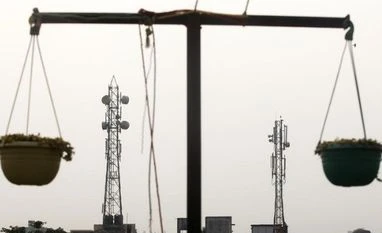 "Telecommunication towers are pictured through hanging flower pots at a residential building in Kolkata (Photo: Reuters)")
Telecommunication towers are pictured through hanging flower pots at a residential building in Kolkata (Photo: Reuters)
The Telecom Regulatory Authority of India (Trai) has recommended auction of 700 MHz spectrum for the first time, at a reserve price of Rs 11,485 crore per MHz.
This is the highest reserve price fixed for a band ever since the process for spectrum auction started nearly five years ago.
700 MHz is considered a good band for offering mobile broadband services / 4G. It is a much sought-after band for long-term evolution (LTE) deployment around the world due to its efficiency and higher penetration inside buildings. Due to lower frequency, it provides wider coverage, which reduces the number of towers required for setting up the LTE network and significantly cuts down capital expenditure involved in making the network live.
However, Bharti Airtel, Idea Cellular and Mukesh Ambani’s Reliance Jio in their submissions to Trai had opposed the auction of the new band 700 MHz till a device ecosystem was in place. The cost of delivering mobile services in the 700 MHz band is approximately 70 per cent cheaper than that in 2,100 MHz.
According to experts, the reserve price of the 700 MHz Band, for which the ecosystem is yet to be ready, has been fixed at a premium level. Operators might not be able to bid aggressively in this new band as the benefits will trickle only in the longer run.
Trai had on Wednesday come out with its recommendations on valuation and reserve price of spectrum in 700 MHz, 800 MHz, 900 MHz, 1,800 MHz, 2,100 MHz, 2,300 MHz and 2,500 MHz bands for the next round of auction, which is expected to happen in May/June this year.
In 2015, the government had earned revenues of Rs 1.1 lakh crore from the spectrum auction. According to experts, the government could rake in Rs 5.5-6 lakh crore this year from the sale of spectrum.
For 1,800 MHz and 2,500 MHz, the reserve price has been fixed at Rs 2,873 crore and Rs 809 crore, respectively. The 2,500 MHz band would be auctioned for the first time.
The recommended price of 1,800 MHz band is 31 per cent higher than the base price fixed by the government in the March 2015 auction. The government had fixed Rs 2,191 crore pan-India (excluding Maharashtra and West Bengal) price for 1,800 MHz band in previous auction held in March 2015.
The regulator also suggested base price for 2,300 MHz and 2,500 Mhz bands. It recommended Rs 817 crore per MHz for spectrum in both 2,300 MHz and 2,500 MHz frequencies, 33 per cent higher than base price fixed for their last auction held in 2010.
At present, Reliance Jio is the only player to have 2,300 Mhz spectrum across India.
For 2,100 MHz, Trai has recommended Rs 3,746 per MHz pan-India against Rs 3,705 crore fixed by government in the March 2015 auction. The 800 MHz band, which is being used for 4G services, has been fixed at a base price of Rs 5,829 per MHz. The new price is about 60 per cent higher from base price of Rs 3,646 crore fixed in the last auctions. It has suggested auction of 800 MHz in 19 out of 22 telecom circles.
The 900 MHz will be put up for auction only in six circles. Trai has also recommended auction of spectrum in 900 MHz in six service areas — Gujarat at base price of Rs 673 crore per MHz, Karnataka for Rs 558 per MHz, Haryana for Rs 151 per MHz, UP East for Rs 776 per MHz, UP West for Rs 739 MHz and Bihar for Rs 444 per MHz.
Earlier, the government had fixed the highest base price at Rs 3,980 per MHz for 900 spectrum band in the last auction.
Overall, 37.5 MHz will be put up for auction in the 800 MHz band, 9.8 MHz in the 900 MHz band, 21 MHz in 1,800 MHz, and 345 MHz (out of which 330 MHz to be released by the defence ministry) in the 2,100 MHz band.
In the 2,300 MHz (first auctioned in 2010), 320 MHz will be put up for sale and in 2,500 MHz, 600 MHz will be put up for sale.
Trai has taken 80 per cent (50 per cent for Jammu & Kashmir and northeast) of the average valuation of spectrum band in the licensed service area or the price realised in the March 2015/February 2014 auction, whichever is higher as the base price for spectrum.
According to Hemant Joshi, partner, Deloitte Haskins & Sells LLP, says operators’ ability to pay for spectrum will be constrained as the balance sheets are already over-stretched. “The timing of auction should be carefully considered so that all players can effectively participate. Currently, operators are busy rolling out services for the spectrum acquired in recent auctions and grappling with challenges of servicing debt and maintaining healthy profitability and cash flows.”
On 700 MHz, Trai said 12 commercial networks have already been launched and 13 countries have auctioned this band. A total of 35 MHz would be put up for auction in this frequency.
The regulator has recommended taking back 1,800 MHz band spectrum assigned to Aircel in Haryana and Madhya Pradesh; Tata Teleservices (TTSL) in Himachal Pradesh; and 800 MHz band spectrum assigned to Tata in West Bengal and Quadrant (Videocon) in Punjab, and auctioning these frequencies.
In April 2013, TTSL had surrendered the CDMA spectrum 800 MHz held by it beyond 2.5+2.5 MHz in all circles except in Delhi and Mumbai. However, the spectrum has not been put to auction by the department of telecommunications because the matter is sub-judice. According to Trai, DoT should not keep spectrum surrendered by TTSL as idle and take appropriate legal remedies to put it in the upcoming auction.
The entire available spectrum in the 2,100 MHz band, including spectrum taken back from STel, should be put to auction, Trai said. Although the Supreme Court had cancelled STel’s 2G permits, the company’s holding in 3G band in Bihar, Odisha and Himachal Pradesh remained unaffected by the order. The company later closed its operations in India and the regulator said its 3G spectrum could be put for auction.
According to Trai, the audit for all allocated spectrum should be done by an independent agency. The recommendations will now be considered by the Telecom Commission, the highest policy making body of DoT and then will go for the Cabinet’s final approval. However, it is unlikely that the spectrum auction will happen in the current financial year as envisaged by the government earlier.

Don't miss the most important news and views of the day. Get them on our Telegram channel
First Published: Jan 28 2016 | 12:27 AM IST