


Treasury gains offer hopes for banks in 2015
Sharp rate cuts expected following benign inflation
)
Even as credit growth in the banking system remains muted and bad loans continue to haunt lenders, treasury gains could help banks boost profitability with expectations of a rate cut by the Reserve Bank of India (RBI) and lesser government borrowing in the next financial year.
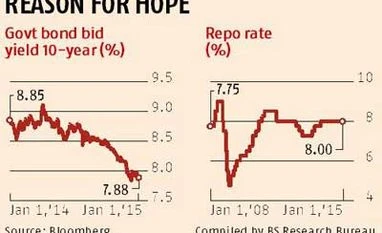
RBI governor Raghuram Rajan raised the benchmark repurchase rate thrice from September 2013 to January 2014, and has since kept it steady at eight per cent. In the fifth bi-monthly monetary policy review held last month, Rajan said a change in the monetary policy stance was likely in early 2015, should improvements in inflation and fiscal health were to continue.
“Bond market will do well this year. I expect rate cuts of 100 basis points. The 10-year bond yields may drop by another 60-65 basis points in that case. I also expect the government borrowing for the next fiscal (FY16) to be lower and that too will help the bond market,” said Jayesh Mehta, managing director and country treasurer at Bank of America-Merrill Lynch.
The repo rate - the rate at which banks borrow from RBI - had been cut by 175 basis points in 2009 and since then, such sharp cuts have not been seen.
The yield on the 10-year benchmark bond dropped 97 basis points in 2014, the most in six years. The yields on the 10-year bond fell by 253 basis points in 2008. The fall in bond yields in 2014 was on the optimism that RBI will cut interest rates in 2015 on the back of falling oil prices helping ease inflation numbers. Consumer Price Index-based inflation rose 4.38 per cent year-on-year in November 2014, the slowest pace in data going back to January 2012. The December 2014 inflation data is due to be released this month. The drop in oil prices helps bring down costs for the country, which imports about 80 per cent of its oil requirement.
“Profits of banks will be driven by gains in treasury. Last year, we saw that the deposit growth was better than the credit growth. This trend may continue in 2015, too. That money may get invested mainly in government bonds and a part of it may also flow into 'AAA' rated corporate bonds,” said N S Venkatesh, executive director and head of treasury at IDBI Bank. 'AAA' is the highest rating given by credit-rating agencies and it signifies that a firm has an extremely strong capacity to meet its financial commitments.
RBI data show that as of December 12, 2014, credit grew 10.9 per cent year-on-year, compared with 14.9 per cent during the corresponding year-ago period. During the same period of comparison, deposits grew 10.6 per cent against 17 per cent.
The fiscal deficit for the current financial year is pegged at 4.1 per cent of the GDP, while it has been targeted at 3.6 per cent of the GDP for FY16. A lower fiscal deficit indicates lesser government borrowing by way of government bonds.

Don't miss the most important news and views of the day. Get them on our Telegram channel
First Published: Jan 02 2015 | 12:48 AM IST