


Google, Facebook turn on the fake Riviera charm
Google is cutting off much of that access to outsiders, arguing that GDPR precludes the sharing of such data
 "graph")
premium
graph
Last week at Cannes Lions, the advertising world’s yearly schmooze-fest on the Cote d’Azur, the industry tried to present a unified front.
Internet ads have their place, went the message, but as something that complements rather than replaces traditional media such as television and billboards. And there will be a place for everybody – from incumbent ad giants such as WPP Plc and Publicis SA to interloper consulting firms like Accenture – in making sure that creative campaigns are distributed in winning ways across the media old and new.
Given their recent tribulations over personal data, the Silicon Valley giants were eager to peddle the same conciliatory narrative. It’s important for Facebook Inc. and Alphabet Inc.’s Google to not be seen as too dominant, for fear of riling the regulators. So they too were quick to highlight the importance of the agencies, saying that no brand wanted to become dependent on any one form of ad distribution.
There was one word that constantly came up in a darker context: Disintermediation. This is the notion that Google and Facebook are increasingly trying to cut out the agency middlemen and women by working directly with the big consumer brands.
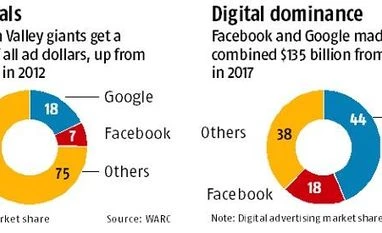
It’s not a new threat. Ever since Google bought DoubleClick in 2007, letting advertisers buy ad spots directly online using real-time auction systems, there have been mutterings about Silicon Valley encroachment onto Madison avenue turf. But there’s no denying that the power of Google and Facebook is increasing rapidly, as is shown by their quarter share of all the world’s advertising dollars.
And the irony is that just as the EU is trying to limit the tech giants’ dominance, its new, much-praised General Data Protection Regulation may in fact make it harder to break Google and Facebook’s stranglehold on digital ads.
While the agencies are racing to beef up their own internet businesses, the amount of personal data held by the Silicon Valley duo is already vast – and the new GDPR rules will deepen the competitive moat around it.
Internet ads have their place, went the message, but as something that complements rather than replaces traditional media such as television and billboards. And there will be a place for everybody – from incumbent ad giants such as WPP Plc and Publicis SA to interloper consulting firms like Accenture – in making sure that creative campaigns are distributed in winning ways across the media old and new.
Given their recent tribulations over personal data, the Silicon Valley giants were eager to peddle the same conciliatory narrative. It’s important for Facebook Inc. and Alphabet Inc.’s Google to not be seen as too dominant, for fear of riling the regulators. So they too were quick to highlight the importance of the agencies, saying that no brand wanted to become dependent on any one form of ad distribution.
There was one word that constantly came up in a darker context: Disintermediation. This is the notion that Google and Facebook are increasingly trying to cut out the agency middlemen and women by working directly with the big consumer brands.
It’s not a new threat. Ever since Google bought DoubleClick in 2007, letting advertisers buy ad spots directly online using real-time auction systems, there have been mutterings about Silicon Valley encroachment onto Madison avenue turf. But there’s no denying that the power of Google and Facebook is increasing rapidly, as is shown by their quarter share of all the world’s advertising dollars.
And the irony is that just as the EU is trying to limit the tech giants’ dominance, its new, much-praised General Data Protection Regulation may in fact make it harder to break Google and Facebook’s stranglehold on digital ads.
While the agencies are racing to beef up their own internet businesses, the amount of personal data held by the Silicon Valley duo is already vast – and the new GDPR rules will deepen the competitive moat around it.