


Just the fear of trade war straining economy
The Mexican government recently imposed 20 percent tariffs on American apples in response to Mr. Trump's duties on steel
 "Trump, Donald trump, united states")
premium
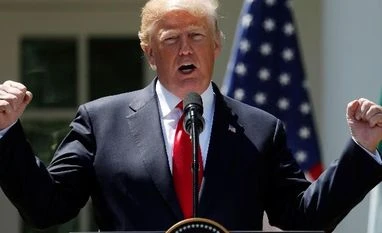
US President Donald Trump gestures while addressing a joint news conference with Nigeria's President Muhammadu Buhari in the Rose Garden of the White House in Washington, US | Photo: Reuters
Only a few months ago, the global economy appeared to be humming, with all major nations growing in unison. Now, the world’s fortunes are imperiled by an unfolding trade war.
As the Trump administration imposes tariffs on allies and rivals alike, provoking broad retaliation, global commerce is suffering disruption, flashing signs of strains that could hamper economic growth. The latest escalation came on Friday, when President Trump announced fresh tariffs on $50 billion in Chinese goods, prompting swift retribution from Beijing.
As the conflict broadens, shipments are slowing at ports and airfreight terminals around the world. Prices for crucial raw materials are rising. At factories from Germany to Mexico, orders are being cut and investments delayed. American farmers are losing sales as trading partners hit back with duties of their own.
Workers in a Canadian steel mill scrambled to recall rail cars headed to the United States border after Trump this month slapped tariffs on imported metals. A Seattle customer soon canceled an order.
“The impact was felt immediately,” said Jon Hobbs president of AltaSteel in Edmonton. “The penny is really dropping now as to what this means to people’s businesses.”
The Trump administration portrays its confrontational stance as a means of forcing multinational companies to bring factory production back to American shores. Trump has described trade wars as “easy to win” while vowing to rebalance the United States’ trade deficits with major economies like China and Germany.
Trump’s offensive may yet prove to be a negotiating tactic that threatens economic pain to force deals, rather than a move to a full-blown trade war. Americans appear to be better insulated than most from the consequences of trade hostilities.
As a large economy in relatively strong shape, the United States can find domestic buyers for its goods and services when export opportunities shrink. Even so, history has proved that trade wars are costly while escalating risks of broader hostilities. Fears are deepening that the current outbreak of antagonism could drag down the rest of the world.
Before most trade measures fully take effect, businesses are already grappling with the consequences - threats to their supplies, uncertainty over the terms of trade and gnawing fear about what comes next. “Just talking about protectionism is causing trouble,” said Marie Owens Thomsen, global chief economist at Indosuez Wealth Management in Geneva. “It’s an existential risk to the world economy.”
As the Trump administration imposes tariffs on allies and rivals alike, provoking broad retaliation, global commerce is suffering disruption, flashing signs of strains that could hamper economic growth. The latest escalation came on Friday, when President Trump announced fresh tariffs on $50 billion in Chinese goods, prompting swift retribution from Beijing.
As the conflict broadens, shipments are slowing at ports and airfreight terminals around the world. Prices for crucial raw materials are rising. At factories from Germany to Mexico, orders are being cut and investments delayed. American farmers are losing sales as trading partners hit back with duties of their own.
Workers in a Canadian steel mill scrambled to recall rail cars headed to the United States border after Trump this month slapped tariffs on imported metals. A Seattle customer soon canceled an order.
“The impact was felt immediately,” said Jon Hobbs president of AltaSteel in Edmonton. “The penny is really dropping now as to what this means to people’s businesses.”
The Trump administration portrays its confrontational stance as a means of forcing multinational companies to bring factory production back to American shores. Trump has described trade wars as “easy to win” while vowing to rebalance the United States’ trade deficits with major economies like China and Germany.
Trump’s offensive may yet prove to be a negotiating tactic that threatens economic pain to force deals, rather than a move to a full-blown trade war. Americans appear to be better insulated than most from the consequences of trade hostilities.
As a large economy in relatively strong shape, the United States can find domestic buyers for its goods and services when export opportunities shrink. Even so, history has proved that trade wars are costly while escalating risks of broader hostilities. Fears are deepening that the current outbreak of antagonism could drag down the rest of the world.
Before most trade measures fully take effect, businesses are already grappling with the consequences - threats to their supplies, uncertainty over the terms of trade and gnawing fear about what comes next. “Just talking about protectionism is causing trouble,” said Marie Owens Thomsen, global chief economist at Indosuez Wealth Management in Geneva. “It’s an existential risk to the world economy.”