


Making a difference
As more global QSR chains target India as their next big market, the battle for supremacy will be won by delivering a unique customer experience
)
In September 2013, right at the beginning of his training period at Pita Pit's headquarter in Kingston, Canada, Anun Dhawan, director at Mentor Hospitality (master franchisee for Canadian QSR chain Pita Pit in north and east India), figured out the significance of creating great customer experience. Recalling an incident in his first training session, he says, "The session started with a seemingly idealistic question: how do you train store staff to deliver the right customer experience in a country where there's a huge economic disparity between them and the customers?"
That is where the problem really starts, he says. The other issue that compounds the challenge of creating a great customer experience is language. First, each market within India speaks, or rather understands, a different language. Therefore, a store staff must know at least two languages - English and Hindi. This is quite different from any other market where the restaurant is present - be it South Korea, France, Australia, Brazil or the US. After listening to Dhawan's concerns the trainers told him that it all boiled down to building confidence and that to instill confidence is his team Dhawan had to lead by example.
So when Pita Pit's first store was opened in November 2013, Dhawan along with the leadership team of Mentor Hospitality, rolled up their sleeves to manage some of the key aspects of the store's operations - such as noting down orders at the front counter and managing the workflow in the kitchen. All along, the company's co-founder Nelson Lang, who was present at the store, kept a keen eye on the goings-on. While the store staff was intimidated by his presence initially, they understood what the management was trying to convey.
Over the next five years, Pita Pit will open around 50 outlets across the north and east of India. Its training calendar comprises induction sessions for new employees besides weekly manager meetings. Most of the training happens on the job. The area manager is mainly responsible for maintaining the score cards of all the employees - from store managers down to the cleaning staff. With a little more than one year of operations, Pita Pit India is already trying hard to cut down the turnaround time for orders, especially the ones placed during the so-called rush hours. The company claims it can serve a sandwich within 2.5 minutes of receiving an order. "We understand that delivering the right customer experience is actually about staying on high alert and adjusting your operations to consumer demand from time to time," adds Dhawan.
Pita Pit is not alone. With competition in the Rs 7,000-crore quick service restaurant space hotting up, most players feel they have to conjure up fresh ways to attract and keep guests coming back. And if you are a relative new-comer, you have to work a lot harder to attract new customers or simply to maintain a steady stream of patrons to keep the cash boxes ringing. This is sometimes accomplished with inexpensive marketing initiatives, but other times more elaborate and expensive approaches are in order. The fact is, in addition to getting customers in the door you have to ensure that they have a positive in-store experience. From promotions to web advertising, from vouchers to social media, a QSR has to attempt to stay ahead of the competition through a variety of methods. But the first point of human contact, or the store itself, has now emerged as the field where the battle for the customer is being fought.
Timing is everything
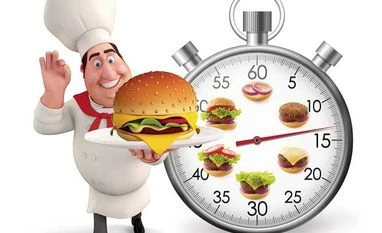
Popular for its charbroiled burgers, US fast-food chain Carl's Jr. has done its homework well ahead of its scheduled store launch in April this year. Interestingly, the company has taken three years to re-engineer its menu for India. Since Carl's Jr.'s main objective is to serve "fine-dining food" within three minutes of getting an order, it has devised a unique consumer engagement strategy. Says Samir Chopra, chairman and founder, Cybiz BrightStar Restaurants (Carl's Jr. franchisee), "The distinction between the experience at a fine dining restaurant and a QSR is made on two grounds: the quality of the food and the time taken in delivering the service."
To understand how Carl's Jr. is reworking the serving time, we have to first look at the amount of time customers spend on an average at a fine dining restaurant. After walking into the restaurant the customer tends to spend three to five minutes in getting a table of her choice. The next 5-10 minutes is spent on placing the order followed by another 15-20 minutes of waiting before the food arrives at the table. At the end of the meal it takes around 5-10 minutes to settle the bill. Put together, the overall turnaround time for any order at a fine dining restaurant is 40-50 minutes. "If we take that much time in processing an order, customers will never revisit us," adds Chopra.
He says that today many QSR chains end up on the wrong side of the customer, especially during rush hours, because there's little to do to kill time while they wait for their food. In that situation, even a three-minute wait seems harrowingly long. To keep its customers engaged, Carl's Jr. will introduce the concept of 'partial service'. After they place an order at the counter, customers will be asked to fetch beverages from a vending machine. Initially, the company will place one staff member to help the customers at the vending junction. To some extent, this is expected to reduce the workload of the serving staff. By the time the customer reaches her table, the food would have been served by a staff member. All this in three-and-a-half minutes.
A strong training process and the handling capacity of in-store equipment will play a major role in cutting down the turnaround time per order. All the training is undertaken by the Carl's Jr. Star Academy, known to provide MBA-style leadership training, in tandem with a web-based in-store learning management system. Currently Carl's Jr. India is setting up its training calendar for 2015. This will include off-sites for general managers, sessions for the leadership team at the master franchisee premises, classes on business planning, time management and other things related to store operations. By the end of this month a team of seven general managers from Carl's Jr. India - all with more than eight years of prior experience - will fly down to California for a 10-week training programme. This team will be responsible for training the rest of Carl's Jr.'s India staff.
The show must go on
Uma Talreja, chief marketing officer at Burger King India (BKI), is of the opinion that service is faster and better when a restaurant gets crowded. Otherwise low footfalls spread lethargy among the store staff. On an average weekend, BKI makes 5,000-6,000 burgers, more than double the number it does on weekdays. Talreja says, "Going forward, right training will be the key differentiator in ensuring the best customer experience." Talreja, who has a background in fashion with stints at Westside, Aditya Birla Retail and Shopper's Stop, went to Miami to receive functional training for her role at BKI. The first part of her induction had begun in India when she was introduced to the hygiene principles adhered to by the chain so that she is better prepared to assimilate the second part of her induction in the US. In Miami, she spent a week understanding every aspect of store operations. Marketing-related training sessions included lessons on innovation, research and the brand's visual imagery.
As part of her training, Talreja was required to visit competing QSR chains like Wendy's, Johnny Rockets, Chipotle Mexican Grill, among others, to understand what they have to offer and what are some of the things that Burger King could adopt in its format. She says on a lighthearted note, "One day in my week-long training calendar was assigned for restaurant visits only. Besides observing the best practices followed at these restaurant chains, I was also expected to try their food. Honestly I did throw up the next day."
For Burger King, store managers are a key cog in the wheel because they carry customer feedback to the company's leadership team. One thing that BKI has learnt is that consumer expectations vary from market to market. For instance, in Singapore consumers expect robot-like efficiency. The store staff can have a conversation with customers, but without ever stopping their jobs behind the counter. Such efficiency is respected in Singapore. On the other hand, an average customer in India who is equally interested in experiencing a new brand, like it if the store staff pays extra attention while helping them select items from the menu. "So on every new restaurant opening, while the store staff is responsible for efficiency, Burger King India's leadership team spends more time interacting with customers," adds Talreja.
In order to receive Burger King's certification, every crew member and store manager has to work in the kitchen. For training purposes, BKI has a fully-equipped test kitchen in Mumbai. Under the company's training system, when a country opens a new restaurant and expands operations, it earns credit points. Before the opening of its first three restaurants in Delhi and Mumbai, the BKI crew was sent to Sri Lanka for training. Before that, BKI's regional heads along with the country's training head went to Bangkok to undergo a month-long training programme.
The QSR industry is a tough business to be in. It isn't a secret that a majority of new restaurants shut down within five years. Some of the ways to attract new customers are extremely affordable, but others may require imagination. If you're on a tight budget in an overcrowded space it would be a good idea to start with your people.
QSR: 2015 and beyond
-
The Indian organised QSR industry is a Rs 7,000- crore market dominated by chains like McDonald's and Subway
-
In the organised eating-out market, which includes cafes, casual dining, frozen dessert, pub/club/bar/lounge etc, QSRs will lead with a projected growth rate of 21 per cent till 2020
-
Increased spends on eating out activities, exposure through international travel and media and evolving palate of the Indian consumer are the key demand drivers in QSR
- 2015 will see leading international burger chains like Fatburger, Carl's Jr., and Burger King battling to win the trust of the evolved Indian consumers

Don't miss the most important news and views of the day. Get them on our Telegram channel
First Published: Jan 19 2015 | 12:15 AM IST