


<b>Percy Mistry</b>: Collateral damage of demonetisation
A corrupt political-administrative nexus is the real disease, not black money
 "ATM")
premium
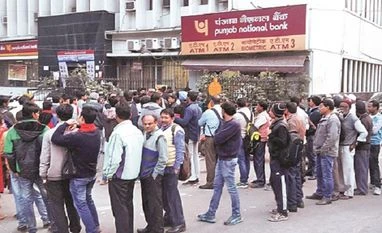
Long winding road: People queued up outside an ATM in New Delhi to withdraw cash. Asking people to be patient is disingenuous because demonetisation will not achieve its aim
After 50 days, it is clear that demonetisation has failed, with severely damaging consequences. Many have attempted to defend it as an inconvenience that will be forgotten when its long-term beneficial effects take hold. Over a hundred deaths, billions of man-hours in queues waiting in vain for cash, millions of lost jobs and incomes, are mere inconveniences?
Instead of course-correction, through remonetisation and roll-back of counterproductive measures, Prime Minister Narendra Modi is doubling down, with the promise of more action. His bombastic rhetoric is shriller. Intending to curb black money, Modi has instead damaged millions of ordinary Indians. Whether contract labourers, farmers, traders, vegetable vendors, sole proprietors, plumbers, carpenters, doctors, lawyers, accountants or domestic help, millions of livelihoods and incomes have been impaired through misdirected draconian measures.
Asking people to be patient is disingenuous because demonetisation will not achieve its aim. It will not curb black money. Instead it will destabilise the Indian economy when economic portends are malignant. It will do much damage over the long term by increasing investor perceptions of unusually high policy risk in India, when such measures can be taken by one man, without any checks and balances.
Oddly, demonetisation is the brainchild of a consummate politician supposedly in touch with the public mood. His defenders claim he was ill-served by bureaucrats, who should have made him aware of adverse consequences and should have implemented demonetisation better. There are two problems with this argument. First, Modi has created a super-sycophantic climate in obsequious Delhi and Bharatiya Janata Party-run states. Everyone is too frightened to tell the emperor he has no clothes. Second, it is impossible to see how as monumental a folly as demonetisation could achieve more with better implementation, when it was so badly mis-designed.
Instead of course-correction, through remonetisation and roll-back of counterproductive measures, Prime Minister Narendra Modi is doubling down, with the promise of more action. His bombastic rhetoric is shriller. Intending to curb black money, Modi has instead damaged millions of ordinary Indians. Whether contract labourers, farmers, traders, vegetable vendors, sole proprietors, plumbers, carpenters, doctors, lawyers, accountants or domestic help, millions of livelihoods and incomes have been impaired through misdirected draconian measures.
Asking people to be patient is disingenuous because demonetisation will not achieve its aim. It will not curb black money. Instead it will destabilise the Indian economy when economic portends are malignant. It will do much damage over the long term by increasing investor perceptions of unusually high policy risk in India, when such measures can be taken by one man, without any checks and balances.
Oddly, demonetisation is the brainchild of a consummate politician supposedly in touch with the public mood. His defenders claim he was ill-served by bureaucrats, who should have made him aware of adverse consequences and should have implemented demonetisation better. There are two problems with this argument. First, Modi has created a super-sycophantic climate in obsequious Delhi and Bharatiya Janata Party-run states. Everyone is too frightened to tell the emperor he has no clothes. Second, it is impossible to see how as monumental a folly as demonetisation could achieve more with better implementation, when it was so badly mis-designed.
Long winding road: People queued up outside an ATM in New Delhi to withdraw cash. Asking people to be patient is disingenuous because demonetisation will not achieve its aim
Disclaimer: These are personal views of the writer. They do not necessarily reflect the opinion of www.business-standard.com or the Business Standard newspaper