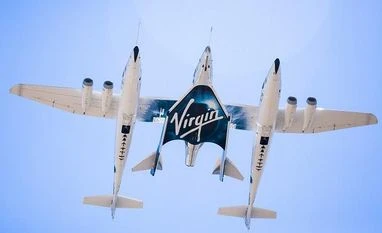
Some of the technology may find applications in more mundane settings, quite apart from offering options of hypersonic travel. The spacecraft Unity, for example, rides to around 15,000 metres in the belly of a plane. When released it uses its own rockets to climb to 80 km. Passengers must be cushioned and protected from high acceleration during this period, and during the landing. The cabin must be pressurised, and all furniture secured to handle weightlessness. Moreover, insulation is required to protect the craft from heat generated by friction. The materials used, and the design elements, could be incorporated in safety equipment in cars and bullet trains. Another set of positive consequences may be the clean-up of space debris. Space is littered with dead satellites and bits and pieces of defunct equipment. Over 30,000 such pieces are tracked by space agencies, all travelling at speeds in excess of 8,000 km per hour. The ISS itself, and every working satellite, are compelled to make multiple course corrections to avoid being hit by these.
While the Space Registration Convention of 1976 and the recent Artemis Accords suggest the clearing up of these objects in principle, the presence of high net-worth tourists will add a sense of urgency. This would, in the long run, be highly beneficial and the technologies, which would have to be refined and deployed for such a clean-up, would also help to protect the Earth from meteor strikes in future. There could be other areas where space tourism leads to ancillary benefits. But it is unlikely that the entry of private operators will result in a huge surge of “blue-sky” research. Private entities tend to be focused on very specific technologies, which have visible payoffs within a foreseeable future.
The exploration of space and associated research have led to many revolutionary advances in the grasp of basic science and technology. Many areas ranging from modern communications, and geo-location systems, to renewable energy usage, weather prediction, waste water recycling, medicine, robotics, artificial intelligence, etc., owe their existence to space research. But all those spinoffs came from big blue-sky programmes mounted by publicly-funded national space agencies with no immediate payoffs apparent when the research was initiated. It is likely that this situation will continue but the presence of interested private parties may ensure that such research is monetised quicker.


 "Virgin Group Founder Richard Branson. (Photo: Reuters)")