


The state of states: Have they really been fiscally profligate?
A couple of states may be guilty of fiscal imprudence. But why tar all of them with the same brush?
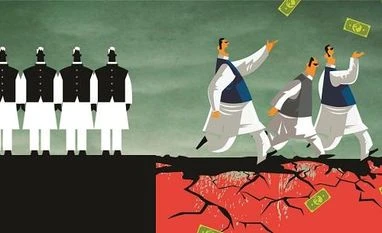 "The state of states")
premium
Illustration: Binay Sinha
Concerns have been expressed over some states seeking recourse to excessive borrowing, which no doubt is fiscally imprudent and irresponsible. But how serious are these concerns? And are some states indeed borrowing excessively and living beyond their means?
Data on the debt position of states will tell you a slightly different story. According to a study by the National Institute of Public Finance and Policy, aggregate public debt of 18 major states did go up from 20.53 per cent of gross state domestic product (GSDP) in 2019-20, a pre-Covid year, to 23.5 per cent of GSDP in 2020-21. However, growth in these states’ public debt has slowed down since then. In the revised estimates for 2021-22, the public debt of these states increased marginally to 23.66 per cent of GSDP and is projected at 23.93 per cent in 2022-23.
A close look at the debt position of the individual states is even more revealing. The Fifteenth Finance Commission had indicated a glide path for the states’ debt position in its report of October 2020. According to it, the states should stay below a debt level of 31.1 per cent of GSDP in 2020-21; 30.7 per cent in 2021-22; and 31.3 per cent in 2022-23. By that yardstick, only two states had accumulated debt higher than the stipulated level in 2020-21 — West Bengal at 32.61 per cent and Punjab at 42.17 per cent of GSDP. For the two following years of 2021-22 and 2022-23, the debt level is set to exceed the stipulated level only for two states — Bihar and Punjab.
It would, thus, appear that Punjab has been consistently maintaining a high debt level of over 42-46 per cent of GSDP. Bihar is also a problem state, but its slippage is marginal. Note that apart from these two states, all the other 16 states have stayed within the norms of the Fifteenth Finance Commission. Indeed, the average debt level of these 18 major states is estimated at 23.5 per cent in 2020-21; 23.66 per cent in 2021-22; and 23.93 per cent in 2022-23, which is at least 7-8 percentage points below the level stipulated by the Commission.
It could be argued that the debt numbers for 2022-23 are only the Budget estimates and, therefore, the concerns expressed now could have been caused by the states’ performance during the current year. The borrowing data for the first half of 2022-23 are now available for most of these major states. What they show is that the borrowing of almost all the states is under control — lower than what they had run up in the first half of 2021-22. The problem states once again are Bihar and Punjab, whose borrowing this year is higher than in the same period of 2021-22. Himachal Pradesh has also run up a higher borrowing in the first half of 2022-23.
Data on the debt position of states will tell you a slightly different story. According to a study by the National Institute of Public Finance and Policy, aggregate public debt of 18 major states did go up from 20.53 per cent of gross state domestic product (GSDP) in 2019-20, a pre-Covid year, to 23.5 per cent of GSDP in 2020-21. However, growth in these states’ public debt has slowed down since then. In the revised estimates for 2021-22, the public debt of these states increased marginally to 23.66 per cent of GSDP and is projected at 23.93 per cent in 2022-23.
A close look at the debt position of the individual states is even more revealing. The Fifteenth Finance Commission had indicated a glide path for the states’ debt position in its report of October 2020. According to it, the states should stay below a debt level of 31.1 per cent of GSDP in 2020-21; 30.7 per cent in 2021-22; and 31.3 per cent in 2022-23. By that yardstick, only two states had accumulated debt higher than the stipulated level in 2020-21 — West Bengal at 32.61 per cent and Punjab at 42.17 per cent of GSDP. For the two following years of 2021-22 and 2022-23, the debt level is set to exceed the stipulated level only for two states — Bihar and Punjab.
It would, thus, appear that Punjab has been consistently maintaining a high debt level of over 42-46 per cent of GSDP. Bihar is also a problem state, but its slippage is marginal. Note that apart from these two states, all the other 16 states have stayed within the norms of the Fifteenth Finance Commission. Indeed, the average debt level of these 18 major states is estimated at 23.5 per cent in 2020-21; 23.66 per cent in 2021-22; and 23.93 per cent in 2022-23, which is at least 7-8 percentage points below the level stipulated by the Commission.
It could be argued that the debt numbers for 2022-23 are only the Budget estimates and, therefore, the concerns expressed now could have been caused by the states’ performance during the current year. The borrowing data for the first half of 2022-23 are now available for most of these major states. What they show is that the borrowing of almost all the states is under control — lower than what they had run up in the first half of 2021-22. The problem states once again are Bihar and Punjab, whose borrowing this year is higher than in the same period of 2021-22. Himachal Pradesh has also run up a higher borrowing in the first half of 2022-23.
Illustration: Binay Sinha
Disclaimer: These are personal views of the writer. They do not necessarily reflect the opinion of www.business-standard.com or the Business Standard newspaper
Topics : Fiscal Policy GSDP Finance Commission debt risk