Sunday, January 18, 2026 | 11:40 PM ISTहिंदी में पढें
Business Standard
Notification Icon
userprofile IconSearch

NHAI bonds offer similar rates to NBFCs, but should you invest in them?

However, retail investors should analyse risk of NBFCs more diligently
chart
premium

Priyadarshini Maji
The National Highways Authority of India (NHAI) has filed draft papers with Securities and Exchange Board of India to raise Rs 100 billion for public issue of taxable, secured redeemable non-convertible bonds for retail investors. These bonds may offer 8.50-9 per cent interest across tenors, including three-, five-, and 10-year maturities.

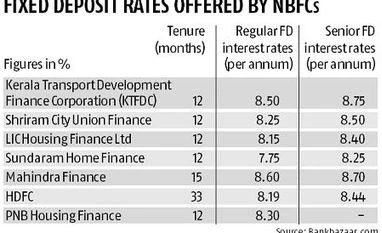
The interest rates are similar to those being offered by many non-banking financial companies (NBFCs). For instance, Bajaj Finance is currently offering 8.75 per cent on their one- to five-year fixed deposits (FDs) for its new customers.
In comparison, State Bank of India, the largest bank in the country, is offering an interest rate of 6.85 per cent for a 5-10-year FD – these are comparable rates, as FDs of over five years get tax benefits under Section 80C, if the limit of Rs 150,000 hasn’t been exhausted.  


However, with similar interest rates being offered by the NHAI bonds and NBFCs, where should investors lock in their money?

Says Hemant Rustagi, chief executive officer, Wiseinvest Advisors: “While the interest rates offered by the NBFCs and NHAI bonds are likely to be comparable, investors must decide, considering other factors such as safety, liquidity, and post-tax returns. Although the NHAI bonds are preferable over NBFC FDs regarding safety, investors may have to compromise on the liquidity during the duration of the bonds, as the secondary market may not provide the desired level of liquidity to them.”

Although FDs of NBFCs have a mandatory lock-in period of three months, you can prematurely withdraw money by paying a penalty in the form of a lower interest rate.

In the case of the NHAI bonds, there will not be any lock-in period, and you will be able to sell these bonds in the secondary market after allotment. However, the market price of these bonds also fluctuates, based on the demands for these bonds in the secondary market and interest rate movement.

Says Dhawal Dalal, CIO-fixed income, Edelweiss MF: “Investors should consider investing in high-quality corporate bonds with the rating of ‘AAA’ and ‘AA+’ and maturing in three to five years.”

The bonds issued by the NHAI are ‘AAA’-rated bonds, which are highly stable and secure. However, experts suggest the investment window should also be taken into account before deciding, as the NHAI are typically long-term deposits, with tenors of up to 10 years.


The NBFCs, on the other hand, typically have one-five year tenors for FDs. Adds Dalal: “Interest rates offered by the capital-starved NBFCs are likely trend up further in the near term to collect money from public issues. Note that raising money through public issues is a relatively costlier way and has limited collection ability of up to Rs 20-30 billion in the current market scenario.”

The interest earned on FDs is fully taxable in the hands of investors. Says Aditya Bajaj, head-investments, BankBazaar.com: “In case of capital gains bonds from the NHAI, the amount invested is exempted from capital gains tax. However, the interest earned on these bonds is liable to income-tax (I-T) based on the I-T slabs of the investor, similar to interest income from the NBFC deposits.”

If the interest earned on FDs is more than Rs 5,000, tax deducted at source is charged at 10 per cent. In case of the NHAI bonds, no tax will be deducted at source. However, if bonds are sold in the secondary market after one year, capital gains will be taxed at 10 per cent (without any indexation benefit).

According to experts, for investors looking for a safer option, without compromising on the returns, the NHAI bonds with 8.5–9 per cent interest across various tenors, expected to be launched in December 2018, would be a better bet, as these are quasi-sovereign bonds. But remember that they have a longer tenor, and could be illiquid. So, you need to look at different factors, including the investment period, the liquidity, and your risk appetite, and not just the interest rate while taking a decision.