A technical group had projected Punjab's female population above the age of 20 to be about 10.261 million in 2021. If Rs 12,000 is given in a year to this population, the outlay would be Rs 12,313.20 crore a year. This means that the outlay on Kejriwal's promise would be little more than that, since the female population aged 18 years and above would be a bit higher.
Now come to SAD's promise. About 5.59 per cent of Punjab's total population was poor in 2015-16, according to the multi-dimensional poverty index of Niti Aayog. This is the only official count on poverty since the Modi government came to power at the Centre in 2014. If this is extrapolated to the Punjab population of 30.34 million in 2020-21, about 1.69 million people of the state will be poor. Now, the average household size in Punjab was a little over five members, according to the 2011 census. This means 339,190 families were poor in Punjab. Assuming all women heads of these families are alive, the total dole-out by SAD to these women at the rate of Rs 2,000 a month would be Rs 814.06 crore a year.
Calculating the cost of Sidhu's announcement is complex as it depends on how one defines homemakers. Sidhu had said those homemakers who do not have jobs and professions to rely on would be given Rs 2,000 a month. Will that include women domestic helps or those who are vendors or who serve as manual workers at construction sites? This is not clear. Also, exact data on Punjab's working women isn't available since official data on employment by National Statistical Organization (NSO) regards even those doing farm jobs and other sundry jobs as employed.
As such, let us take an extreme situation. Let's assume that all the families have one homemaker. In that case, there would be 6.07 million homemakers, which would cost Rs 14,562 crore a year at the rate of Rs 2,000 a month to each of these women. However, some of these women would be employed, and would be excluded from the dole-out. The exact data on that is difficult to find out.
One can assume the dole out would cost anywhere between Rs 814 crore and Rs 12,000 crore a year, depending on which of the three parties comes to power at the Centre.
Now, let us compare these sums to Punjab's education and health budget. The state government has projected to spend Rs 4,662 crore on health and family welfare during the current financial year in its Budget. SAD's promise of Rs 814 crore is just 17 per cent of this budget. But Kejriwal's promise of Rs 12,000 crore (figure rounded off) is 257 per cent of the projected allocation on health and family welfare.
Similarly, the Punjab government has projected to spend Rs 13,652 crore on education, sports, arts and culture for FY'22. It is almost 17 times of what SAD promised to women. However, the allocated sum is a bit higher than what Kejriwal assured women of the state.
It should also be noted that Punjab is a highly indebted state of the country. The budget has projected its debt to be 46.4 per cent of GSDP in 2021-22. As much as Rs 68,828 crore is projected to go for debt servicing in 2021-22, which is 41 per cent of the state's total expenditure, pegged at Rs 1.68 trillion.
Given this context, one can say that cash-doles may cost the exchequer quite a lot if no exclusion is made as Kejriwal has promised, but it may not hit the coffers much if some exclusion is made such as SAD has done in its announcement. If some exclusion is made, the doles may empower the marginalised section without hitting the exchequer much.


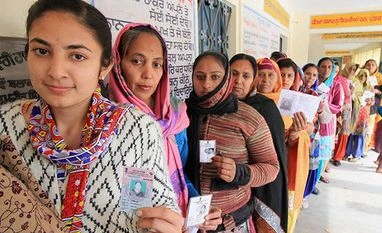 "Women voters wait in a long queue at a polling station to cast their votes for Punjab Assembly elections. Photo: PTI")