


A wild ride for US diplomacy
Stuart E Eizenstat's book is a technocratic endeavour that harks back to an ideal of US diplomacy as a nonpartisan arena
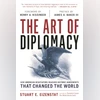 "THE ART OF DIPLOMACY: How American Negotiators Reached Historic Agreements That Changed the World")
THE ART OF DIPLOMACY: How American Negotiators Reached Historic Agreements That Changed the World
By Fintan O’Toole
THE ART OF DIPLOMACY: How American Negotiators Reached Historic Agreements That Changed the World
Author: Stuart E Eizenstat
Publisher: Rowman & Littlefield
Pages: 491
Price: $35
Also Read

When I was growing up in Catholic Ireland, books on moral and theological matters carried, near their title pages, a mark of approval from a local bishop and the phrase “nihil obstat” — a fancy Latin way of saying “all clear.” Stuart E Eizenstat’s book on the major episodes of American diplomacy over the last half-century — from the opening of China to the invasion of Gaza — comes with nihil obstats from the secular equivalent of an entire conclave of cardinals.
It has a posthumous foreword by one former secretary of state, Henry Kissinger, and a preface by another, James A Baker III. It carries gushing blurbs from one former US president (Bill Clinton), three former prime ministers (the United Kingdom’s Tony Blair, Ireland’s Bertie Ahern and Israel’s Ehud Olmert), international luminaries and two further luminaries of US diplomacy, Hillary Clinton and John Bolton. All of them have also been interviewed for their insights.
The book, therefore, harks back to an ideal of US diplomacy as a nonpartisan arena, an essentially technocratic endeavour. Mr Eizenstat is unhappy “when diplomacy is politicised” and he hopes to promote a “vision of bipartisan US leadership.” Yet, if there was ever a time when it was possible to imagine an unpoliticised diplomacy, it is surely long gone. Mr Eizenstat acknowledges, for example, that tackling climate change “will be a supreme test” of America’s global leadership. Whether that test is met depends utterly on which party is in power.
The folly of trying to avoid partisanship is obvious even in Kissinger’s foreword. He provides a brutal summary of his own longstanding intellectual position: In foreign policy, actions do not express “a notion of justice” but are “based on a conception of interests.” This is a false dichotomy. Any sane foreign policy must stem from an understanding that, in a radically interdependent world, global justice is also a vital national interest.
It is especially odd that Mr Eizenstat, who in addition to serving under President Carter is the author of President Carter: The White House Years, mostly evades the obvious clash between the worldview set out by Kissinger and that of his former boss, who insisted as president that US foreign policy “is rooted in our moral values,” except to say that President Carter’s election victory “signalled a shift away from Kissinger’s realpolitik.”
In a hagiographic opening chapter on Kissinger himself, Mr Eizenstat writes that he “presided over some of the greatest triumphs of America’s foreign policy, as well as some of its tragic failures.” The triumphs — especially the opening of diplomatic relations with China and the making of peace between Egypt and Israel — are recounted in vivid and engrossing detail. The tragedies are swept under the thin carpet of an endnote: “For example, Kissinger’s support for Latin American dictators with egregious human rights policies; the massive, deadly, destabilising bombing of Cambodia; continuing the Vietnam War,” and the “support for the Indonesian dictator Suharto’s invasion of East Timor.”
Of Mr Eizenstat’s case studies, the one I know best is the negotiation of the 1998 Good Friday Agreement, which ended the long period of sectarian violence in Northern Ireland known as the Troubles. While his description of the deal-making is broadly accurate, his grasp of the political context is weak. Discrimination against Catholics in Northern Ireland, though systematic, was emphatically not “a form of apartheid in all but name.”
Bizarrely, he further claims that Irish American politicians, including Senator Edward Kennedy, “weighed in against US involvement” in the peace process. As one of his own endnotes seems to acknowledge, the precise opposite happened. Perhaps, in trying to span such a range of situations, from Vietnam and the former Yugoslavia to Angola and Afghanistan, Mr Eizenstat has spread himself too thin.
He even tries to bring the book up-to-date by adding quick (and insightful) thoughts on the Gaza crisis. He hails the success of the Trump administration’s brokerage of a package of deals between Israel and the United Arab Emirates, Bahrain, Morocco and Sudan. This agreement (known as the Abraham Accords) has, he writes, “transformed Israel’s position in the Middle East and the future of the peace process, integrating Israel in the region for the first time.” Immediately after this, in a short section on the Hamas atrocities of October 7, he writes that “Israel’s response has impeded its further integration in the region.” These terrible events make his overly optimistic conclusions about the efficacy of constricted bargains less persuasive.
Being sharp on the mechanics of negotiations but hazy on the wider political environments is perhaps an occupational hazard of Mr Eizenstat’s search for a notion of depoliticised diplomacy. The mechanics matter but, as the horrific events in Israel and Gaza remind us, deal-making is not an art that can be practised successfully in isolation from much larger political and moral imperatives. A more reflective and supple account of US diplomacy would pay much more attention to the complex and sometimes tragically contradictory relationship between those two activities.
The reviewer is a columnist at The Irish Times. © 2024 The New Times News Service
Topics : BOOK REVIEW Book reading books diplomacy
Don't miss the most important news and views of the day. Get them on our Telegram channel
First Published: Jun 03 2024 | 9:36 PM IST