


Furious Minds: The MAGA intellectuals and the rise of extremist ideas
How ideas that used to be the arcane obsessions of nerdy young men and buttoned-up tenured professors have become 'an engine and accelerant' for extremism
 "book review")
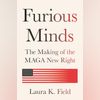
FURIOUS MINDS: The Making of the MAGA New Right
Listen to This Article
FURIOUS MINDS: The Making of the MAGA New Right
By Laura K Field
Published by
Princeton University Press
406 pages $35
Also Read

 "The Forgotten Indian Prisoners of World War II: Surrender, Loyalty, Betrayal and Hell By Gautam Hazarika")
 "Donald Trump, Trump")
 "Donald Trump, Trump")
 "PM Modi, Donald Trump")
 "White House plaques")
But a year into a second Trump term, those “Trumpy intellectuals” are wielding palpable influence, even if it has been obscured by President Donald Trump’s total lack of interest in the world of ideas. As Ms Field explains in her fascinating and important new book, what’s notable is how swiftly some esoteric theories have helped to radicalise the MAGA movement. During the early 1960s, the historian Richard Hofstadter described anti-intellectualism as a phenomenon that was more pronounced on the far right. Ms Field would mostly agree. In the United States, she says, conservative intellectuals were once largely an ameliorating force, acting as a “brake and restraint” on some of the right’s uglier impulses (bigotry, misogyny). Now, bizarre, “galaxy-brained” ideas that used to be the arcane obsessions of nerdy young men and buttoned-up tenured professors have become “an engine and accelerant for extremism.” Ms Field borrows a vivid analogy from the Christianity scholar Matthew Taylor’s book The Violent Take It by Force: The fringe has become the rug.
Having written extensively about the New Right for outlets like The New Republic and The Bulwark, Ms Field knows her subject well. She is a political theorist who studied with professors inspired by the 20th-century political philosopher Leo Strauss — a totemic figure among conservative thinkers for his embrace of the ancients and his refusal of moral relativism.
Ms Field divides the figures in Furious Minds into three main groups: The “Claremonters,” who are associated with the Claremont Institute in California and “idolize the American founding”; the “Postliberals,” who want to curb individual rights in favour of what they vaguely define as “the common good”; and the “National Conservatives,” who endorse a homogenous nation-state and often embrace elements of Christian nationalism.
Ms Field also identifies another, more amorphous, group as part of this New Right: a “Hard Right Underbelly” that draws from (and fuels) the other three. Figures in this last group adopt aggressively silly nicknames like “Raw Egg Nationalist” (who has a PhD from Oxford) and “Bronze Age Pervert” (who has a PhD from Yale). They are extremely online and promote a hypermasculinist aesthetic; some of them, she notes, are openly racist and fascist.
What all these groups share is a hatred of liberalism — defined not as a partisan political ideology that is left-wing (though they hate that too), but as a system of government that values individualism and pluralism. Postliberals like Patrick Deneen, a political theorist whom Ms Field credits with “the most palatable, sanitized version of Trumpy populism that one is likely to encounter,” started out by criticising a liberal establishment composed of mainstream centrists in both parties.
Deneen and his fellow postliberals have insisted that this liberal establishment, despite its claims of open-mindedness, is overweening and tyrannical. Ms Field suggests that these thinkers’ fury stems from being immersed in a milieu — as the highbrow postliberals often are — of “insular academics and elites.” Within that context, “conservatives who complain about liberal intolerance have a point.”
There was a time when such critiques were undeniably bracing — and some liberals, despite the postliberal slur against them as blithe and uncaring, were apparently willing to listen. Barack Obama, still a bugbear among the MAGA faithful, even included Deneen’s Why Liberalism Failed (2018) on one of his annual reading lists.
But for some of Deneen’s right-wing peers, his critique of liberalism didn’t go far enough. Ms Field details the strange call-and-response between Deneen and Adrian Vermeule, a constitutional scholar at Harvard Law School, who in a review of Why Liberalism Failed encouraged Deneen to offer a more ambitious political programme. Deneen obliged, publishing Regime Change in 2023, in which he envisioned a “self-conscious aristoi” and the conservative masses joining forces in an “overthrow of a corrupt and corrupting liberal ruling class.”
Ms Field is an excellent and intellectually honest guide to these self-styled egghead brawlers. She takes them seriously, reading their texts closely, “trying my best to give their ideas a fair shake, and assuming a degree of good faith.” But her sympathetic approach cannot avoid showing how even the most diligent far-right intellectuals eventually succumb to apocalyptic despair, replacing the hard work of thinking and reflecting on the world — in all of its pluralism and plenitude — with a reflexive embrace of coercive political power.
She is unsparing when enumerating the deficits of liberal rationalism — the faith in technocratic solutions to political problems, the tendency to dodge big existential questions, the blind spots when it comes to potent emotions like anger and enmity. But she also reminds the intellectuals of the New Right of something they all too easily forget: They can indulge in fantasies of an authoritarian regime because of the freedom and security afforded by the liberal democracy they loathe.
Ms Field detects a strain of decadence underlying the fanaticism, with soft, comfortable men mistaking cruel titillation for insight and trying their mightiest to look tough: “It is unseemly, and it is unmanly, and some of you will miss your liberalism when it’s gone.”
The reviewer is the nonfiction book critic for The Times. ©The New York Times News Service
More From This Section
 "Finding My Way")
 "The Case for American Power")
 "Dark Squares: A cult leader, a child prodigy, and the chess revolution")
 "The Caste Con Census")
 "The Serpent's Tale: Kundalini, Yoga, and the History of an Experience")
Don't miss the most important news and views of the day. Get them on our Telegram channel
First Published: Dec 18 2025 | 10:13 PM IST