


AP Budget 2026: ₹53,915 cr for public capex highest in state's history
The government has positioned infrastructure as a multiplier for private investment, job creation and long-term productivity growth, moving beyond consumption-led spending towards asset creation
 "Andhra Pradesh Budget 2026")
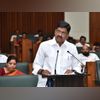
Andhra Pradesh Finance Minister P Keshav. (X/@P Keshav)
Listen to This Article
The Andhra Pradesh government on Saturday presented its Budget 2026, marking a decisive shift towards infrastructure-driven economic expansion while maintaining tight fiscal discipline.
With total receipts and expenditure both estimated at ₹3.32 trillion, the state has balanced growth ambitions with financial stability, reinforcing investor confidence in the state’s long-term development trajectory.
The centrepiece of the Budget, presented by Finance Minister P Keshav, marks a decisive shift towards infrastructure-driven economic expansion while maintaining tight fiscal discipline. is a major expansion in public capital expenditure, which has been raised to ₹53,915 crore, one of the highest levels in the state’s history. This large-scale investment is designed to accelerate economic activity across transport networks, irrigation systems, energy infrastructure, urban development and industrial corridors.
The government has clearly positioned infrastructure as a multiplier for private investment, job creation and long-term productivity growth, moving beyond consumption-led spending towards asset creation that strengthens the state’s economic backbone.
A significant share of the capital push is being channelled into future-facing sectors. The energy sector alone has been allocated ₹13,934 crore, reinforcing Andhra Pradesh’s ambition to become a clean energy powerhouse. Connectivity and logistics - covering roads, ports and airports - will receive ₹13,546 crore, strengthening supply chains and export competitiveness. The development of Amaravati as the people’s capital has been backed with ₹6,000 crore, alongside major funding for industrial promotion, MSMEs and digital infrastructure, including the Quantum Valley initiative. Together, these investments are aimed at positioning the state as a hub for advanced manufacturing, deep-tech industries and global trade flows.
Also Read

 "Chandrababu Naidu, Andhra CM")
 "Piyush Goyal, Piyush")
 "Nitin Gupta, CEO, Attero Recycling")
 "RBI")
 "AP Inter Hall Ticket 2026")
Even as spending rises sharply, the Budget reflects strong progress in fiscal management. The revenue deficit has been brought down to 1.11 per cent of GSDP, a steep improvement from previous years, while the fiscal deficit stands at 3.84 per cent of GSDP and the primary deficit at 1.95 per cent. These numbers signal a steady return to sustainable public finances without compromising on development priorities. At the same time, the state’s economy continues to expand at a robust pace, with GSDP projected to reach ₹19.75 trillion in 2026–27, underscoring Andhra Pradesh’s position as one of India’s faster-growing regional economies.
The Budget makes a strong case for people-first growth by substantially increasing allocations to education, healthcare and skilling. Nearly ₹35,000 crore has been earmarked for school and general education, while the medical and health sector will receive over ₹19,000 crore.
Significant funding has also been provided for scholarships, mid-day meals, higher education and skill development programmes, creating a pipeline of industry-ready talent. The government’s approach links social investment directly with economic competitiveness, ensuring that Andhra Pradesh’s workforce is prepared for emerging sectors such as clean energy, digital services and advanced manufacturing.
Recognising the central role of agriculture in inclusive development, the 2026–27 Budget channels large resources into irrigation, farmer income support and climate resilience. Over ₹9,900 crore has been allocated for major irrigation projects outside Polavaram, while the Polavaram Project itself receives ₹6,105 crore. The Annadata Sukhibhava scheme continues to support farmers’ incomes, complemented by crop insurance and price stabilisation mechanisms. These investments aim to stabilise rural livelihoods, enhance productivity and protect farmers against market and climate risks, while integrating agri-tech and modern infrastructure into the farm economy.
Rather than treating welfare as standalone spending, the Budget integrates social protection within a broader development model. Large allocations have been made for NTR Bharosa and other social security schemes, housing programmes, healthcare missions and women-centric economic initiatives. The approach focuses on targeted support for vulnerable sections while simultaneously expanding opportunities through infrastructure, employment generation and skill development. This balanced model seeks to combine social equity with long-term economic sustainability.
The Budget aligns closely with the state’s long-term Swarna Andhra @2047 vision, which aims to transform Andhra Pradesh into a high-income, globally competitive economy by India’s centenary year of independence. The strategy rests on infrastructure-led wealth creation, deep-tech adoption, world-class logistics, human capital excellence, sustainable agriculture and clean energy leadership. Each major spending decision in the Budget has been mapped to these long-term goals, signalling policy continuity and strategic clarity for investors and development partners.
More From This Section
 "Budget 2026, Budget, Nirmala Sitharaman, Nirmala")
 "Nirmala Sitharaman, Nirmala")

 "Nirmala Sitharaman, Nirmala")
 "Nirmala Sitharaman, Nirmala")
Don't miss the most important news and views of the day. Get them on our Telegram channel
First Published: Feb 14 2026 | 4:04 PM IST