


Harrier.ev in driver's seat as Tata Motors eyes 50% market share in EVs
Electric PV market expected to grow by over 50% in FY26; company yet to disclose full price range of Harrier EV
 "Harrier EV car")
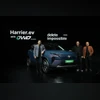
The Harrier EV, aggressively priced with a starting price of Rs 21.49 lakh, is expected to compete with Mahindra & Mahindra’s XUV 9e, which starts at Rs 21.9 lakh.


Listen to This Article
Electric passenger vehicle (PV) market leader Tata Motors is betting on its new off-roader electric high-sport utility vehicle (SUV), the Harrier.ev, and other interventions in the entry- and mid-level electric vehicle (EV) segments to sustain over a 50 per cent share of India’s 100,000-unit EV market, which is expected to grow by over 50 per cent in 2025-26 and cross the 150,000-unit mark.
Meanwhile, the company said it does not face any immediate crisis from the rare-earth metals supply disruption in China.
The Harrier.ev, priced aggressively at ₹21.49 lakh (starting price), is expected to take on Mahindra & Mahindra’s (M&M’s) XUV 9e, which starts at ₹21.9 lakh.
Speaking to Business Standard, Tata Motors Passenger Vehicle and Tata Passenger Electric Mobility Managing Director Shailesh Chandra said the SUV segment has grown over the years to now command 55 per cent of the PV market, and within this, the high-SUV segment (vehicles priced over ₹20 lakh) accounts for around 25,000 units a month.
This is a sizeable segment and attracts more sophisticated customers — mostly upgraders from earlier cars — who are looking for better performance, quality, and new technology in their vehicles.
Also Read

 "Howard Lutnick, Trump's Commerce nominee")
 "tree")
 "IPL 2025 Final RCB vs PBKS highlights")
 "Orange cap winners list")
 "Full list of IPL winners over the years")
Chandra said that in the overall EV market, entry-level EVs priced below ₹12 lakh (Tiago, etc.) sell around 3,500–4,000 units a month, while midsize EVs (Punch, Nexon, etc.) sell around 6,000 units a month. The Punch straddles the entry and midsize segments, typically offering a 300–400 km range. This segment sees the highest volumes and intense competition, as these vehicles double up as city cars and are capable of intercity drives.
Then comes a new category of high SUVs as EVs, in which the Harrier has been positioned. According to Chandra, this segment could break barriers to EV adoption.
“New customers who haven’t considered EVs so far will come into the fold due to fast charging (Harrier EV, for example, can add 250 km of range in 15 minutes), longer range (500–600 km) — comparable to any internal combustion engine (ICE) vehicle — and thus EVs will become more mainstream,” he said.
Tata Motors has been facing stiff competition from players like JSW MG Motor India and M&M in recent months, and its market share has dropped from over 70 per cent to 55.4 per cent in 2024–25.
According to Vahan data, Tata Motors’ EV market share in the first two months of 2025-26 (FY26) is around 37.9 per cent, down 13.8 percentage points year-on-year. M&M and MG are close behind, with 24.4 per cent and 31.2 per cent shares, respectively.
Chandra said he remains optimistic that FY26 will be their best yet.
“The industry might grow by over 50 per cent, and we are entering a new segment that should give us more volumes. We’re also addressing challenges in existing segments from last year, and this should help us grow as well,” he said, adding that the goal is to maintain a 50 per cent market share in EVs in the mid to long term.
Asked whether Tata Motors will focus on exports as domestic competition intensifies, Chandra said exports will be a mid- to long-term focus, but the immediate priority is improving the value proposition of existing products, including entry-level EVs. The plan is to expand the entry-level market from 3,500 to 6,000 units a month.
“We are also working on the fleet segment to make it competitive with the value proposition of the compressed natural gas (CNG) segment,” he added. After the end of FAME or Faster Adoption and Manufacturing of (Hybrid) and Electric Vehicles subsidies, Tata Motors saw a sharp decline in fleet sales, which once made up nearly 20 per cent of its EV volumes.
The Harrier.ev, which comes loaded with features like a 540-degree surround view, transparent mode, blindspot view, digital key (via smartwatch or phone), auto-park assist, and summon mode, will be produced at the company’s Pune plant.
While Chandra did not share production targets, he said they are prepared for a rapid ramp-up if needed. He does not expect the Harrier EV to cannibalise sales of the Harrier ICE version.
“We’ve seen success with a multi-powertrain strategy in other products. For example, the Punch ICE launched in 2021 sold 8,000 units a month. With the EV and CNG variants added, we now sell 16,000 units a month. So the segment expands — and that’s how I see this,” he said. He believes EVs could achieve double-digit penetration in the high-SUV segment in the coming quarters.
More From This Section
 "Gensol Engineering")
 "Through iSight, employees can share feedback and insights about HUL's products, their placement, market trends and observations in the marketplace. They can also include suggestions made by family and friends.")
 "adani")
 "Sun Pharma")
 "Reliance Q4FY25 earnings preview, RIL Q4 2025 results date, Reliance Industries analyst estimates, RIL consolidated revenue forecast, Reliance net profit estimate Q4FY25, Reliance Retail EBITDA forecast, retail sector")
Topics : Tata Harrier EV push EV policy
Don't miss the most important news and views of the day. Get them on our Telegram channel
First Published: Jun 03 2025 | 8:02 PM IST