


India-US trade deal: Why Trump's $500-billion export claim raises doubts
Donald Trump's claim that India will buy $500 billion of US goods under a new trade deal dwarfs current trade flows and follows a familiar pattern from his earlier negotiations
 "Modi Trump")
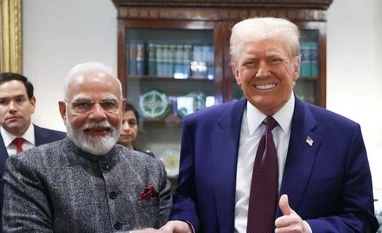
Prime Minister Narendra Modi with US President Donald Trump. (Photo: X/@NarendraModi)
Listen to This Article
US President Donald Trump’s claim that India will buy $500 billion worth of American energy, agricultural products, coal and other goods under a newly announced trade deal has triggered sharp questions about the arithmetic behind the statement.
The fine print of the deal has not yet been released by either side. India has also not publicly confirmed any such purchase commitment. Yet Trump’s assertion, repeated by members of his administration, dwarfs the scale of existing US–India trade and fits a familiar pattern from his earlier negotiations with allies such as Japan and South Korea.
What has Donald Trump claimed about India’s purchases?
Announcing the deal on Monday, Trump said India had agreed to buy more than $500 billion worth of US goods, spanning energy, agriculture, coal and other products. He framed the agreement as part of a broader reset in trade ties after the US imposed higher tariffs on Indian exports earlier this year.
The White House has not released a detailed fact sheet outlining timelines, sectoral breakdowns or enforcement mechanisms for the purchase commitment. While Prime Minister Narendra Modi and other central ministers have welcomed the reduction in US tariffs on Indian goods, they have not commented on any $500-billion import pledge.
Why does the maths behind the claim look implausible?
The scale of Trump’s claim stands in stark contrast to existing trade data. According to the Office of the United States Trade Representative, US goods exports to India were valued at $41.5 billion in 2024. Services exports, which include sectors such as IT, financial services and travel, were $41.8 billion that year. Combined, total US exports to India were about $83 billion. In 2025, US goods exports to India stood at roughly $42 billion until November.
Also Read

 "Piyush Goyal, Piyush")
 "qatar")
 "Anil Ambani")
 "Car scrapping")
 "Life Insurance Council, Insurance")
Against this backdrop, a $500-billion purchase commitment represents a quantum leap. It is more than twelve times the value of annual US goods exports to India and about six times total goods and services exports combined.
Even if the figure is meant to be spread over several years, the implied growth remains extraordinary. A ten-year timeline would still require India to import around $50 billion of US goods annually, a level higher than current total US exports to India across all categories.
India’s total annual goods imports from all countries are in the range of $700–750 billion, according to Commerce Ministry data. In FY25, India’s merchandise imports stood at $720.24 billion.
A $500-billion commitment to a single country would mean the US capturing a dominant share of India’s import basket, displacing suppliers across energy, agriculture, manufacturing and minerals. Even if the imports are staggered over five or ten years, such a commitment would still imply the US securing the largest share of India’s total merchandise imports.
Why agriculture and energy pose the biggest hurdles
In agriculture, the challenge is even sharper. US Agriculture Secretary Brooke Rollins said the deal would unlock India’s “massive market” for American farmers and help reverse the US agricultural trade deficit with India.
US exports of farm products to India have historically been modest, partly due to India’s high tariffs and non-tariff barriers designed to protect domestic farmers. Expecting India to absorb tens of billions of dollars of US farm goods would require sweeping domestic policy changes, which would likely face political resistance.
In a LinkedIn post, Global Trade Research Initiative founder Ajay Srivastava said Trump claims India will eliminate tariffs and non-tariff barriers on all US products, but no product list, timelines or legal text are available.
“Sensitive sectors like food grains, regulatory imports, and agriculture have historically been excluded from liberalisation in trade talks,” he said.
On the $500-billion export claim, Srivastava added: “India currently imports under $50 billion worth of US goods annually. A leap to $500 billion would require sustained growth over many years — suggesting this is likely a long-term aspiration, not a binding commitment.”
Is pressure part of Trump’s negotiating style?
Trump’s claim also needs to be viewed through the lens of his negotiating approach.
During his earlier presidency, Trump frequently used tariffs and trade threats to force partners into headline-grabbing commitments. These deals often relied on large, round-number pledges that sounded transformational but were loosely defined.
In talks with South Korea, the Trump administration pressed Seoul to commit to a massive $350 billion investment package in the United States, effectively a promise to “buy American” on a grand scale. US Commerce Secretary Howard Lutnick bluntly warned that “the Koreans either accept that deal or pay the tariffs”. In January 2026, Trump again raised the tariff rate back to 25 per cent because Seoul has not yet ratified a trade framework deal agreed in 2025 that was meant to cap US levies at 15 per cent.
In Japan’s case, Trump announced a $550-billion investment commitment, presenting it as a victory for American workers even though the timeline and binding nature of the pledge remained unclear.
In both cases, the strategy followed a pattern: apply pressure through tariffs, extract a large numerical commitment, and frame it as a political win at home.
What happens next for the India–US trade deal?
While Trump has said that India would reduce tariffs to “zero”, New Delhi may substantially lower tariffs on industrial and agricultural goods while continuing to protect sensitive sectors.
Commerce and Industry Minister Piyush Goyal on Tuesday reassured that India has protected its sensitive agriculture and dairy sectors in the US trade deal. Even US Trade Representative Jamieson Greer said that India, like every country in the world, has some protection around certain key areas.
The key missing piece, however, remains the text of the agreement. Until details are released, uncertainty will continue to surround Trump’s claims.
More From This Section
 "India US trade deal")
 "smartphone manufacturing, PLI Scheme")
 "Finance Commission")
 "Piyush Goyal")
Topics : Donald Trump India US Trade Deal US India relations Trade deal agriculture in India BS Web Reports
Don't miss the most important news and views of the day. Get them on our Telegram channel
First Published: Feb 04 2026 | 10:56 AM IST