


PM Modi holds talks with Namibia President; digi tech, defence in focus
Lula backs India's push to expand Mercosur trade pact
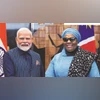 "PM modi with Namibia prez")
PM Modi was given Namibia's highest civilian award on Wednesday. | Photo: PTI


Listen to This Article
Prime Minister (PM) Narendra Modi’s discussions with Namibian President Netumbo Nandi-Ndaitwah on Wednesday in Windhoek, the capital of the mineral-rich southern African country, were slated to focus on increasing bilateral cooperation, especially in the exploration, processing, and supply of critical minerals, including rare earth elements.
The PM landed in Windhoek on Wednesday morning. It was the first visit to Namibia by an Indian PM in 27 years and also the final port of call on his five-nation tour. Modi’s discussions with the leadership of Ghana, Argentina, and Brazil — countries he visited during his longest foreign trip since 2015 — had also focused on expanding India’s import of critical minerals. He also visited Trinidad and Tobago.
“Cooperation in areas such as digital technology, defence, security, agriculture, healthcare, education, and critical minerals figured prominently in our discussions,” Modi said in a post on social media after he met with Ndaitwah. “We also discussed how to boost linkages in trade, energy, and petrochemicals. Expressed gratitude for the assistance from Namibia in Project Cheetah,” he added.
It was also announced that Namibia will roll out the Unified Payments Interface (UPI) later this year. The UPI technology licensing agreement was signed between the National Payments Corporation of India and the Bank of Namibia in April last year. ALSO READ: Trump's Brics tariff warning puts India-US trade deal on shaky ground
After concluding his participation in the Brics Summit in Rio de Janeiro, the PM held discussions with Brazilian President Luiz Inácio Lula da Silva in Brasília on Tuesday. India’s Ambassador to Brazil, Dinesh Bhatia, told the media in Brasília after the talks: “Given India’s interest in critical minerals and also rare earth elements, we were told that Brazil is coming up with a new policy in the second half of this year, and that will open up many more opportunities for India and Indian companies in particular.”
Also Read

 "cisco, Cisco Systems")
 "tax")
 "fossil fuel, gas, lpg, pipes")
 "Vietnam's Ambassador to India Nguyen Thanh Hai (left) with Naresh Pachisia, Bharat Chamber of Commerce president, at an event in Kolkata on Monday.")
 "India US trade deal, India US trade surplus, India trade with US, US-India economic relations, trade deficit USA, mutually beneficial trade deal, US trade concerns India, America First trade policy, India imports from US, US exports to India, Indo-US")
In a joint statement, the two sides emphasised the importance of critical minerals for economic development, national security, and clean energy technologies. Modi and Lula welcomed collaboration between public and private companies from both countries to strengthen supply value chains and global competitiveness in mineral exploration, mining, beneficiation, processing, recycling, and refining of critical minerals.
India and Brazil signed six agreements, including on the exchange of information in the security domain, agricultural research, and renewable energy. At their joint press briefing in Brasília, Modi described his “friend” Lula as the “chief architect” of the strategic partnership between India and Brazil.
The two leaders set a goal of increasing bilateral trade to $20 billion over the next five years. India’s trade with Brazil is its largest among Latin American nations but still falls short of Brazil’s trade volumes with China, the US, Argentina, and Germany.
India-Brazil bilateral trade had reached $16.6 billion in 2022–23, but following the drop in oil and gas prices, it is now around $12.2 billion. Both countries are wary of the tariffs that US President Donald Trump has threatened to impose and are looking beyond America for markets for their respective produce. However, Indian officials said there was no discussion on Trump’s comments during the Modi–Lula meeting.
To increase bilateral trade, the two leaders agreed to set up a ministerial-level mechanism to discuss trade and commercial matters. At India’s request, President Lula conveyed Brazil’s support for the expansion of the India–Mercosur Preferential Trade Agreement and instructed his team to work towards such an expansion. Brazil currently chairs Mercosur, the six-member Latin American trade bloc.
Modi and Lula instructed their respective authorities to identify and address existing non-tariff barriers in bilateral trade. Lula said a Brazilian delegation will visit India to explore trade opportunities.
The leaders also discussed cooperation in defence and security, health and pharmaceuticals, space, renewable energy, agriculture and food processing, and energy security. Officials said they also explored new areas of collaboration, including critical minerals, emerging technologies, artificial intelligence, and supercomputing.
In a joint statement, Modi and Lula called on the international community to ensure that agricultural trade is not undermined by unilateral restrictions or protectionist measures introduced under the pretext of environmental, security, or climate concerns while respecting an open, fair, transparent, inclusive, equitable, non-discriminatory, and rules-based multilateral trading system, with the World Trade Organization at its core. They did not mention the US by name.
In the pharmaceutical sector, 15 large Indian pharmaceutical companies are already present in Brazil; several of these are manufacturing within the country, Bhatia said. The two leaders stressed not only the export of medicines from India but also collaborations to manufacture drugs in Brazil. Brazil proposed that the joint committee, which includes pharmaceutical regulators from both countries, review the licensing mechanism together.
India also requested faster approvals for medicines entering the Brazilian market that have already been cleared by the US Food and Drug Administration or the European Directorate for the Quality of Medicines & Healthcare. Indian officials said they are keen to learn from Brazil’s experience in mandating flexible fuel content and its regulatory approach.
Indian officials added that the Brazilian delegation specifically mentioned importing rice from India. “There are times when the crops here produce less than expected in a particular season. At those times, the output needs to be augmented by importing from elsewhere,” Secretary in the Ministry of External Affairs P Kumaran said.
More From This Section
 "Coal")
 "RBI, Reserve Bank of India")
 "US President Donald Trump")
 "veg thali food plate chef restaurant")
 "pharma")
Topics : Narendra Modi trade imports Exports
Don't miss the most important news and views of the day. Get them on our Telegram channel
First Published: Jul 09 2025 | 9:25 PM IST