


"Homebuyers disappointed": Supreme Court questions RERA effectiveness
The Supreme Court on Thursday said it is high time all states rethought the constitution of the real estate regulatory authority (RERA) as the institution is doing nothing, except facilitating default
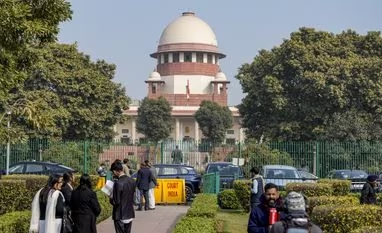 "Supreme Court, SC")
A bench of Chief Justice Surya Kant and Justice Joymalya Bagchi said the people for whom RERA was created were "completely depressed, disgusted and disappointed" and asserted that it won't mind if the institution was abolished.
Listen to This Article
In a strong observation that could worry homebuyers, the Supreme Court on Thursday questioned whether Real Estate Regulatory Authorities (RERA) across states are truly serving the people they were created to protect.
The remarks came during a hearing related to the shifting of the Himachal Pradesh RERA office from Shimla to Dharamshala — but the court’s comments went far beyond the administrative issue and focused on the larger functioning of RERA.
What the case is about:
This case began after the Himachal Pradesh government decided in June 2025 to shift the state Real Estate Regulatory Authority (RERA) office from Shimla to Dharamshala, saying the move was an administrative step to decongest Shimla and support development in other cities. The Himachal Pradesh High Court stayed this decision, but the state challenged the order in the Supreme Court. The Supreme Court has now allowed the government to shift the office for the time being, while clarifying that the final outcome will depend on the High Court’s decision in the pending case.
During the hearing, however, the Supreme Court made strong observations about the functioning of RERA authorities across states. The bench said many homebuyers feel “depressed, disgusted and disappointed” because they are not getting effective relief from RERA. The judges also remarked that in some places the authority appears to be “facilitating defaulting builders” rather than protecting buyers, and questioned the practice of appointing retired bureaucrats to such bodies without domain expertise.
Also Read

 "The Supreme Court criticised RERAs for failing homebuyers, set aside a High Court stay, and allowed Himachal Pradesh to shift the RERA headquarters from Shimla to Dharamshala | Illustration: Binay Sinha")
 "SC, Supreme Court")
 "SC, Supreme Court")
 "Jairam Ramesh, Jairam")
 "Air India Crash, Ahmedabad plane crash")
The court also addressed practical concerns about access to justice, noting that most real estate projects and complaints in Himachal Pradesh are located around Shimla. To reduce inconvenience to people affected by RERA orders, the court suggested shifting appellate powers to a district court in Dharamshala if the office relocation proceeds. Overall, while the case is technically about relocating a state RERA office, it has drawn attention to broader concerns about how effectively RERA institutions are working for homebuyers.
Why the Supreme Court is concerned
A bench led by the Chief Justice said that, instead of protecting homebuyers, RERA in some cases appears to be “facilitating defaulting builders.”
The court also noted that many people who approach RERA are “depressed, disgusted and disappointed” due to delays in relief and ineffective enforcement.
For homebuyers, this is significant because RERA was created to:
- Protect buyers from project delays and fraud
- Ensure transparency in real estate projects
- Provide faster dispute resolution
- hold developers accountable
The court’s observations suggest that these goals may not be fully met in practice.
What this means for homebuyers
For ordinary property buyers, the issue is not about the location of an office — it’s about how effectively complaints are resolved.
Many homebuyers rely on RERA when:
- possession of a flat is delayed
- refund claims are stuck
- builders change project plans
- promised amenities are not delivered
If the dispute-resolution mechanism becomes slow or ineffective, buyers are often forced to approach courts — which can mean longer legal battles and higher costs.
Concerns about appointments and structure
The Supreme Court also questioned how RERA bodies are staffed, suggesting that some authorities may have become “rehabilitation centres” for retired officials, rather than expert regulatory institutions.
The court indicated that domain experts — such as urban planners or architects — may be better suited to help shape real estate regulation and planning decisions.
The bigger picture
RERA was introduced in 2016 to restore trust in India’s real estate sector after years of project delays and developer defaults. It significantly improved transparency by mandating project registration, escrow accounts, and disclosure norms.
However, implementation has varied widely across states. The court’s comments highlight growing concerns about:
- delays in complaint resolution
- weak enforcement of orders
- uneven regulatory capacity across states
What homebuyers should take away
If you are planning to buy property:
- Check whether the project is registered with RERA
- Review the developer’s track record
- Keep all agreements and payment records documented
- Track complaint timelines if you approach RERA
- Understand escalation options if orders are not enforced
More From This Section
 "Smallcap mutual funds, mutual funds")
 "Nirmala Sitharaman, Nirmala")
 "transfer pricing provisions, associated enterprise definition, draft Income Tax Bill 2025, beneficial ownership tax rule, intra-group transactions India, house property income taxation, pre-construction interest deduction, Income Tax Act associated e")
 "smart kitchens")
 "Car Loan, Family, Loan")
Topics : Supreme Court
Don't miss the most important news and views of the day. Get them on our Telegram channel
First Published: Feb 13 2026 | 11:08 AM IST