


H-1B visa has lost relevance after Covid, Piyush Goyal explains why
Commerce minister says Indian firms no longer press for more US work visas as remote work and GCCs reshape hiring
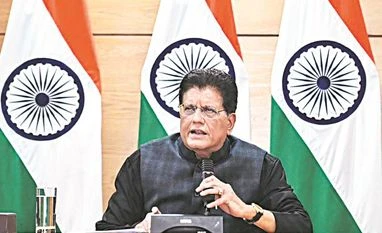 "Piyush Goyal")
Piyush Goyal, Union Commerce and Industry Minister
Listen to This Article
Commerce minister Piyush Goyal on Sunday said the H-1B visa had lost much of its relevance after the Covid-19 pandemic. “Global businesses no longer depend on moving large numbers of Indian engineers to the United States,” he said.
Speaking during separate discussions on US-India trade issues with NDTV and CNBC, Goyal said the world of work had changed and Indian companies were no longer pressing the government to negotiate for more H-1B visas.
“The H-1B visa story had gradually deteriorated into a lottery. So if I needed two H-1B visas, I would calculate that one out of seven are going to get it. I would apply for 15 and hope to get two out of those. Gradually, the process had gone down to that level, post-Covid,” he said, describing how firms coped with uncertainty in the programme.
What is the H-1B visa and why Indians dominate
The H-1B visa is a temporary US work visa for highly skilled professionals, allowing American firms to employ foreign nationals in specialised roles. Indians have historically been the biggest beneficiaries, accounting for more than 70 per cent of approvals in recent years.
Also Read

 "Jimmy Lai")
 "Ajit Doval")
 "Delhi Winter, New Delhi Winter, Winter, Cold, Smog, Delhi Pollution, Delhi Air Quality, Pollution")
 "markets, stock markets, indian stock markets")
 "Winter, India Weather, Punjab winter")
Asked whether tighter US restrictions on the H-1B programme had featured in trade talks, Goyal said the issue had not been discussed with his American counterparts.
“I have not heard any company, absolutely any company, come to me and ask me to talk to the US or try to negotiate for more H-1B visas. The world has changed today,” he said.
Why Indian industry is not worried
He added that conversations with Indian industry suggested little anxiety about the recent tightening of the visa regime.
“I had discussed with our Indian industry, and they really do not seem to be perturbed at all about the restrictions on H-1B. They are very confident that wherever they require it, they will get it,” Goyal said.
Some companies, he noted, believed the changes could even work in their favour.
“In fact, some people also told me it will actually become better, because a lot of the fringe applications will go out, and really serious players will now be looking for entry of their people into the US to serve high-tech products and high-tech requirements,” he said.
How remote work and GCCs changed the equation
Goyal said the rise of remote working had reduced the need to physically relocate staff to high-cost economies.
“Personally, I think H-1B lost its significance significantly post-Covid, when we all saw that working from home, we could do a lot of work,” he said, linking the shift to the growth of Global Capability Centres (GCCs) in India.
According to the minister, more than 1,800 GCCs are now operating across the country, allowing multinational firms to deliver services offshore while creating jobs locally.
“Almost 1,800 GCCs now operate in India. Large corporations recognise that you could as well do the same work from any other offshore location instead of getting people into very high-cost economies like the US or the UK,” he said.
Why this works in India’s favour
He said this trend was beneficial for India because professionals remain based at home.
“The people stay in India with their families. They earn in India. They pay taxes in India. They spend in India, adding to our economy and economic activity. They save in India, invest in India, and we also earn foreign exchange,” Goyal said.
He contrasted income levels to underline the cost gap. “Rather than struggling to take people from India to the US and then pay them top-dollar salaries because the cost of living in the US at $90,000 per capita income versus $3,000 per capita income in India are humongously high,” he said.
What changed in the H-1B programme
From late September 2025, the Trump administration rolled out a series of measures that reshaped how H-1B visas are issued, with a sharp impact on Indian professionals.
A presidential proclamation effective September 21, 2025 made it mandatory for most new H-1B petitions to include a $100,000 payment from the employer before processing. Earlier, total fees were usually limited to a few thousand dollars.
The higher fee applies only to petitions filed after the proclamation. Existing H-1B holders and renewals approved before the change are not subject to the additional cost.
The steep increase has raised the overall expense of hiring skilled workers from overseas. Critics say it discourages international recruitment, while supporters say it protects domestic jobs.
How the new selection system works
The traditional lottery has been replaced with a wage-weighted selection process. Under the updated system, effective for the 2027 visa season starting February 2026, applicants with higher wage offers receive more chances of selection than lower-paid candidates.
This favours senior and highly paid roles, while reducing opportunities for early-career professionals and recent graduates.
Why vetting has become tougher
Procedural changes have also introduced enhanced scrutiny in the adjudication process. Internal guidance has expanded background checks and vetting for certain applicants, contributing to longer processing times and greater uncertainty.
Indians are among the most affected because of their dominant share in the programme. Employers face higher costs when sponsoring Indian professionals from outside the US, while the wage-weighted system lowers the odds for entry- and mid-career applicants. Delays in consular appointments, visa stamping and renewals have added further hurdles for many Indian H-1B holders seeking to travel or extend their stay.
More From This Section
 "Canada")
 "Deported Indians")
 "New Zealand")
 "ICE, US immigration")
 "US immigration")
Topics : H1B Visa US immigration BS Web Reports immigration
Don't miss the most important news and views of the day. Get them on our Telegram channel
First Published: Feb 09 2026 | 10:20 AM IST