


Immigration raids in Minneapolis ripple through jobs, schools, and wallets
Fear of immigration crackdown ripples through Minneapolis, hitting work, schools, and local commerce
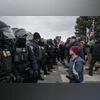 "Federal law enforcement officers attempt to disperse demonstrators protesting Immigration and Customs Enforcement (ICE) activity outside the Bishop Henry Whipple Federal Building in St. Paul, Minnesota")
Federal law enforcement officers attempt to disperse demonstrators protesting Immigration and Customs Enforcement (ICE) activity outside the Bishop Henry Whipple Federal Building in St. Paul, Minnesota | Image Credit: Bloomberg
Listen to This Article
A sweeping immigration crackdown by the Trump administration in the Twin Cities of Minneapolis and St Paul is no longer just a political flashpoint. It is fast becoming a personal finance shock for immigrant families, small businesses, and local communities, disrupting incomes, schooling, and day-to-day economic activity, according to a report by Associated Press.
Dubbed Operation Metro Surge, the enforcement drive involves more than 2,000 federal officers conducting raids across neighbourhoods. Unmarked convoys, early-morning operations, and frequent clashes with protesters have turned parts of the metropolitan area into zones of constant tension, the AP reported.
Fear hits work, schools, and earnings
For many immigrant households, the immediate concern is survival. Parents are keeping children home from school or shifting to remote learning. Families are avoiding religious services and public places. For daily wage earners and hourly workers, this translates directly into loss of income.
Small disruptions can have outsized financial effects. Missing a few days of work can mean unpaid rent, delayed utility bills, or difficulty buying groceries. Community groups cited by AP say they are seeing a surge in requests for food assistance and help with basic needs.
Small businesses shut doors
According to AP, the crackdown has also hurt local businesses, particularly in immigrant-heavy areas such as Lake Street in Minneapolis. Several restaurants and shops have temporarily closed, citing “current conditions”.
Also Read

 "SBI, state bank of India")
 "H1B Visa")
 "Zone Zero fitness")
 "Ayatollah Ali Khamenei, Ayatollah Ali, Ayatollah")
 "foot health, joints, joint pain")
Ice-cream shops, taquerias, and retail centres serving immigrant communities are limiting entry or shutting altogether. For owners operating on thin margins, even short closures can strain cash flows, affect loan repayments, and jeopardise staff wages.
In contrast, wealthier and whiter suburbs have been largely unaffected, highlighting how enforcement actions can create uneven economic stress within the same city.
Community costs mount
Beyond lost income, there are indirect financial costs. Residents report damaged vehicles during enforcement actions, time spent dealing with detentions, and legal uncertainty. In one case described by AP, a motorist’s car was damaged during a confrontation with officers, leaving him worried about repair costs and accountability.
Local leaders warn that city resources are stretched. Minneapolis Mayor Jacob Frey said the presence of thousands of federal agents in a compact city has created an outsized impact, with spillover effects on policing and civic services.
Mutual aid fills the gaps
As official systems strain, community support networks have stepped in. Volunteers are distributing food packs, arranging transport for work and medical visits, and standing watch outside schools to alert parents if enforcement convoys approach.
Residents have also helped protesters and bystanders recover from tear gas exposure by handing out water and supplies. These informal safety nets, while vital, underline the absence of financial stability for many families caught in the crackdown.
The episode offers a stark reminder that immigration policy is not just about borders and legality. It has direct consequences for household finances, small businesses, and local economies, often hitting the most vulnerable first, as reported by the Associated Press.
More From This Section
 "US visa, US immigration, green card")
 "US visa interview")
 "US Visa")
 "US visa, H4, H1B")
 "US visa social media directive, US visa rules Indian students, Indian students US visa screening, F1 visa decline India, Indian non-immigrant visa trends, US visa approvals India FY25, Indian students US study 2025, F1 J1 M1 visa types India, US visa")
Topics : Trump’s immigration agenda BS Web Reports
Don't miss the most important news and views of the day. Get them on our Telegram channel
First Published: Jan 19 2026 | 2:32 PM IST