


Obituary: Meghnad Desai was true gadfly in the best sense of the word
In the United Kingdom, he joined the Labour Party and was an active participant in its policy formations for three decades after 1980. He was made a life peer in 1991
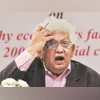 "Meghnad Desai, chairman, Academy of Economics")
After the 2014 crisis affecting many advanced economies, he wrote a volume Hubris: Why Economists Failed to Predict the Crisis and How to Avoid the Next One. | File Image
Listen to This Article
Lord Meghnad Desai St Clement Danes, the Vadodara-born British academic-politician, who died yesterday at the age of 85, is often described as an economist. He was doubtless a renowned practitioner of the dismal science, but to call him a mere economist is to do injustice to his multi-faceted personality. His long-running weekly column in the Sunday Express covered his forthright thoughts on politics, governance, culture, and whatever else was happening in the world at large besides economics. His oeuvre of more than 20 volumes contains two novels and Nehru’s Hero: Dilip Kumar in the Life of India (2004). He called this biography of the thespian, whom he called the best actor not just in India but in the world, his most satisfying work. For the record, his other books covered Marxian economics, econometrics, development economics, among others. Although an atheist, he wrote a well-received volume called Who Wrote the Bhagavadgita? A secular enquiry into a sacred text (2014).
Lord Desai took his bachelor’s and master’s degrees from what was then the University of Bombay. He went on to do post-graduate work in econometrics at the University of Pennsylvania and obtained his doctorate at the young age of 23. He spent most of his academic career at the London School of Economics. Besides teaching, he held various administrative responsibilities at that Mecca of studies of economics.
In the United Kingdom, he joined the Labour Party and was an active participant in its policy formations for three decades after 1980. He was made a life peer in 1991. He once ran, unsuccessfully, for the position of the Lord Speaker of the House of Lords. He became gradually disenchanted with the party and resigned his membership in 2020 after nearly 50 years, citing the Labour’s increasing drift towards antisemitism, especially under the leadership of Jeremy Corbyn, as the reason.
Although an early admirer of Marxian thought, he was not a doctrinaire Marxist. He was particularly critical of the statist version of socialism in Britain as well as in India. He held Jawaharlal Nehru in high esteem, but thought that the socialistic pattern of society ushered in after the 1963 Avadi session of the Congress held India back and was the main reason for its falling behind on the development curve post the mid-1960s. The title of his 2002 book, Marx’s Revenge: The Resurgence of Capitalism and the Death of Statist Socialism, succinctly sums up his position. He was also increasingly critical of monetarists. After the 2014 crisis affecting many advanced economies, he wrote a volume Hubris: Why Economists Failed to Predict the Crisis and How to Avoid the Next One.
He was no blind admirer of what happened in India post liberalisation either. His 2010 interview with Sucheta Dalal and Debasish Basu of Moneylife was entitled “If only bureaucrats and the politicians got out of the way, people would do fine.” Interestingly, he called KYC Kick Your Customer, a term which most accurately describes the process as it is practiced even today!\
Also Read

 "Meghnad Desai, chairman, Academy of Economics")
 "HSBC")
 "Savi Soin, president, Qualcomm India")
 "punjab national bank, pnb")
 "NISAR launch, ISRO NASA satellite")
He met Kishwar Ahluwalia in the course of writing his biography of Dilip Kumar. She was his editor. They married, both for the second time, in 2004. Lord and Lady Desai were very prominent in the social circles of London, Delhi and Mumbai.
Given his widespread interests in politics, food, films and sometimes even cricket, he was a frequent guest on numerous talk shows. He made quite an impression with his distinguished appearance with a halo of hair and his sonorous voice. He wore his scholarship lightly in these discussions and was immensely popular.
For decades, critics and biographers have claimed that W Somerset Maugham described himself as “in the very first row of the second-raters.” This has no authentication on record. He was most likely a writer keenly aware of his strengths and limitations, but never self-deprecating to the point of dismissing his own work. Like Maugham, Lord Desai never took himself too seriously, but never doubted his contributions. He used his sharp wit and varied interests to provoke others into action, the mark of a true gadfly in the best sense of the word.
The author is a Baroda-based economist. shreekant.sambrani-@gmail.com
More From This Section
 "Buddha, Lord Buddha, Buddha Purnima")
 "stray dogs")
 "narendra modi, monsoon session")
 "Allahabad High Court")
 "Parliament, New Parliament")
Topics : Meghnad Desai General news Vadodara
Don't miss the most important news and views of the day. Get them on our Telegram channel
First Published: Jul 31 2025 | 12:18 AM IST