


Kumbh devotees count their dead as crowd fails to reduce at NDLS
"If you think this is crowded, yesterday's sights would have horrified you," said a vendor at Platform 16 - first platform upon entry as one makes their way in through Ajmeri Gate complex of station
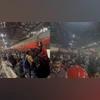 "New Delhi railway station")
New Delhi railway station | Photo: X
Listen to This Article
On Sunday evening, close to 50 officers of the Rapid Action Force (RAF) – India’s specialised riot control paramilitary unit – were standing along the rails of the staircase descending to Platforms 14 and 15 of the New Delhi railway station.
This is the area in the middle of the tragedy on Saturday night, when a stampede left at least 18 dead and several others injured.
“If you think this is crowded, Saturday’s sights would have horrified you,” said a vendor at Platform 16 – the first platform upon entry as one makes their way in through the Ajmeri Gate complex of the station.
This is where the railways is running its special Prayagraj-bound trains on Sunday. By the evening, huge crowds gathered at the platform again, even as another platform with passengers waiting for the Amb Andaura Vande Bharat Express bears a calm look.
As a special train stops at the platform, pandemonium ensues for the next few minutes, with desperate travellers climbing over each other to enter the general coaches – several of those wrestling to get through get hit by large cartons being pushed in by other passengers.

 "stampede, NDLS stampede")
 "NDLS stampede, stampede")
 "Criminal in handcuffs")
 "Union Minister for Information Technology Ashwini Vaishnaw")
 "Railways, train")
Officers of the railway police force (RPF), stationed at each gate of every coach, try to manage the crowd. Once the train is ready to depart, a deafening cacophony of loud whistles engulfs the air: the officers blowing in unison to coordinate with each other.
“A day after the tragic incident of stampede at New Delhi railway station, Northern Railway enforced a number of measures to avoid any such untoward incident in the days to come. It has been decided that all special trains in the direction of Prayagraj will be run from platform number 16. Therefore, all the passengers wanting to go to Prayagraj shall come & go from Ajmeri Gate side of New Delhi railway station,” the ministry of railways said on Sunday evening.
Nearly 20 hours after the tragedy, the administration looks to stagger the entry of passengers to manage crowds at the station. A queue spanning several hundred metres is visible at the entry gates of the station, with dozens of railway officers working to streamline the process.
Those who were present at the station on Saturday night say that they had not seen a crowd like that at the station in their whole lives.
The New Delhi station is among India’s busiest, and often finds itself filled to the brim, but the stampede has put the spotlight on alleged mismanagement by railways – with critics and opposition leaders slamming the national transporter, alleging an attempt to hide facts and misrepresent the gravity of the situation.
An initial statement by the Chief Public Relations Officer (CPRO) of Northern Railways on Saturday said that there was, in fact, no stampede, while no official information from the ministry was available on casualties till Sunday.
“One could not even breathe, at one point people were ready to storm the stall as there was place left to stand,” said a snacks and beverage vendor at Platform 14.
A proposed redevelopment of the station has been pending for well over a decade, which would increase capacity and change the way passengers approach and move around the station.
On the other hand, a pall of gloom lay over the campuses of Lok Nayak Jai Prakash (LNJP) Hospital and the Lady Hardinge Medical College (LHMC), more than 12 hours after they witnessed the arrival of dead bodies from the New Delhi Railway Station (NDLS).
“I saw ambulance after ambulance come in through the gates. From the first moment, it seemed that a very major tragedy had taken place,” Mukesh Sharma, who was attending a relative admitted in LHMC, said.
LNJP saw the most dead and injured persons from NDLS, at 15 and 13 respectively, whereas LHMC recorded three deaths and one injury.
The unease and silence lay cover to the sobs of bereaved family members. “It was unbearable to see young kids sobbing for their mothers,” Janak Ram, who works as a cleaner at LNJP said.
He added that the dead included mainly women, but there were small kids among them as well. Official numbers suggest that the victims of the stampede include 11 women, three men and four children aged below 18 years — the oldest of whom was aged 15, while the youngest was just 7.
An administrative official at LNJP stated that identification of all dead bodies has been completed with some being shifted to Ram Manohar Lohia (RML) Hospital and the Maulana Azad Medical College (MAMC) for post mortem.
A spokesperson for the RML Hospital confirmed this development, adding that five dead bodies that had come for post mortem there have now been handed over to their families. The cause of death for all five was traumatic asphyxia or suffocation.
Out of the 15 people injured in the mishap, four are still admitted in LNJP and LHMC while others have either been discharged or have left against medical advice. “Of those admitted to LNJP, two have fractures and are still in the orthopedic ward, whereas the rest have either been discharged,” an official at LNJP confirmed.
Several eyewitnesses said the stampede occurred due to an announcement of platform change at the station, which prompted those waiting for the Prayagraj special train on Platform 14 to rush to Platform 12 in huge numbers, leading to a stampede on the staircase.
The railways maintains that no last minute change of platform was done. "The incident took place around 9.15 PM on the staircase of Platforms 14 and 15, where a large crowd had gathered to board trains heading to Prayagraj. Neither platform change was made by Northern Railway at New Delhi Station, nor any special train cancelled," an official said.
The ministry has officially asked people not to "fall prey to rumours" and not change platforms based on hearsay.
"All the travellers are requested not to change platforms on hearsay and strictly follow the official announcement. Indian Railway seeks cooperation of passengers by adhering to operational planning of Indian Railways,” the ministry said.
The railways has set up a committee to investigate the matter, albeit comprising officers from Northern Railway itself – Pankaj Gangwar, Principal Chief Security Commissioner and Nar Singh, Principal Chief Commercial Manager, Northern Railway, both higher administrative grade (HAG) officers.
“The HAG level inquiry panel started its probe at around 11 am on Sunday and it will take into account all these claims of change of platform announcement as well,” a railway spokesperson had told this paper on Sunday afternoon.
Another senior official said that the Commissioner of Railway Safety will not look into this incident as its primary remit is to investigate train accidents.
The spokesperson quoted above said that the railways will rely primarily on the report of the two-member committee.
“No deadline is there for the committee, but they will submit their findings as soon as possible. All video footage has been retrieved,” he said.
Former railway officials said that they could not comment on the veracity of the claims of a last minute platform change, but said that the practice is actively discouraged but continues to be prevalent in the railways.
More From This Section
 "Air ambulance")
 "The roof of Delhi airport's T1 collapsed amid heavy rainfall on June 28, 2024, killing one and injuring eight | File: PTI")
 "New Delhi railway station")
 "Chaotic scenes: Travellers at stampede-hit platform no 14/15 of New Delhi Railway Station; Prayagraj railway station; Patna railway station; Varanasi, Ranchi railway stations, on Sunday; Inset: One of the 15 injured after the incident | Photos: PTI")
Topics : Indian Railways Kumbh Mela
Don't miss the most important news and views of the day. Get them on our Telegram channel
First Published: Feb 16 2025 | 11:58 PM IST