


Govt may raise motor third-party insurance premiums by up to 10% soon
The hike, likely to take effect by October 2025 or April 2026, aims to ease pressure on insurers facing rising claims, especially from commercial vehicles and pandemic-era payouts
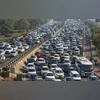 "Traffic, Traffic jam, New Delhi Traffic Jam")
Currently, third-party premiums are ₹2,100 for cars with engines up to 1,000 cc. (Photo: PTI)
Listen to This Article
The Ministry of Road Transport & Highways (MoRTH) and the Insurance Regulatory and Development Authority of India (IRDAI) are discussing a proposal to raise third-party motor insurance premiums by up to 10 per cent, according to The Economic Times.
While a uniform hike is unlikely, loss-heavy segments — particularly commercial vehicles — could see sharper increases. Premiums for low-risk categories such as school buses may be raised only marginally or even held steady to avoid public backlash.
“Talks have resumed between the ministry and the insurance regulator to increase the third-party motor rates, which could go up on an average 10 per cent,” a source was quoted as saying. “For certain segments like school buses, the hike may be minimal or held back entirely.”
Insurers cite pandemic-era distortions and rising claims
Insurers had earlier urged the government and IRDAI to approve a 5-15 per cent hike starting April 2025, pointing to mounting losses from court awards, accelerated claims processing, and pandemic-induced distortions.
Also Read

 "Ashok Leyland, commercial vehicle")
 "Maruti Suzuki")
 "passenger vehicle, commercial vehicle, tata motors")
 "Vedanta")
 "Dheeraj Hinduja, chairman, Ashok Leyland")
“On an accident-year basis, the motor third-party segment continues to bleed. A substantial hike is needed,” a senior industry executive told the publication.
Premiums trail claims ratios amid rising losses
Third-party premiums, which are reviewed annually based on historical claims data, have remained mostly flat since 2018 — capped at 2–3 per cent in most years, frozen in 2021, and adjusted only slightly in 2022-23.
Net claims ratios stood at 82 per cent in FY24 and FY23, while ultimate loss ratios reached 88 per cent and 91 per cent respectively — reflecting persistent strain on the sector.
Currently, third-party premiums are ₹2,100 for cars with engines up to 1,000 cc and ₹3,400 for those between 1,000 cc and 1,500 cc. During FY24, insurers booked ₹54,455 crore in third-party motor insurance premiums.
Effective date could be October 2025 or April 2026
Any approved increase would apply prospectively. “There is no provision to revise the rates retrospectively. The earliest they can implement it is from April 1, 2026, or possibly mid-year from October 1, 2025,” a source noted.
Commercial vehicles remain under pressure
The sharpest losses continue to come from commercial vehicles. The burden is worsened by a mandatory rule requiring insurers to pay up to ₹1.5 lakh for emergency hospital care within the first hour of a road accident — regardless of fault or insurance coverage.
With both regulators and the industry in broad agreement on the need for higher tariffs, the remaining question is how sharply — and how soon — premiums will rise across vehicle classes.
More From This Section
 "Escorts Kubota, automotive industry, Tractors, Mahindra & Mahindra, farm sector, VST Tillers Tractors, Nifty Auto index")
 "Fastag, Paytm")
 "Tesla robotaxi")
 "Cars")
 "salary, employee")
Topics : IRDAI commercial vehicles insurance plans motor third-party insurance premiums BS Web Reports
Don't miss the most important news and views of the day. Get them on our Telegram channel
First Published: Jun 20 2025 | 9:36 AM IST