


UIDAI launches Aadhaar face authentication software for banks, fintechs
UIDAI has launched a new Aadhaar Face Authentication SDK and sandbox, enabling banks, fintechs, insurers and other entities to integrate secure face authentication directly into their mobile apps
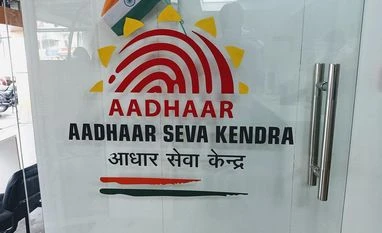 "Adhaar, UIDAI")
The Aadhaar Face Authentication SDK brings UIDAI’s face authentication capability directly into native Android and iOS applications. Photo: Wikimedia Commons
Listen to This Article
The Unique Identification Authority of India (UIDAI) on Wednesday launched a new Aadhaar Face Authentication Software Development Kit (SDK) and a dedicated sandbox, allowing banks, fintech companies, insurers and other financial-sector entities to integrate Aadhaar-based face authentication directly into their mobile applications.
The launch, announced at the Global Fintech Fest 2026 in Mumbai, is aimed at simplifying digital onboarding by eliminating the need for users to switch between multiple applications while completing Aadhaar face authentication.
UIDAI also unveiled a ‘Playbook on ease of Onboarding’, which will serve as a guide for banking, financial services and insurance (BFSI) entities seeking to join the UIDAI authentication ecosystem for identity verification of customers, staff and other business partners.
What does the new Aadhaar Face Authentication SDK do?
The Aadhaar Face Authentication SDK brings UIDAI’s face authentication capability directly into native Android and iOS applications. This means a customer using a banking, insurance or broking application can complete Aadhaar face authentication within the same app instead of being redirected to a separate application.
The ready-to-use SDK is designed to simplify integration for ecosystem partners. It incorporates artificial intelligence (AI) and machine-learning based liveness detection and anti-spoofing capabilities, while supporting the secure handling and encryption of authentication data. The SDK is designed to work across consumer smartphones and is expected to help government departments, banks, non-banking financial companies (NBFCs), fintech firms and other organisations deploy Aadhaar Face Authentication-enabled services more efficiently.
Also Read

 "image")
 "In this image posted on Sept. 8, 2026, Prime Minister Narendra Modi during the inauguration of the Global Fintech Fest (GFF) 2026, at the Jio World Centre in Mumbai. (narendramodi.in via PTI Photo)")
 "Devendra Fadnavis, CM of Maharashtra")
 "Raghav Chadha, Raghav, Chadha")
 "Philippines Defence Secretary Gilberto Teodoro")
Until now, a similar Aadhaar Face Authentication journey required the FaceRD application to be present on the user’s device. The FaceRD app worked in the background during authentication. According to UIDAI, this added an additional step to the onboarding process and made the experience dependent on the availability of the FaceRD app on the device. The launch fulfils a long-standing demand from the fintech and banking ecosystem for a seamless and secure user onboarding journey from within an organisation’s own mobile application.
How does the new authentication model work?
UIDAI Chairman Neelkanth Mishra said the new SDK will allow partner banks and businesses to run Aadhaar authentication locally on their own servers rather than routing requests through UIDAI’s central systems. “The problem with removing geofencing is, then you are vulnerable,” he said, as quoted by The Indian Express. “It’s critical infrastructure. And of course, we see hundreds of attacks every day. We have safeguards."
Under the model, authentication runs on the bank’s own server rather than UIDAI’s central infrastructure. This means the bank secures its own local authentication process, while the exposure does not pass back to UIDAI’s systems.
What is the Aadhaar Face Authentication Sandbox?
Alongside the SDK, UIDAI launched the Aadhaar Face Authentication Sandbox, a secure and controlled environment that allows organisations to integrate, test and validate the complete Face Authentication journey before production onboarding.
The sandbox is designed for developers and quality assurance teams to test key stages of the authentication process, including user provisioning and consent, face capture, liveness checks, authentication, error handling and response validation. Testing can be carried out without the need for external biometric hardware.
The sandbox also allows organisations to simulate failure scenarios, including invalid digital signatures, network interruptions, timeouts and spoofing attempts. This enables organisations to test how their applications respond to different authentication and security-related failures before moving to a live environment.
Who stands to benefit from the new software?
The technology is designed to work across consumer smartphones and is expected to make it easier for government departments, banks, NBFCs, fintech companies and other organisations to deploy Aadhaar Face Authentication-enabled services. The move is particularly relevant to the banking and financial services sector, where digital customer onboarding and identity verification have become increasingly important for delivering services remotely.
UIDAI’s indigenously engineered AI/ML-driven Face Authentication solution was launched in 2021. According to UIDAI, it has since been adopted by nearly 200 entities, including Union government ministries and departments, state governments, banks, NBFCs, telecom operators, brokerage firms and certifying authorities, among others. The technology received the Prime Minister’s Award for Excellence in Public Administration 2023 under the Innovation category.
For users, the key change is a simpler onboarding journey. Instead of downloading and switching between multiple applications, a customer can complete Aadhaar Face Authentication within the banking, insurance or broking app being used for onboarding.
More From This Section
 "rupee, cash, money, finance, economy")
 "C S Setty, Chairman, SBI")
 "Bank of India")
 "Bank strike")
 "stake sale")
Topics : Fintech Indian FinTech UIDAI Aadhar card BS Web Reports
Don't miss the most important news and views of the day. Get them on our Telegram channel
First Published: Sep 10 2026 | 9:10 AM IST