


Debate on freebies & investment crucial for growth, says Jagdeep Dhankhar
Rajya Sabha Chairman Jagdeep Dhankhar's remarks came after MP Ramgopal Yadav urged raising MPLAD funds from Rs 5 cr to Rs 20 cr, citing the need for higher allocations to support development projects
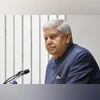 "Jagdeep Dhankhar, Jagdeep, Dhankhar, VP")
Vice President of India and Chairman of Rajya Sabha Jagdeep Dhankhar (Photo: PTI)
Listen to This Article
Vice President of India and Chairman of Rajya Sabha Jagdeep Dhankhar on Wednesday emphasised the need for lawmakers to engage in discussions regarding investment policies and the issue of freebies, stressing that the nation’s economic growth depends on capital expenditure. He advocated for a structured national policy to ensure that government investments, regardless of form, contribute effectively to broader welfare.
He said, “On placatory mechanisms, on appeasement, which is often known as freebies, this House needs to deliberate....Because the country grows only with capex being available. The electoral process is such that these have become electoral allurements and thereafter the governments that came in saddle found themselves very uncomfortable, so uncomfortable that they wanted to revisit their thoughts.”
Dhankhar’s remarks followed a request by Samajwadi Party MP Ramgopal Yadav, who called for an increase in Members of Parliament Local Area Development (MPLAD) funds from Rs 5 crore to Rs 20 crore.
Yadav argued that the current allocation is insufficient to implement developmental projects, especially given rising inflation and the Goods and Services Tax (GST) on spending. “One-third of the Lok Sabha MPs [members of Parliament] lose elections because of MPLAD... in several states including Uttar Pradesh and Delhi, the funds allocated to MLAs [members of legislative assembly] for spending are more than the MPLAD,” he said.
Under the MPLADS scheme, legislators can recommend development projects in their constituencies, including the construction of essential infrastructure such as roads and schools.
Also Read

 "New Delhi: Union Finance Minister Nirmala Sitharaman speaks in the Rajya Sabha during the Budget session of Parliament, in New Delhi, Tuesday, March 18, 2025. (Sansad TV via PTI Photo)")
 "Northeast India")
 "Nirmala Sitharaman, Nirmala, Finance Minister")
 "Parliament, New Parliament")
 "Parliament, New Parliament, Lok sabha, Rajya sabha")
As MPs from different parties voiced their support for Yadav’s proposal, Dhankhar highlighted the disparities in fund allocation and remuneration for elected representatives, noting that the Constitution does not provide a uniform framework for lawmakers at different levels.
“So you will find legislatures in several states give perks and salaries to members of the assembly, much beyond members of Parliament, and even the pension variation for a former member of the assembly is on a scale of 1 to 10. If in one state, one is getting one rupee, in the other state the pension will be 10 times, and therefore, since these are the issues where legislation can deal with the issue and it will help the politician, it will help the government, it will help the executive and it will also ensure high quality of investment,” Dhankhar said.
He said there is a need to reassess the subsidy framework. “Subsidies, if required in areas like the farm sector, should be direct, and that is the practice in developed countries. I checked with the US mechanism. The US has 1/5th of farm households as our country but the average income of a US farm household is more than the general income of a US household, and that is because the subsidy to the farmer is direct, transparent, without intermediary,” he said.
More From This Section
 "Shashi Tharoor, Shashi, Tharoor")
 "Mallikarjun Kharge, Sonia Gandhi, Rahul Gandhi, rahul, sonia, AICC hedqaters")
 "BJP Flag, BJP")
 "Sandosh Kumar, Communist Party of India, CPI")
 "Rahul Gandhi, Rahul, Congress leader")
Topics : Rajya Sabha BS Web Reports
Don't miss the most important news and views of the day. Get them on our Telegram channel
First Published: Mar 19 2025 | 1:44 PM IST