


Philips Air Purifier AC4221 review: Silent, effective, and intelligent
The Philips Air Purifier AC4221 builds on a familiar foundation while introducing meaningful improvements in capacity, noise management, and intelligence
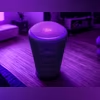 "Philips Air Purifier AC4221")
Philips Air Purifier AC4221
Listen to This Article
My experience with Philips air purifiers began in 2020 with the Philips AC3059/65. Over the years, it became a routine appliance in daily use, running through seasonal changes in air quality without drawing attention to itself. Its performance remained consistent, and the purifier largely operated as a background device that did its job without intervention. This continued until the time came to replace the filter.
That routine replacement turned into a constraint. The required filter was unavailable for extended periods, despite multiple checks. With no clear timeline for restocking, the usability of the existing purifier was affected. It was during this period that I was offered the opportunity to test the Philips Air Purifier AC4221, a newer generation model from Versuni India, priced at Rs 27,995. The transition, therefore, was not driven by curiosity but by a practical limitation.
Familiar yet revised
While unboxing the Philips Air Purifier AC4221, it became clear that Philips had retained several aspects of the previous model that had worked well, while revising others. The form factor, control layout, and usage logic followed a familiar pattern. At the same time, changes in design, footprint, and overall structure signalled that this was not a direct replacement but a reworked iteration.
The AC4221 continues to position itself as a smart home-ready appliance. It includes built-in Wi-Fi, compatibility with Alexa, Siri, and Google Home, and access to a companion smartphone app called Philips Air+. The core approach remains intact: continuous air monitoring, automated purification, and multiple ways to control the device, whether physically, through the app, or using voice commands.
Also Read

 "Smog, Delhi Pollution, Delhi Air Quality, Pollution")
 "Supreme Court, SC")
 "Prataprao Jadhav, Prataprao")
 "Smog, Delhi Pollution, Delhi Air Quality, Pollution")
 "Delhi air pollution")
Shared foundations and meaningful changes
At a functional level, the Philips Air Purifier AC4221 shares several fundamentals with the older AC3059/65. It uses the same three-stage filtration process, relies on built-in sensors to track air quality in real time, and features a touch-based control panel located on the top surface for quick access to modes and settings. These common elements help preserve continuity for existing Philips users.
However, the AC4221 introduces changes that go beyond design updates. The unit is more compact and lighter, yet this has not resulted in reduced performance. On the contrary, the clean air delivery rate has been increased by 80 cubic metres per hour to 600. According to Versuni, this enables the purifier to complete three full air cleaning cycles per hour in a standard-sized room. The purifier is rated to cover areas of up to 700 square feet, placing it firmly in the category of appliances designed for large rooms and open living spaces.
Noise, automation, and adaptive behaviour
Noise levels are an area where the AC4221 shows refinement. At lower fan speeds, a wheezing sound is present, but it remains noticeable only during quieter hours, such as late at night. At its highest setting, the turbo mode produces noise comparable to air conditioner blowers operating at full speed. This behaviour is not unexpected for a device moving large volumes of air.
To manage this, Versuni has introduced an ‘Auto+’ mode in addition to the standard automatic mode. While the traditional auto mode responds only to real-time air quality parameters, Auto+ builds a usage profile over time. It adjusts fan speeds based on learned patterns, balancing purification performance with noise levels. The mode also contributes to energy optimisation by reducing activity when air quality is within acceptable limits. In contrast, the standard auto mode does not clean pre-emptively and plays a limited role in conserving power.
Filtration
The filtration system consists of a pre-filter, a HEPA 14 layer, and an activated carbon filter. Each component has a defined role. The pre-filter captures larger particles, the HEPA layer removes fine particulate matter, and the activated carbon handles odour, gases, and volatile organic compounds.
After a month of continuous use, the condition of the filters provided clear evidence of the purifier’s function. The pre-filter showed a visible layer of dust and debris spread across its surface. Beneath it, the HEPA filter, which is white when new, had darkened significantly. This change illustrated the volume of particulate matter processed during daily operation. For the system to continue performing efficiently, the pre-filter requires periodic manual cleaning using a brush and a vacuum cleaner.
App experience and connected controls
The Philips Air+ app is available on both iOS and Android platforms. Configuration is straightforward, requiring a Wi-Fi connection and a Philips account to enable synchronisation and data storage. Once set up, the app presents relevant information directly on the home screen, including air quality indicators and device status.
Tapping on the purifier icon opens detailed views, including historical air quality data. The app also supports scheduling, allowing users to automate power cycles based on time. Integration with voice assistants such as Alexa and Siri is supported, enabling basic voice-controlled operations. However, not all functions are accessible through voice commands, limiting hands-free interaction to a subset of features.
Verdict
The Philips Air Purifier AC4221 builds on a familiar platform while addressing performance, capacity, and automation. The improvements in air delivery rate, adaptive operation, and filtration performance make it a meaningful update rather than a visual refresh. At the same time, its design choices and smart features remain consistent with what long-term Philips users would expect. The AC4221 positions itself as an evolution shaped by usage patterns, rather than a departure from established design principles.
More From This Section
 "Lava Agni 4")
 "OPPO Enco Buds 3 Pro Plus")
 "Vivo X300 Pro in Dune Gold colourway")
 "Google Pixel Watch 4 (45mm) in Satin Moonstone colour (Image: Harsh Shivam)")
 "Apple MacBook Pro M5 in Silver")
Topics : Philips Philips India air purifier air pollution
Don't miss the most important news and views of the day. Get them on our Telegram channel
First Published: Dec 11 2025 | 1:41 PM IST