


China shows tech resilience against Trump's export curbs over Rare earths
Tiptoeing around sensitive topics like state subsidies, eight tech executives who addressed reporters downplayed the impact of a yearslong US campaign to curtail China's technological ascent
 "Magiclab robots")
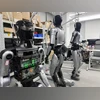
Magiclab Robotics Technology Co., a firm in the eastern city of Suzhou was founded barely more than a year ago | Image: Bloomberg


Listen to This Article
As Donald Trump brandishes US export controls on technology as a bargaining chip to wrest supplies of rare earth magnets from Beijing, China is showcasing what it can do without the most advanced American semiconductors.
On a government-organized trip this month to Jiangsu and Zhejiang, two of China’s richest provinces that spawned AI darling DeepSeek, authorities lined up a host of executives from technology companies to meet with journalists from Bloomberg News and other media outlets. The message was ultimately one of defiance: China’s technology sector still aims at world dominance despite US curbs.
Take Magiclab Robotics Technology Co., a firm in the eastern city of Suzhou founded barely more than a year ago. Its president, Wu Changzheng, said it had independently developed more than 90 per cent of the parts it uses to make humanoid robots. The rest consists of semiconductors and micro-controller units procured domestically and overseas, he said, adding that they don’t use US chips.
“China doesn’t have many weak links in this industry,” Wu said, as he demonstrated a human-sized robot destined for factory floors. He brushed off Trump’s recent ban on US firms exporting semiconductor design software to China, saying his robots only require “standard chips.”
Other entrepreneurs emphasized self-reliance over the five-day trip with companies spanning bio-pharmaceuticals, humanoid robotics, AI and autos — all sectors pivotal to President Xi Jinping’s manufacturing ambitions. Many in China’s business sector have rallied around Xi’s government in the face of Trump’s tariffs and expanding US export curbs.
Also Read

 "Nirmala Sitharaman, Nirmala")
 "A television broadcasts US President Donald Trump during a NATO press conference on the floor of the New York Stock Exchange on June 25, 2025")
 "Donald Trump, Mark Carney")
 "US Capitol, Senate, washington, us govt")
 "US Citizenship and Immigration Services")
Access to so many executives at once is typically difficult for foreign journalists in a country where media access is tightly regulated and company officials can be reluctant to speak freely for fear of reprisal.
The trip exemplifies Beijing’s desire to boost global investor confidence in its $19 trillion economy, which has been plagued by a property crash, deflation and now the US’s highest tariffs in a century. Although DeepSeek’s surprise AI breakthrough earlier this year proved China can innovate with a limited supply of chips, Beijing still faces difficulty catching the US while being denied access to Nvidia Corp.’s most advanced semiconductors.
On the press tour, the Chinese government mostly presented firms that don’t require top-tier chips such as AISpeech Co, which makes in-car AI-powered audio and video tools. For companies pioneering autonomous driving models or artificial general intelligence — systems that possess human-level cognitive abilities — accessing the latest chips is likely to be far more important.
Tiptoeing around sensitive topics like state subsidies, eight tech executives who addressed reporters throughout the trip downplayed the impact of a yearslong US campaign to curtail China’s technological ascent, emphasizing the country’s increased self-reliance as government officials listened attentively on the sidelines.
The executives spoke about how they are instead leveraging local advantages they consider disruption-proof, from a vast talent pool to supply chains walled off from the outside world.
Yu Kai, AISpeech’s co-founder and chief scientific officer, said the company has hired more than 700 people in research centers in Beijing and Suzhou, after starting off with fewer than 10 people developing an algorithm in Cambridge. It has set up a subsidiary in Shenzhen for its proximity to smart equipment manufacturing and also runs a unit in southern China to produce software for cars built by a local auto-making partner.
Illustrating the deep concern in Beijing on US tech controls, Xi has restricted China’s rare earth magnets in recent months in a bid to unwind some of Trump’s recent export curbs. US Commerce Secretary Howard Lutnick said last week that the US and China signed a document to codify trade terms reached last month in Geneva, including a commitment from Beijing to deliver rare earths used in everything from wind turbines to jet planes.
China’s economic stamina was a common theme of the trip that began in Nanjing, a city in Jiangsu where researchers publish three times more scientific papers than those in New York. Ferried by two buses, dozens of journalists went to Suzhou and neighboring Zhejiang province by high-speed train, as the focus of discussions shifted more to the development of green technologies.
There’s debate in China over how it matters to access state-of-the-art chipmaking machines, and Nvidia’s most-advanced AI accelerators. Ren Zhengfei, the founder of Huawei Technologies Co., recently said Chinese firms can adopt means such as chip stacking to get results similar to the most cutting-edge semiconductors. Beijing also blocks most AI services from US rivals, meaning domestic players don’t have to compete against American leaders.
China has to put on a display of “confidence and window dressing” after years of tech curbs, according to Julian Mueller-Kaler, director of the Strategic Foresight Hub at the Stimson Center in Washington. High-end chips for AI data centers, for example, can be replaced with less capable models, at the expense of more energy usage, he said.
“The reason the Chinese didn’t really retaliate that much after the chips restrictions a few years ago is Beijing actually likes them, to a certain degree,” he said. “It forces Chinese companies to develop their own capabilities and reduce the reliance on American tech — a political goal Chinese decision-makers had for a long time but was hindered by economic realities.”
Still, for all the savvy on display, few companies will emerge unscathed from deteriorating ties with the US. Some executives on the trip mentioned they were feeling the pain as Trump’s America First policy seeks to limit US investment in China’s high tech sectors.
“The impact on financing is significant,” said Zhang Jinhua, chairwoman of IASO Biotechnology Co., which makes a life-saving cancer treatment. “I tell my team to stop asking when this winter ends. We must treat winter as the four seasons and adapt to prolonged uncertainty.”
More From This Section
 "Donald Trump, Trump")
 "The offices of Banque Saudi Fransi stand in Riyadh, Saudi Arabia")
 "US flag, US, united states")
 "US President Donald Trump")
 "A man washes solar panels installed on a rooftop during a heat wave in Jacobabad, Pakistan")
Don't miss the most important news and views of the day. Get them on our Telegram channel
First Published: Jun 30 2025 | 11:42 AM IST