


Hiroshima and Nagasaki: Nuclear bombing must keep being commemorated
Truman's moral case might have been stronger had the US issued a clear public warning to Japan in July 1945; the Allies threatened consequences but didn't reveal the nature of the coming devastation
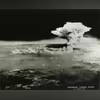 "Clouds over hiroshima")
No sane person could applaud the dropping of the first bomb, and less still that of the second, which annihilated Nagasaki on Aug 9 | Image: Wikimedia Commons
Listen to This Article
By Max Hastings
Nobody should ever say that it was a good call, but it was the only one a US President was likely to make in 1945. The decision to drop an atomic bomb on Hiroshima on Aug. 6, 80 years ago, was the almost-inevitable outcome of Japanese intransigence and of the technical success of the Manhattan Project, which brought into being nuclear weapons.
The anniversary is generating a wave of commemorations and renewing the arguments for, and against, the mission of Colonel Paul Tibbets to drop “Little Boy” from his B-29, named Enola Gay, over Japan on that summer morning. In the 21st century, many brand the bombing a war crime — maybe the worst of all those committed in World War II save the Holocaust.
I disagree. Some 20 years ago, I wrote a book about the 1944-45 battle for Japan for which I spent months poring over the Hiroshima controversy. I found writing a chapter about it one of the toughest challenges I have ever faced as a historian because the military, political and moral issues are so complex.
Also Read

 "80th Hiroshima Day 2025")
 "hiroshima, nagasaki, bombing, japan, hiroshima bombing, nagasaki bombing,")
 "markets, Sensex, nifty")
 "RBI Governor Sanjay Malhotra")
 "National stock exchange, NSE")
No sane person could applaud the dropping of the first bomb, and less still that of the second, which annihilated Nagasaki on Aug. 9. Yet I defend President Harry Truman and those around him who shared responsibility for doing so.
Many modern critics assume that the Bombs (we will hereafter capitalize them) represented the worst possible outcome of the war. This is not so. At the rate people were dying in Japan — especially prisoners in Japanese hands — more victims would have perished than the 100,000 (a conservative guesstimate) who died at Hiroshima and Nagasaki had the struggle continued for even a few weeks longer.
Moreover, during the earlier months of 1945, conventional bombing of Japanese cities by B-29s had already killed more than 300,000, one-third of these in the March 9 fire-raising assault on Tokyo.
There is a myth that commands support among a modest faction of modern historians that in August 1945 the Japanese were ready to quit. This is untrue. The Tokyo leadership, dominated by the military, certainly wanted an out. But they sought terms such as no US government would entertain. They wished to maintain Japanese hegemony over Korea and Manchuria, to be spared from allied occupation and to be granted the right themselves to conduct any war crimes trials.
Despite their catastrophic defeats in successive Pacific battles, the Tokyo war party believed Japan still held an important card — the capability to savage an invasion of the mainland, inflicting casualties that the squeamish Americans would find unacceptable. The Japanese looked forward to wreaking carnage among allied troops landing on Japanese beaches.
There is another, uglier aspect of the story. This derives from technological determinism — the extent to which the Bomb-dropping commitment was finally made because the weapons existed, that they had been bought and paid for. An especially repugnant conversation took place in July 1945, when the Hungarian-born scientist Leo Szilard trekked to the Spartanburg, South Carolina, home of Secretary of State James Byrnes, to argue passionately against using the weapon he had helped to create.
Byrnes, disgusted by the impassioned outburst, responded with two remarks that reflect scant credit on him. First, he said that the US Congress “would have plenty to say if $2 billion proved to have been expended on the Manhattan Project for no practical purpose.” He added that the Bomb could even help to get Stalin’s legions out of Szilard’s own country.
The visitor walked back to Spartanburg station having accomplished nothing. Along with most of the scientists working on the Manhattan Project, he had for years been motivated by terror that Hitler might acquire a nuclear device ahead of the allies. They saw their own work as defensive. When Germany collapsed, and with it the threat of a Nazi Bomb, it became abhorrent to consider its use.
Their difficulty in making their case was that they were bound by intensive secrecy and could not speak out. Truman had assumed the presidency on April 12, 1945, ignorant of the program. When he was briefed that the US would, within weeks, probably possess the most terrible weapon in history, nobody invited him to make any great decision.
It was taken for granted that if the Japanese were still fighting when the Bomb program achieved consummation, the US would use its progeny to force Tokyo’s surrender.
Some people to this day assert that Americans would never have employed the Bomb against Europeans. This is almost certainly untrue. The German generals who claimed that, if Hitler had followed their advice, they could have kept the European war going for months longer, ignored the near certainty that in such circumstances, the first nuclear weapon would have fallen on Berlin.
As it was, even after Hiroshima most of the Japanese leadership persisted in resisting surrender. Their obduracy provided an excuse for the far less defensible detonation of the second bomb, “Fat Man,” on Nagasaki because there was a desire to test its technology.
Nonetheless the decisive factor in the belated Japanese surrender, conveyed to the Americans on Aug. 14, was the Russian declaration of war on Japan and invasion of Manchuria.
Stalin had known of the American nuclear program through his agents in the West but was devastated by news of Hiroshima because he worried Tokyo would quit immediately, denying him the excuse for belligerency and seizure of the territorial prizes he had been promised. As it was, on Aug. 9, the Red Army launched its assault and secured Stalin’s booty.
Many of the Western critics who today denounce the Bombs are essentially arguing that the US should have saved the Japanese people from the madness of their own leaders. Yet in the sixth year of a horrific global struggle that had desensitized all its participants in various degrees, this was asking too much.
I believe Truman would have a stronger moral case in the eyes of posterity had the US given an explicit public warning to Japan if they kept fighting. In July 1945, the allies did threaten dire consequences but failed to specify what these would be.
Moreover, there seems a good argument that Hiroshima and Nagasaki have done much to preserve mankind ever since. The mushroom cloud, the ghastly images of the horrors of nuclear warfare, leave no room for doubt that if any nation resorts to such weapons, we are doomed. Even the world’s vilest dictators recognize this.
It is right that we continue to commemorate the anniversaries of Hiroshima and Nagasaki, pivotal and dreadful moments in the history of humankind. But responsibility for them should rest with the Japanese leaders who launched their country into a war of aggression that cost countless lives.
We should be thankful that billions of today’s people, though familiar with little history, at least know what happened on those August days 80 years ago, and thus recognize that a repetition would augur an end of everything.
(Disclaimer: This is a Bloomberg Opinion piece, and these are the personal opinions of the writer. They do not reflect the views of www.business-standard.com or the Business Standard newspaper)
More From This Section
 "Palestinians walk by houses destroyed by Israeli strikes in Gaza. The resurgence of Hamas has cast doubt on Israel's goal of eliminating it as a military threat")
 "US President Donald Trump")
 "flights, planes")
 "Matthew Perry aka Chandler death")
Don't miss the most important news and views of the day. Get them on our Telegram channel
First Published: Aug 06 2025 | 9:07 AM IST