


Iran prez joins pro-government rallies as protests intensify: Key updates
The developments came as US President Donald Trump said Iran appeared to be approaching a "red line" set by his administration over the treatment of protesters
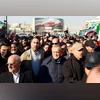 "Iranian President Masoud Pezeshkian appeared among the millions of protesters")
Iranian President Masoud Pezeshkian seen among protesters. (Photo: Screengrab from a video by Islamic Republic of Iran Broadcasting)
Listen to This Article
Iran drew global attention on Monday after authorities mobilised tens of thousands of supporters for pro-government rallies, with President Masoud Pezeshkian joining the show of strength even as anti-government protests driven by economic distress and political anger continued across the country.
Iranian state television aired images of large crowds moving towards Enghelab Square in Tehran, portraying the rallies as a response to what officials described as “American-Zionist terrorism”. The coverage, however, avoided direct reference to the economic hardship that has fuelled unrest for more than two weeks, the Associated Press reported.
Government media also broadcast footage of similar rallies in other cities, reinforcing claims by Foreign Minister Abbas Araghchi earlier in the day that the authorities had regained control of the situation, the report added.
Trump warns Iran is nearing a ‘red line’
The developments came as US President Donald Trump said Iran appeared to be approaching a “red line” set by his administration over the treatment of protesters.
Speaking to reporters aboard Air Force One on Sunday (local time), Trump was asked whether Tehran had crossed that threshold following reports of protesters being killed. “They’re starting to, it looks like,” he said.
Also Read

 "leg cramps, muscle pain")
 "Nirmala Sitharaman, Nirmala, Union Budget, Budget. Union Budget 2025")
 "Australia")
 "Prime Minister Narendra Modi and German Chancellor Friedrich Merz")
 "National Youth Day, healthy ageing")
“There seem to be some people killed that aren’t supposed to be killed,” Trump said, adding, “We’re looking at it very seriously. The military’s looking at it. We’re looking at some very strong options; we’ll make a determination.”
Trump also claimed Iran had reached out to the United States to explore negotiations after he warned of possible action over the crackdown. While he said talks were being discussed, he cautioned that action could come first if the violence continued.
“Iran wants to negotiate,” Trump said.
Iran says ready for war, but open to dialogue
Iranian Foreign Minister Abbas Araghchi accused the US president of fuelling violence through repeated warnings of military intervention, Al-Jazeera reported.
Addressing foreign diplomats in Tehran on Monday, Araghchi alleged that protests had “turned violent and bloody to give an excuse” for Washington to intervene militarily. He said the surge in violence over the weekend had subsided and claimed the situation was now “under total control”.
“We are ready for war, but also for dialogue,” Araghchi said, while alleging that “terrorists” had targeted both protesters and security forces to invite foreign intervention.
He further claimed authorities possessed footage of weapons being distributed to protesters and said confessions from detainees would soon be released. The demonstrations, he added, were “stoked and fuelled” by foreign elements, Al-Jazeera report said.
Protests persist despite clampdown
The unrest, triggered by Iran’s worsening economic conditions, has placed renewed pressure on the country’s theocratic leadership.
Authorities have imposed widespread internet and telephone shutdowns, complicating efforts to assess developments on the ground.
The US-based Human Rights Activists News Agency reported that more than 500 protests have taken place across all 31 provinces, with at least 544 deaths and over 10,600 arrests. Iranian officials have not released nationwide casualty figures, and independent verification has remained difficult due to communication restrictions and limits on journalistic movement.
Despite warnings from Supreme Leader Ali Khamenei that “rioters must be put in their place”, demonstrations have continued, according to activist groups cited by AP.
Economic anger and old grievances resurface
The protests began in late December amid a sharp economic downturn. Iran’s rial has plunged to more than 1.4 million to the US dollar, while prices of essential goods such as meat and rice have surged. Inflation has hovered around 40 per cent annually.
Public anger intensified after the government raised prices on subsidised fuel and ended preferential exchange rates for most imports, measures analysts warn could further drive up food costs.
Long-standing grievances have also resurfaced, particularly following the 2022 death of Mahsa Amini in police custody, which had earlier triggered nationwide unrest. Some protesters have voiced support for exiled Crown Prince Reza Pahlavi, who recently urged Iranians to take to the streets.
More From This Section
 "EVs, China EV, electric cars, Electric vehicles")
 "moon")
 "Heineken NV Chief Executive Officer Dolf van den Brink")
 "rare earth magnet, magnet")
 "Iran, Iran flag")
Don't miss the most important news and views of the day. Get them on our Telegram channel
First Published: Jan 12 2026 | 8:17 PM IST