


Is there a new kind of war playing out for Europe beneath the sea?
In the Baltic Sea, undersea cables and pipelines that power homes, connect data, and sustain economies are reportedly being struck, severed, and quietly repaired repeatedly
 "Baltic sea")
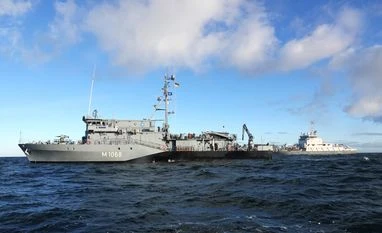
NATO’s Baltic Sentry steps up patrols in the Baltic Sea to safeguard Critical Undersea Infrastructure. (Photo: X/NATO Maritime Command)


Listen to This Article
A quiet war is unfolding beneath the surface of Europe’s waters. Under the Baltic Sea — an area larger than Germany — undersea cables and pipelines that power homes, connect data, and sustain economies are being repeatedly struck, severed, and quietly repaired, according to a report by Politico. Since 2022, there have been at least six suspected sabotage incidents in the region, disabling 11 critical cables since 2023 alone.
None of the attacks have plunged nations into darkness or severed the continent’s digital backbone yet. Lights stayed on and WiFi continued churning high-speed data. But the frequency and precision of these incidents have triggered a sense of urgency across European capitals, the news report said. The message is clear: these are not random accidents. They are calculated moves in a broader geopolitical contest — and Europe is waking up to a new and murky front in its struggle with Russia.
Data cable, gas pipelines being targeted
Even as investigations into individual incidents continue, a growing consensus is emerging within European security circles: the pattern of attacks is no longer incidental. Strategic infrastructure — from data cables to power lines and gas pipelines — is being targeted in ways that appear designed to test defences, spread uncertainty, and remind the West of its vulnerabilities.
The consequences of a successful, coordinated strike could be dramatic. A handful of cable cuts could knock out a country’s electricity supply or digital connectivity. Countries like Ireland, with limited sub-sea connections to the mainland, could lose a significant portion of their power. Norway, which supplies a third of the EU’s gas via undersea pipelines, represents another critical node at risk.
Low cost of attacking undersea cables, high impact
What makes this threat particularly insidious is the simplicity of its execution. Damaging undersea infrastructure doesn’t require high-tech weaponry or military-grade operations. In many cases, it could be as basic as lowering an anchor in the right location. Shallow waters — the Baltic averages just 52 metres in depth — make these cables especially accessible.
Also Read

 "Kunal Kamra")
 "Donald Trump, Trump")
 "Mamata Banerjee, Mamata")
 "Nike shoes, Trump tariff, Nike Vietnam production")
 "Congress MP Manish Tewari")
The cables themselves aren’t built for intentional sabotage. Telecom lines are roughly as thick as a human arm, while power cables are bulkier but still vulnerable. Though buried beneath the seabed and shielded against fishing nets or storms, they are no match for an anchor dragging with intent — as shown by recent incidents where vessels were found to have cut through multiple cables over long distances.
Repairing these breaks is slow, expensive, and logistically complex. Europe has only around 80 cable repair ships worldwide. Data cables can take weeks to fix; power cables may require months. Costs range from a few million to well over €100 million per incident. In the meantime, uncertainty grows.
Growing doubts among European governments
For now, the damage has been mostly economic and symbolic, reports Politico. Europe’s energy and data networks are deeply interconnected, with redundancies that prevent single-point failures. But the repeated incidents have seeded doubt among governments, businesses and citizens alike. There’s a growing recognition that modern life — from Zoom calls to hospital operations — is tethered to cables that are surprisingly fragile and poorly protected, it highlighted.
In some cases, even minor disruptions have triggered ripple effects. An unexplained technical glitch in a Baltic cable earlier this year sent energy bills up by 10 percent in one country, showing how thin the margin for error has become. The fear is that a more coordinated attack — or single timed cyber disruption — could trigger widespread outages or economic panic.
Moreover, not all European countries are equally prepared. Islands like Ireland and Malta are particularly exposed, with fewer backup links and limited naval capacity to monitor or respond to sabotage. Some, like Ireland, are not Nato members and lack the military infrastructure to defend their waters. Others face legal limits in intervening against suspicious vessels operating outside their maritime borders.
How is Europe preparing to counter such attacks?
In response, Europe is starting to act. NATO has stepped up surveillance in the Baltic, deploying drones, patrol planes and naval vessels under a new ‘Baltic Sentry’ programme. The EU has committed over half a billion euros to upgrade infrastructure, buy dedicated repair ships, and stockpile critical cable materials.
#NATO is ready to defend critical underwater infrastructure in the #BalticSea. Op #BalticSentry deploys #SNMG1 & #SNMCMG1, maritime patrol aircraft & naval drones to increase our understanding of the maritime environment, improving Allies’ ability to deter, defend & respond to… pic.twitter.com/WmbhFfrVi3
— NATO Maritime Command (@NATO_MARCOM) January 15, 2025
Several countries are also tightening laws to allow action against vessels suspected of tampering with infrastructure in international waters. Artificial intelligence tools are being tested to flag suspicious ship movements using public tracking data. And in countries like Finland, energy infrastructure protection is now being integrated into national defence plans — a signal of how seriously the threat is being taken.
Maritime laws hinder any significant progress
Yet serious gaps remain. International maritime law limits what countries can do beyond their territorial waters — 12 nautical miles from their shores. Suspicious vessels operating in these zones are governed by their flag states, which are often reluctant or slow to act. In several recent cases, foreign-flagged ships were suspected of sabotage, but local authorities were blocked from carrying out full investigations, the Politico report mentioned.
This lack of enforcement capacity in international waters creates a legal no-man’s land — one that bad actors appear increasingly willing to exploit. With limited consequences and high strategic rewards, the risk-reward ratio heavily favours those seeking to cause disruption.
More From This Section
 "Pakistan Flag, Pakistan")
 "Shanghai police")
 "Biodiversity")
 "Breakthrough Prizes")
 "JP Morgan")
Topics : BS Web Reports Europe Battlegrounds
Don't miss the most important news and views of the day. Get them on our Telegram channel
First Published: Apr 07 2025 | 7:19 PM IST