


Meet Stephen Miran: Trump's economic advisor behind US reciprocal tariffs
Stephen Miran is considered the brains behind Trump's reciprocal tariffs that shook global markets. Here's a closer look at Miran and his views on US' economic and trade policies
 "Donald Trump picked Stephen Miran on December 22 to lead the Council of Economic Advisors")
Donald Trump picked Stephen Miran on December 22 to lead the Council of Economic Advisors. | Credit: X
Listen to This Article
The blueprint behind US President Donald Trump's "reciprocal tariffs" can be found in the ideas of his key economic advisor, Stephen Miran. He holds a PhD in economics from Harvard University and strongly advocates the use of tariffs in reshaping the United States into a "fabulous" economy.
Donald Trump picked Stephen Miran on December 22 to lead the Council of Economic Advisors (CEA). Miran has consistently backed the president's trade policy centred around high tariffs, despite the significant turbulence in global markets that followed the tariff announcements.
Who is Stephen Miran?
Miran graduated from Boston University in 2005, studying economics, philosophy, and mathematics. He earned a PhD in economics from Harvard University in 2010, studying under Martin Feldstein, a prominent American economist who led the CEA during Ronald Reagan's presidency in the early 1980s.
Prior to becoming the 32nd chair of the US Council of Economic Advisors, Miran worked as a senior strategist at Hudson Bay Capital Management, a multi-billion dollar global investment management firm. He also co-founded the asset management firm Amberwave Partners and holds a position as an adjunct fellow at the Manhattan Institute.
US can be 'fabulous economy' with tariffs: Miran
During his testimony before the Senate Banking Committee before being confirmed as the chief advisor, Miran stated that economists’ concerns about tariffs are due to a “quirk of the modelling methodology.” There is “something wrong” with assumptions underpinning models that show trade deficits balancing out to zero over the long term. “That really hasn’t happened in recent decades,” he said. Miran also offered some historical backup for Trump’s attraction to the high-tariff policies of William McKinley, who was president at the turn of the last century, and some of his predecessors.
Also Read

 "Xi Jinping, Donald Trump")
 "Donald Trump")
 "US President Donald Trump")
 "USA China, USA China flag ,usa flag,china flag")
 "Donald Trump, Trump")
“The American economic story has seen periods of high tariff rates coincide with extraordinary economic success,” Miran told senators. “There’s nothing in the historical record that would say that it’s impossible to have a fabulous economy with high tariffs.”
Miran's views on trade deficits
Miran has argued on several occasions that other countries should bear more of the costs that he claims have been unfairly carried by the United States. Miran has further claimed that America's contribution to global stability – both militarily and financially – has created an 'undue burden' on US workers and industries.
"President Trump has made it clear that he will no longer stand for other nations free-riding on our blood, sweat, and tears, whether in national security or trade," he stated. Miran contended that trade deficits have continued due to structural imbalances rather than natural market forces.
"The long run is here, and the models are wrong," Miran argued, rejecting traditional economic theories that suggest trade will automatically rebalance itself.
Dollar overvaluation prevents balancing of international trade: Miran
In a November report from the Hudson Institute called "A user's guide to restructuring the Global Trading System," Miran argued that persistent dollar overvaluation was the fundamental cause of economic imbalances, preventing international trade from achieving balance. He outlined various tariff scenarios that could be implemented during a second Trump administration, asserting that despite potential negative consequences, they could still be effective. This appears to be exactly what is occurring now.
Miran acknowledges ‘conflicting narratives’ on tariffs
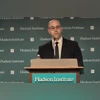
Miran has admitted there are "conflicting narratives" from the administration regarding their openness to tariff reduction agreements. While speaking at the Hudson Institute earlier this week, Miran urged trading partners to persistently contact the White House because the president would "welcome" proposals to reduce tariffs and other trade barriers. This speech was delivered shortly after White House trade and manufacturing advisor Peter Navarro wrote an opinion piece stating that "this is not a negotiation" with regard to tariffs.
More From This Section
 "China's President Xi Jinping")
 "US China")
 "Ursula von der Leyen, Ursula, von der Leyen, Leyen")
 "Saudi Arabia Crown Prince Mohammed bin Salman")
 "Russia Ukraine flag, Russia-Ukraine flag")
Don't miss the most important news and views of the day. Get them on our Telegram channel
First Published: Apr 10 2025 | 5:28 PM IST