


Review of Ruby Lal's 'Empress': A remarkable story of Nur Jahan's reign
Ruby Lal has created a remarkable portrait of an empress by locating her in the historical situation in which she found herself, writes Rudrangshu Mukherjee
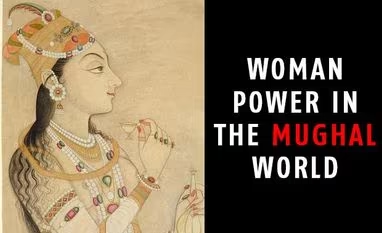 "Empress")
premium
Biography and history are closely related but it is not always a very easy relationship. In the world of Indian scholarship, the problem is further complicated by the fact that biography very often tends to become hagiography. The writing of history requires a certain amount of distance and perspective whereas biographers tend to remain very close to their subjects, often seeing the world and events through the papers and the recollections of their subjects. Biography, by definition, is focused on an individual more often than not on a famous individual — someone who it is assumed made the times and was also made by the times. It is precisely here — a woman in her times — that history and biography begin to intersect. History, especially since the influence of Marxism and of the Annales School became predominant, has been seen as the interplay of vast impersonal forces over which human beings have little or no control yet these forces shape the destiny of human beings. The classic statement on this came from none other than Fernand Braudel in his magnum opus: The Mediterranean And the Mediterranean World in the Age of Philip II, where he wrote, “When I think of the individual I am always inclined to see him imprisoned within a destiny in which he himself has little hand.’’ Braudel was, in a different way, echoing and with greater emphasis the views of Marx as articulated in that famous opening paragraph of The 18th Brumaire of Louis Bonaparte: “Men make their own history but they do not make it just as they please. The dead hand of the past hangs over their present activities.’’ The issue that Braudel and Marx were raising is the one of human agency, which is at the heart of the biographical enterprise. The challenge before a historian-biographer is to locate and analyse the interaction between human agency and the vast impersonal forces.
Topics : BOOK REVIEW