In this book, he extends this framework to looking at the threats and opportunities that Artificial Intelligence (AI) combined with Western Universalism poses for India as a country. Since the author has a computer science degree and has spent some years in the Information Technology industry, his point of view is worth a careful read.
The first area in India that he warns us about is the impending destruction of jobs in India with the spread of Artificial Intelligence. He believes that India is in grave danger of becoming the world’s largest “Digital Colony” controlled by the American companies Google, Facebook, Twitter, Netflix, Amazon as well as Chinese “behemoths” Alibaba, Baidu, Tencent and Huawei.
The second area that he believes India must wake up to is that countries like China are building a massive AI-based “Military Industrial Complex” which will threaten India’s existence.
The third area he warns us about is the extensive penetration in India of American social networks which will have the effect of “gamification” of the average Indian citizen’s mind.
The fourth area, he says, is that at the same time, the Western world will enhance itself by using the tools that AI technologies provide and become Human Version 2.0. Will this result in Indians becoming the equivalent of today’s animals, he asks?
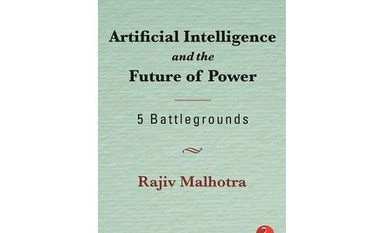
Artificial Intelligence and the Future of Power: 5 Battlegrounds
Pages: 520; Price: Rs 795
The final risk area he believes is that the Indian elite, even the technologically sophisticated ones, will concentrate on merely becoming wealthy, as they have in the past, by selling cheap Indian labour to western countries rather than building intellectual property in India.
He goes so far as to warn that these Big Tech companies are “reminiscent of the way the East India Company stitched together an empire largely with the help of myopic and selfish [Indian] leaders.”
In this book he extensively analyses the dimensions along which China has progressed far ahead of India even though both countries were more or less on a par a few decades ago. For example, he says, in the 1980s China’s and India’s GDP were $191 billion and $186 billion respectively, whereas China’s GDP at present is five times India’s. He attributes China’s progress to not having been under a foreign rule for a prolonged period and thus being able to pursue a development course based on its own concept of society and politics. He says that, in writing this book, he found Vidura in the Mahabharata a good role model, as Vidura is considered “a paragon of truth, integrity, and impartial and consistent judgement…the conscience of the Mahabharata.”
In his mission to oppose Western Universalism, Mr Malhotra has been prolific author with books like Breaking India: Western Interventions in Dravidian and Dalit Faultlines, a 650-page book published in 2011 and The Battle for Sanskrit, a 468-page book published in 2016. The present book is 520 pages. In all fairness, the giant-size of his books is because of the extensive glossaries, bibliographies, notes, and indexes that each of his books carry. For instance, the book under review, has a 24-page appendix, a five-page glossary, a nine-page bibliography, a 30-page notes section and a 32-page index —in all, an additional 100 pages, all of which makes up nearly a fourth of its pages devoted to referencing his ideas.
He says that his mission in writing the current book is not merely to lament about the damage done in the past. He believes that “we live in an epoch defined by disruptions, both predictable and unpredictable, desirable and undesirable…of which AI is a major disruptive influence”. By voluntarily giving up data to American and Chinese tech giants, he says, we are letting the Indian nation to succumb to artificial pleasures offered by these companies, thereby becoming a nation of “Happy Morons”.
His mission is to jolt policymakers in India to create AI projects in India, led by Indians that will enable India to leap-frog ahead of countries like China and the United States by decades.


 "Book cover")