


Home / India News / Voice of street children
Voice of street children
Working across Delhi-NCR, this NGO provides them a platform to lead a meaningful life
 "ngo, children, street, chetna")
premium
The NGO connects with kids who stay away from their families and engages with parents and makes them aware of the potential of children
Last Updated : Apr 21 2018 | 7:48 PM IST
Seventeen-year-old Nafeesa (name changed) has lived a difficult life among rag pickers, being a subject of molestation on various occasions. A class in self-defence was all that was needed to give her the much-needed courage and determination. Fourteen-year-old Manisha (name changed) had always dreamt of going to school. When she was eight her mother died, and so did her dreams. Books gave way to tea cups, but the young tea seller never lost hope. Finally her optimism paid off, and her courageous spirit helped her get into school.
Salman (name changed) ran away from his hometown many years ago and came to Delhi. Having lived his life on the streets for many years, the 18-year-old is now a trained driver. Besides courage and an indomitable will to shine through all odds, these children had one thing in common. A helping hand in CHETNA NGO (Childhood Enhancement through Training and Action).
Founded in 2002 by Sanjay Gupta, CHETNA is currently working with around 10,000 street children. The NGO has around 100 volunteers. Work is spread across west Delhi, east Delhi, Mathura, Agra, Lucknow and Gurgaon. The organisation has a number of donors, both individuals and corporates.
Before founding CHETNA during the course of his 10-year-old career as an engineer, Gupta worked on various projects for villagers, including making water systems for them. It was then that Gupta realised there were a considerable number of people who came from villages to towns every year, but a majority of them ended up on the streets.
In 2003, CHETNA organised a residential workshop for 30-40 street children. Kids came to a restricted place, which was pre-determined, and talked about their lives and strides. The NGO named it “The contact point”, something that would go on to become the blueprint for CHETNA’s functions ahead.
The NGO picks up a team of kids, “Badhte Kadam” in CHETNA’s words, and encourages them to come forward with their stories. Children come to “The contact point”, where they are guided by “street educators”, who form the backbone of the organisation. Children perform 18 types of activities, including reading and writing, extra-curricular activities, knowing about their rights and identifying situations or things that affect them the most. One of the first steps is bridging the gap between these children and the police. CHETNA’s members accompany them to different police stations and introduce them to station house officers (SHOs). The children even paint the walls of the police stations.
“It is a learning experience for both,” says Gupta. “Street children, especially in Delhi, get food and clothing. You cannot attract them with the promise of providing food. So we give them an informal protection cover and act as mentor. There’s a national president, state president, national secretary and state secretary. These roles help in the empowerment of children”, adds Gupta.
Empowerment or awareness building forms a key part of CHETNA’s activities. Children are nurtured to be future leaders and give a voice to their thoughts. “Balaknama”, the children’s own monthly newspaper, is an important step in this direction. Kids are encouraged to write about their experiences and aspirations, and the newspaper, a first of its kind, is already part of the Limca Book of World Records.
The NGO works on a two-pronged strategy: Connecting with kids who stay away from their families (a sort of parenting where CHETNA acts as the guardian) and engaging with parents and making them aware of the potential of the child. It helps children get admission in various schools and follows up for six months.
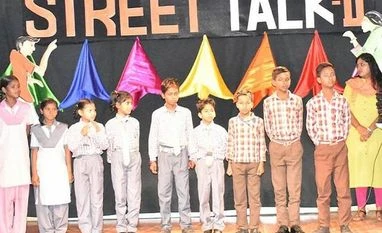
“The number of street children in cities like Delhi is increasing, and in the absence of census data these children lack protection cover. The situation gets worse when they turn to crimes,” says Saumya Gupta, project coordinator, Blue Umbrella, an initiative to provide protection cover to street and working children in the Capital. The NGO organises “Street Talk”, a yearly event, where children come forward to share their experiences.
CHETNA also works with those that come within the immediate circle of the child, “The stakeholder reach” concept. “Parents come within the closest ecosystem of the child. So among other initiatives, we conduct parent-teacher meetings from time to time.” There are success stories within CHETNA itself. Vijay, currently an assistant field coordinator with the organisation, used to work in a factory. A chanced meeting with CHETNA’s volunteers helped him complete his education. Associated with CHETNA since the last five years, he now earns around ~25,000 per month. Subhash, a one-time book seller at traffic signals, now runs an Aadhaar agency. “CHETNA ke bhaiya, didi ne meri help ki aur mera nasha chudwa diya. Ab mein dusvi mein hoon aur koshish karti hun ki meri tarah aur bacche likhna padna shuru kare (CHETNA’s volunteers helped me get rid of my addiction. I am now studying in class 10 and now I work with CHETNA to help other children read and write), says Jyoti, national secretary, “Badhte Kadam”.
So, change is happening.
In 2017, the UN Committee on the Rights of the Child (UNRC), recognised the rights of street children and laid out guidance for states to realise their rights in accordance with the Convention on the Rights of the Child (CRC). India signed and ratified the CRC in 1992. “This is the first time that street children have been acknowledged globally through the UNGC, and it is high time that the voices of these children be converted into policy and actions,” says Gupta.